


EN
Everyone Wants to Buy the Dip. That’s Starting to Worry Me
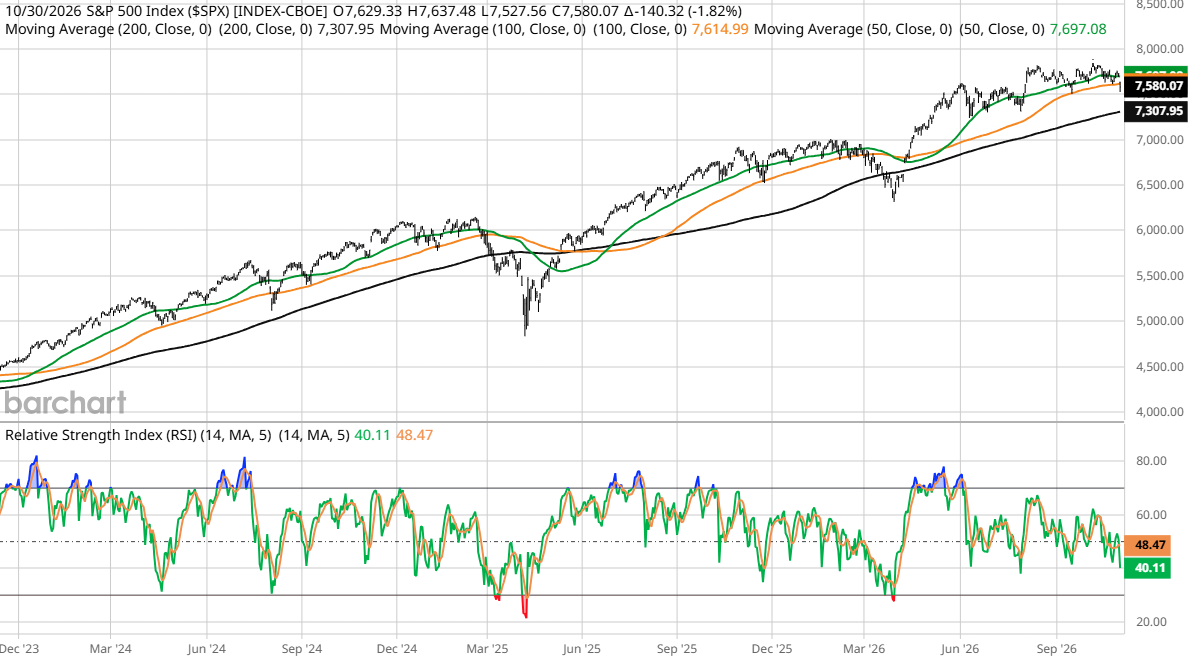
The Nasdaq ended October about 8% below its Oct. 6 peak, amid one of the hardest periods technology investors have faced this year. With more than $2 trillion in value set to leave the Nasdaq 100 this month, investors began to question how much money is being invested in artificial intelligence and how quickly any of it will come back. That's generally when you hear the standard advice again: buy the dip.
I understand why. Investors have been schooled by years of experience to view major dips as opportunities. And in many cases they were. That was cemented drastically in March 2020 and plenty of lesser corrections afterward. Often the ones who bought when the headlines appeared terrible were rewarded while those waiting for everything to feel safe ended up paying more. The issue is a method might succeed for so long that people stop wondering why it worked in the first place. I think that’s where we’re at now.
The backdrop was extraordinarily supportive for much of the post-financial-crisis world. Rates were low, there was plenty of liquidity, earnings mostly went up, and each significant downturn was eventually followed by another high. It was nearly automatic, buying the weakness. A 2026 working paper by Xiao Yin of University College London and Dongchen Zou of Indiana University analyzed a dataset covering roughly 80% of actual U.S. retail trading. They found that retail buying rises significantly after stock-price declines but changes relatively little after gains. They also estimate that individual investors now account for about one-third of U.S. equity trading volume, roughly three times their share a decade ago. In other words, buying the dip is no longer a fringe instinct. It has become part of the market’s structure. That tells me 'buy the dip' is no longer a contrarian inclination. Typical market conduct.
Buying the Dip Is Not the Same as Buying Value
A falling share price tells you very little on its own. Imagine a stock trading at $100. If the business is worth $140 and the stock falls to $80 because investors panic, I am interested. If the business is worth $60 and the stock falls from $100 to $80, I am not seeing a bargain. I may simply be watching the market move closer to reality. The chart looks the same. The investment is entirely different.
That is what concerns me about parts of the current technology selloff. Investors spent years accepting increasingly aggressive assumptions about AI spending, growth, and future margins. Some of those assumptions may prove correct. Others may not. If a stock falls because investors are suddenly realizing that free cash flow will be lower than they expected or that capital spending will stay elevated for longer, then the lower share price may be reflecting new information rather than temporary fear.
Intel, Amazon, and Nvidia can all fall on the same day and still be entirely unique investment problems. One may be dealing with cash burn and operational weakness, another with rising capital expenditure and expectations, and another with a broader sector de-rating. Looking at all three and saying they are “on sale” because they are down misses the point.
Investors get into trouble when the old high becomes the reference point. They see a stock that traded at $120 and is now at $85 and instinctively think about the $35 discount. I would rather forget the old price and ask what the business is worth based on what I know today. The fact that somebody once paid $120 tells me nothing about whether $85 is cheap.
Sometimes a Decline Is Just Price Discovery
This is the part of markets people do not always like to hear. Every decline is not an error that needs to be corrected. Occasionally the previous price was the error.
That is especially true when a theme becomes crowded and valuations get ahead of the economics. AI may change huge parts of the economy, and I think it probably will, but that does not mean every company connected to it deserves the peak valuation. Investors can be right about the technology and still overpay for the stocks.
The same thing happened during the internet buildout. The internet absolutely transformed the world, but plenty of investors lost money because they paid too much for businesses that needed years of capital investment before the returns appeared. Being right about the future does not protect you from paying the wrong price for it.
The current market may be doing some of that work now. Big Tech companies are still producing enormous revenue, but capital expenditure has surged as they build data centers, buy chips, and secure infrastructure. That spending may eventually generate excellent returns. It may also turn out that investors were too generous about how quickly those returns would appear. If expectations are being reset, the first 20% decline does not automatically mean the process is finished. That is why I would not rush simply because something is down.
What I Would Look at Instead
Before buying any falling stock, I would ignore the percentage decline initially and look at the business. What has happened to earnings expectations? What has happened to free cash flow? Has the balance sheet weakened? Is management spending more than expected? Has competition changed? Has anything happened that affects what the company should be worth five years from now?
If the stock is down 25% and earnings projections are down 30%, the valuation may not have improved nearly as much as it appears. If the stock is down 25%, and the long-term economics really haven’t altered, then I get a lot more intrigued.
That is also why I do not put much weight on phrases such as “30% off the highs.” The high may have been ridiculous. I have seen companies fall 50% and remain expensive, and I have seen good businesses fall 15% and become attractive because the market temporarily lost patience with them. The size of the decline is not the useful information. The gap between price and value is.
There will be opportunities in this selloff. I would be surprised if there were not. But I would rather miss the first part of a rebound while I work out the economics than buy something because the market has trained me to think every red screen is a gift.
After more than 35 years in markets, I have become wary of any investment rule that becomes too easy to repeat. “Buy the dip” worked often enough that investors started treating it as a law. It is not.
Sometimes a falling price creates a bargain. Occasionally it is the market correcting an old mistake. The job is to know which one you are looking at. A stock is not cheap because it has fallen. It is cheap because the business is worth more than the price you are being asked to pay. Stop buying prices. Start valuing businesses.
Buy companies, not markets.
On the date of publication, Jim Osman did not directly have a position in any of the securities mentioned in this article. All information and data in this article is solely for informational purposes. For more information please view the Barchart Disclosure Policy here.