


EN
How Investors May Respond To ServiceNow (NOW) Slower Growth Outlook
- ServiceNow reported third quarter 2026 revenue of US$4,106 million and full year margin guidance of about 31.5%, while a series of new AI, security, and workflow partnerships with OpenAI, Google Cloud, HPE, BDO Canada and others expanded the reach of its platform across major enterprise functions.
- The mix of strong top line growth, compressed profitability, and a slower outlook for backlog growth highlights how investors are weighing ServiceNow's heavy AI build out and new alliances against near term pressure on margins and contracted revenue momentum.
- This article examines how ServiceNow's investment narrative is being tested by solid revenue alongside softer backlog growth and margin compression.
Scan beyond ServiceNow and take a look at how other AI workflow and security platforms are priced by reviewing our curated list of 54 AI infrastructure stocks.
ServiceNow Investment Narrative Recap
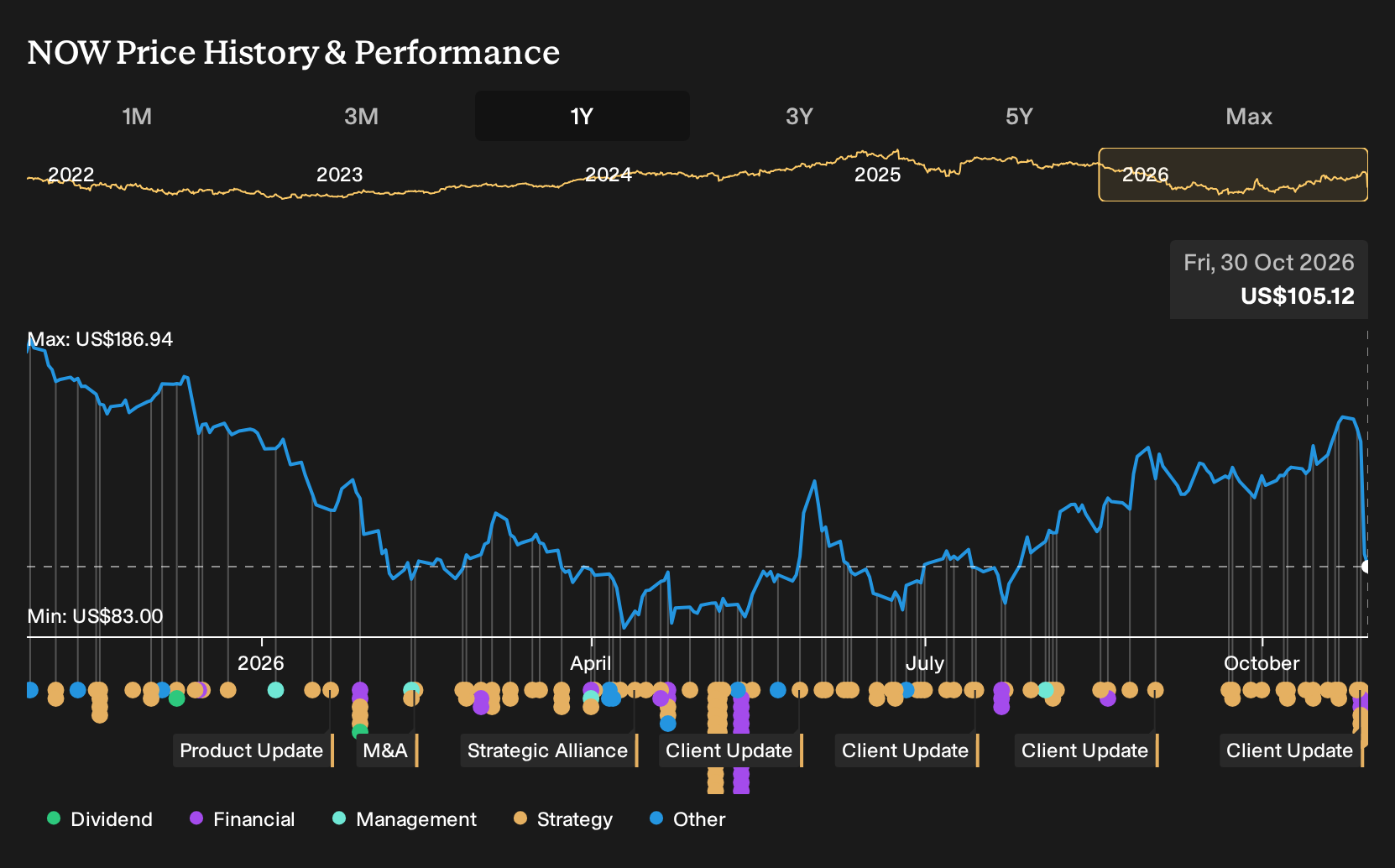
To stay invested in ServiceNow, you need to believe its AI heavy workflow and security push can convert today’s AI annual contract value base into durable subscription growth, while margins recover from current pressure. The sharp share price pullback and weaker earnings in Q3, with net income of US$277 million on US$4,106 million of revenue, keep execution under the microscope.
Over the next few quarters, the key swing factor is whether AI driven workflows and newer areas like CRM, security, and public sector keep scaling fast enough to offset compressed profitability and a slower backlog outlook. The biggest risk is that AI usage patterns, consumption pricing, or any further security issues undercut high margin revenue just as investors are questioning long dated growth assumptions.
The expanded OpenAI partnership is the announcement most tied to the current debate around ServiceNow. Management is pushing deeper into agentic AI with OpenAI models wired into ServiceNow Action Fabric, letting ChatGPT users trigger governed workflows and security actions directly from chat, and positioning the Super Intelligence Control Tower as the control plane over those agents.
Operationally, this matters because it could turn ServiceNow into more of an execution layer for AI decisions. That is exactly where investors are looking for proof that AI ACV can translate into long run subscription and security workflow demand. It also tightens the link between AI performance, governance, and platform trust, so any future AI security flaws or weaker adoption would cut directly into one of the clearest current catalysts.
ServiceNow Consensus Growth and Valuation Setup
Analysts currently frame ServiceNow as a company trading on a long dated growth script that leans heavily on AI workflows, subscription expansion, and margin lift over the rest of the decade. The working model ties the present AI build out and security push to a future earnings profile that is meaningfully higher than today, while still assuming a premium P/E relative to the broader US software sector.
Under the consensus case, revenue is modeled to rise at about 19.4% per year over the next three years, with profit margins moving from 11.3% today to 16.3% over that window. Earnings are expected to climb from US$1.7b today to US$4.1b around 2029, which is an increase of roughly US$2.4b in absolute terms, even before considering the wider spread of analyst views between US$2.4b and US$5.9b. Forecasts also bake in a small annual decline in the share count of roughly 0.38% as buybacks trim outstanding shares.
On valuation, the consensus price target of US$157.12 sits just 1.5% above the current share price of US$154.78. This implies analysts see ServiceNow as roughly fairly valued on their collective numbers. To line up with that view, you would need to accept a 2029 profile that includes about US$25.1b of revenue, US$4.1b of earnings, and a P/E of 50.4x on those earnings, using a discount rate close to 8.7%. That targeted multiple sits well above the current 33.8x P/E cited for the US software industry, which leaves less room for disappointment if revenue, margins, or AI adoption fall short of expectations.
ServiceNow's narrative projects about US$25.1b of revenue and US$4.1b of earnings by 2029. This assumes roughly 19.4% yearly revenue growth and an earnings increase of about US$2.4b from US$1.7b today.
Uncover why ServiceNow's fair value indicates a 49% potential upside to its current price, which could narrow quickly.
Exploring Other Perspectives
One alternate view treats ServiceNow’s AI alliances, including the new BDO Canada partnership, as adding complexity more than clarity. The most pessimistic analysts were only modeling around US$24.8b of revenue and US$2.4b of earnings by 2029 before this news. That is a far more cautious script. Use this spread in expectations to stress test your own assumptions.
Explore 23 other ServiceNow fair value estimates, including one that suggests as much as 12% downside from the current price.
The Verdict Is Yours
Don't just follow the ticker. Dig into the data and build a conviction that's truly your own.
- A great starting point for your ServiceNow research is our analysis highlighting 2 key rewards and 2 important warning signs that could impact your investment decision.
- See our latest analysis for ServiceNow. The report includes a comprehensive fundamental analysis summarized in a single visual, the Snowflake, making it easy to evaluate ServiceNow's overall financial health at a glance.
Looking for more ServiceNow investment ideas?
If the ServiceNow story has you thinking about portfolio upgrades, use this moment to cast a wider net and compare it with other opportunities on the Simply Wall St Screener.
- If capital preservation and steadier profiles matter most to you, start with companies that screen as relatively resilient using our 29 resilient stocks with low risk scores.
- For investors who care deeply about financial strength, scan businesses that pair cleaner balance sheets with solid fundamentals through the list of solid balance sheet and fundamentals (24 results).
- When you want potential mispricing on your side, focus on candidates that combine quality fundamentals with more modest valuations using the 33 high quality undervalued stocks.
Have feedback on this article? Concerned about the content? Get in touch with us directly. Alternatively, email editorial-team@simplywallst.com