


EN
Visa (V) Could Be 13% Below Fair Value On Q3 Earnings And Dividend Raise
Visa (V) just paired a fresh earnings release with a new dividend declaration, giving investors updated cash flow and profit figures along with a higher quarterly payout to digest at the same time.
Visa’s recent earnings beat and higher dividend arrived while momentum in the shares has been building, with a 30-day share price return of 14.68% and year-to-date share price gain of 19.37% feeding into a 1-year total shareholder return of 22.35% and a 5-year total shareholder return of 98.25%. This reflects how investors have been reassessing both growth potential and risk around its expanding digital payments and value-added services business.
Scan Visa’s momentum, then widen your watchlist with hand-picked payment and fintech candidates from our 19 high quality undiscovered gems that could be quietly building similar earnings and cash flow stories.
After this run up, Visa still trades below both intrinsic value estimates and analyst targets. Is that a temporary discount, or a fair price in a market that remains cautious?
Most Popular Narrative: 70% Overvalued
Visa last closed at $413.59 while the most followed narrative on Simply Wall St, according to Esteban, pegs fair value at $243.70 based on a detailed cash flow model using a 7.28% discount rate.
Visa executes steadily on its three-pillar strategy: Consumer Payments volume growing 8-9% in constant dollars driven by secular cash-to-card conversion and cross-border recovery, CMS at ~20% initially decelerating to ~12% by FY30, VAS sustaining 20-25% growth before decelerating to ~15% by FY32 as the business matures. The DOJ antitrust case resolves with a monetary settlement and limited routing adjustments, painful but not structurally disruptive to the debit network economics. A2A rails remain fragmented outside Brazil and India, Visa monetizes the trend indirectly via Visa Direct. Non-GAAP operating margins expand from ~67.7% (FY2025) to ~71% by FY2030 as VAS scales and operating leverage is captured. Revenue grows in low-double-digits in FY2026-FY2027 (consistent with management guidance of "low-double-digit adjusted net revenue growth"), decelerating to 7-8% by FY2033-FY2035 as the base grows and secular conversion matures in developed markets.
See why 10 investors see Visa as 70% overvalued.
Result: Fair Value of $243.70 (OVERVALUED)
Still, that script leans heavily on a smooth DOJ outcome and assumes account-to-account payment rails stay fragmented, rather than quickly eroding Visa’s economics.
Find out about the key risks to this Visa narrative.
Another View On Visa’s Valuation
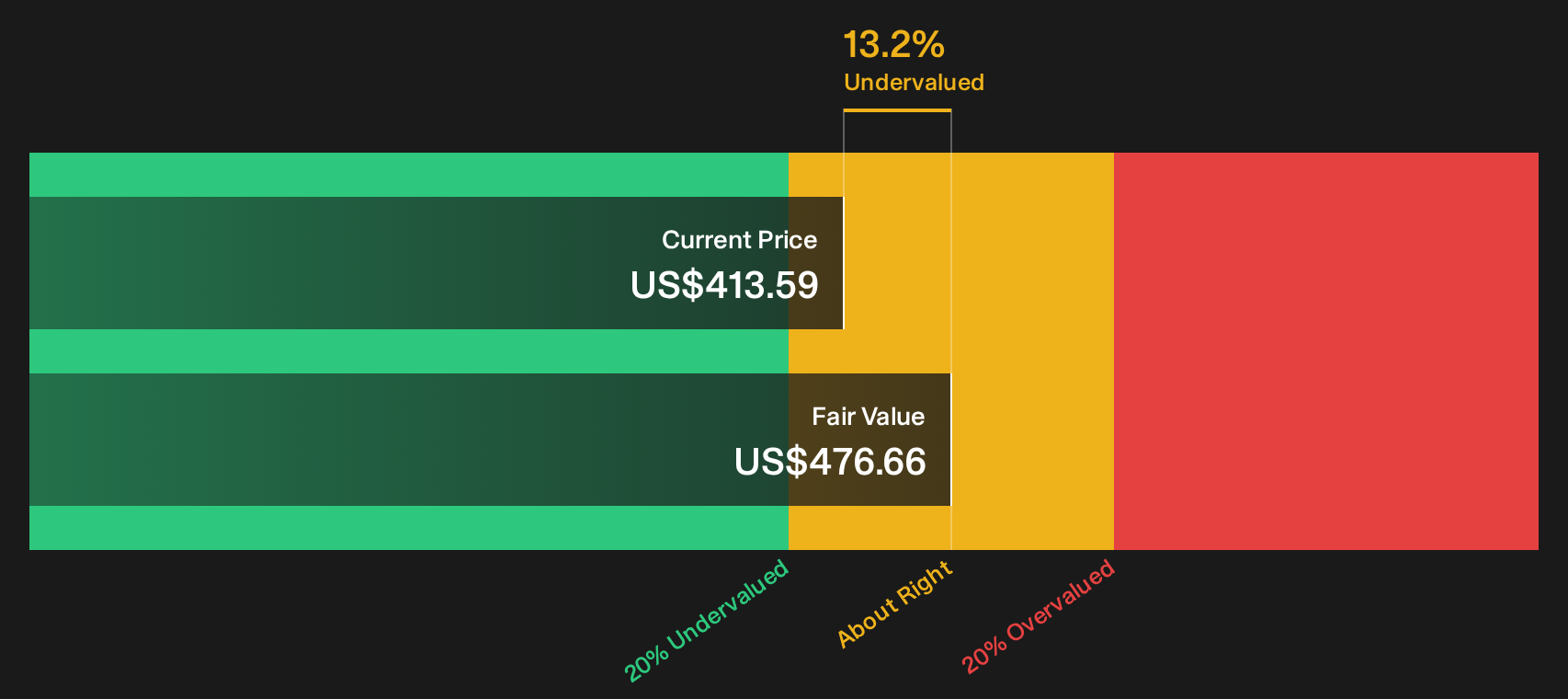
Esteban’s narrative points to Visa as 70% overvalued at $243.70 fair value, yet the Simply Wall St DCF model reports something very different. On that framework, Visa at $413.59 trades about 13% below an estimated future cash flow value of $476.66, which suggests a potential discount instead of a premium. Which story do you weigh more heavily when the same cash engine produces such different price tags?
Look into how the SWS DCF model arrives at its fair value.
Next Steps
Mixed messages on Visa’s value and risk profile are exactly why you should pressure test the numbers yourself and not just lean on one model or narrative. To weigh those trade offs in full, start with our breakdown of 3 key rewards and 1 important warning sign.
Looking for more Visa-sized investment ideas?
Visa is only one piece of your portfolio puzzle, and casting a wider net with structured stock filters can surface opportunities that raw headlines never mention.
- Target potential mispricing by reviewing companies screened as 33 high quality undervalued stocks that combine discounted valuations with solid underlying businesses.
- Strengthen your income stream by focusing on reliable cash payers through our screener of 5 dividend fortresses and see which payouts might suit your plan.
- Dial down portfolio risk by filtering for 29 resilient stocks with low risk scores that pair resilient fundamentals with more measured volatility.
Have feedback on this article? Concerned about the content? Get in touch with us directly. Alternatively, email editorial-team@simplywallst.com