


EN
Does Dividend Hike Change The Bull Case For UniFirst Stock (UNF)?
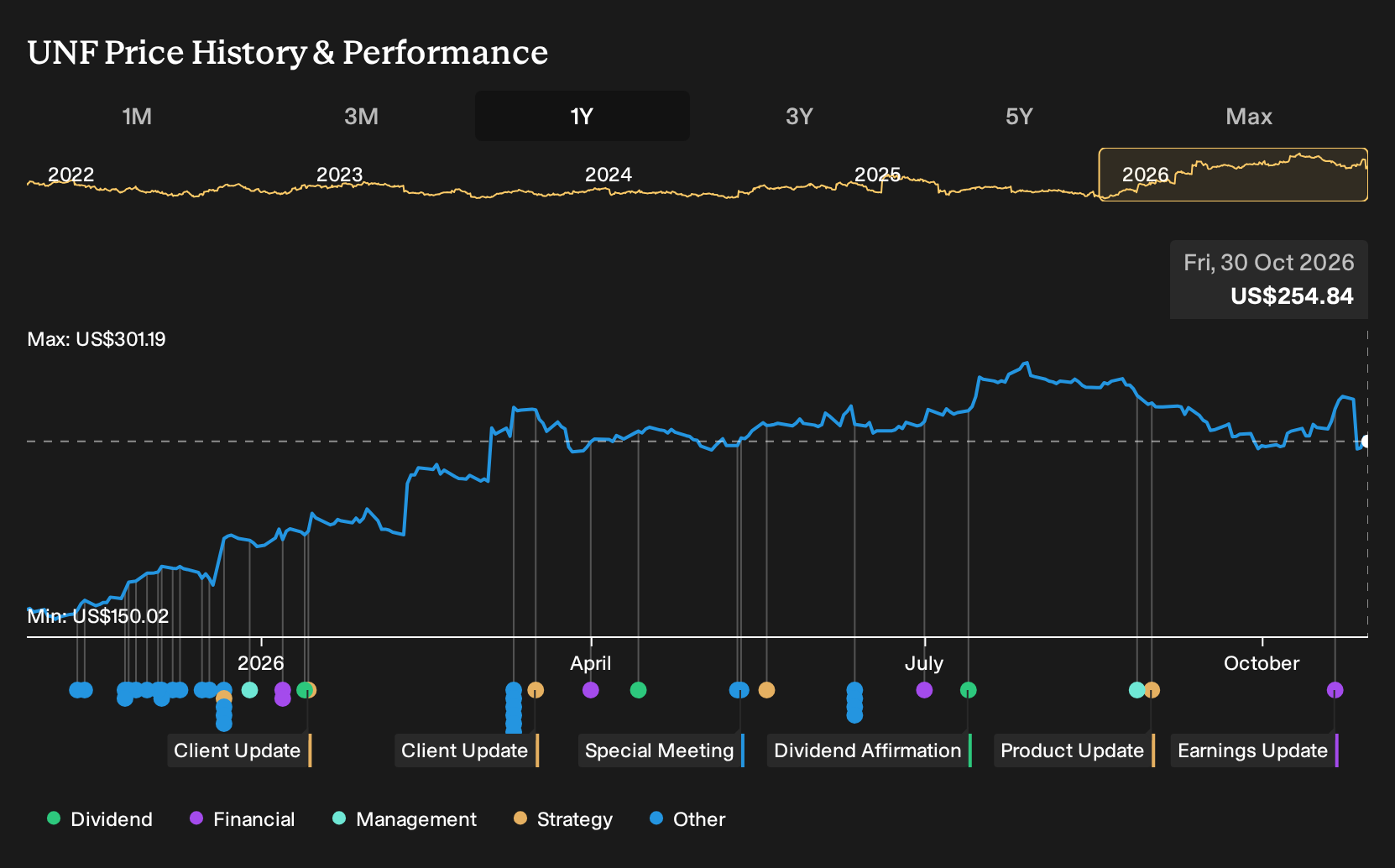
- UniFirst recently reported fourth quarter fiscal 2026 sales of US$645.01 million and full year sales of US$2,523.23 million, with net income and diluted earnings per share from continuing operations below the prior year. The Board also approved higher quarterly cash dividends on both Common and Class B shares, payable on December 15, 2026.
- The combination of softer profitability and an increased cash dividend indicates that UniFirst is balancing near term cost and earnings pressure with a decision to return more capital to shareholders. This places management’s capital allocation priorities under closer scrutiny for anyone tracking its long term uniform and facility services investment story.
- The next step is to consider how UniFirst's higher quarterly dividend fits into, and potentially reshapes, its broader investment narrative.
Scan how UniFirst's dividend move compares with other income focused opportunities by jumping into our curated list of 5 dividend fortresses in the market right now.
UniFirst Investment Narrative Recap
To own UniFirst, you need to be comfortable with a simple story. A labor heavy service business is spending heavily on systems and customer experience while near term profitability is under pressure. The dividend increase does not change that core thesis. The key short term swing factor remains whether UniFirst can keep earnings from eroding further as health care, legal and other operating costs stay elevated.
The biggest risk right now is that these expense pressures and tariffs linger while ERP implementation runs through at least 2027. That combination can hold back any margin recovery and keeps execution risk high. A higher cash payout is incremental information, not a fundamental shift in UniFirst's operating outlook.
The most relevant disclosure for this discussion is the full year 2026 earnings report. UniFirst generated US$2,523.23 million in sales and US$109.49 million in net income, with diluted EPS from continuing operations at US$6.02. Those figures, alongside the fourth quarter step down in earnings versus the prior year, frame why cost control and systems execution now matter more than ever.
Set against that backdrop, the dividend increase effectively asks you to judge whether cash returns today sit comfortably beside ongoing capital and operating spending. The same earnings release confirms the business is already absorbing higher health care, legal and growth related costs. For catalysts such as ERP efficiencies, customer retention gains and any Cintas related integration benefits to matter, UniFirst still has to deliver cleaner earnings that are less influenced by one off items and cost headwinds.
UniFirst's current analyst narrative points to revenues of about US$2.8b and earnings of US$193.3 million by 2029. This aligns with a 3.7% yearly revenue growth assumption and an earnings increase of roughly US$77.5 million from US$115.8 million today.
Uncover why UniFirst's fair value indicates a 7% potential upside to its current price before the discount to UniFirst's shares starts to close.
Exploring Other Perspectives
One bearish twist on UniFirst focuses on merger risk. The most cautious analysts worry that if the Cintas deal faces tougher regulatory outcomes, UniFirst could be left with higher merger costs and no synergy uplift. They were already penciling in 3.9% annual revenue growth to about US$2.8b and US$186.2 million in earnings by 2029. Those views were set before this dividend increase and the latest earnings, so you should expect opinions and forecasts to move around as new information lands and explore several angles before deciding how this income update fits your own view.
Explore 2 other UniFirst fair value estimates, including one that suggests as much as 47% downside from the current price.
Form Your Own Verdict
Don't just follow the ticker; dig into the data and build a conviction that's truly your own.
- A great starting point for your UniFirst research is our analysis highlighting 2 key rewards and 1 important warning sign that could impact your investment decision.
- See our latest analysis for UniFirst. The report includes a comprehensive fundamental analysis summarized in a single visual, the Snowflake, making it easy to evaluate UniFirst's overall financial health at a glance.
Looking for more UniFirst sized investment ideas?
Once you have a handle on UniFirst, it can help to set it alongside a few different types of opportunities and see what really fits your income, quality, and risk preferences.
- If you want income that aims to combine yield with resilience, take a look at our curated set of 5 dividend fortresses that may suit a more defensive approach.
- For investors who care most about balance sheet strength and fundamentals, start with the list of solid balance sheet and fundamentals (24 results) and compare how those businesses stack up against UniFirst's profile.
- If you enjoy getting in early on quieter stories, scan through our hand picked group of 19 high quality undiscovered gems that could broaden your watchlist beyond the usual tickers.
Have feedback on this article? Concerned about the content? Get in touch with us directly. Alternatively, email editorial-team@simplywallst.com