


EN
How Investors May Respond To Intuit (INTU) AI Rollout Expands
- In late October 2026, Intuit rolled out Intuit Intelligence across Enterprise Suite, QuickBooks, Accountant Suite and Credit Karma Tax, adding AI driven automation, industry specific workflows and new tax filing tools, while also expanding its AI partnership with Aprio.
- The push into AI native monthly close, sector tailored ERP features and flat priced Credit Karma Tax signals Intuit prioritizing workflow automation, accountant efficiency and lower entry price points over pure software seat growth.
- We will now look at how Intuit's expanded Intuit Intelligence automation could reshape the company’s broader investment narrative for investors.
Intuit Investment Narrative Recap
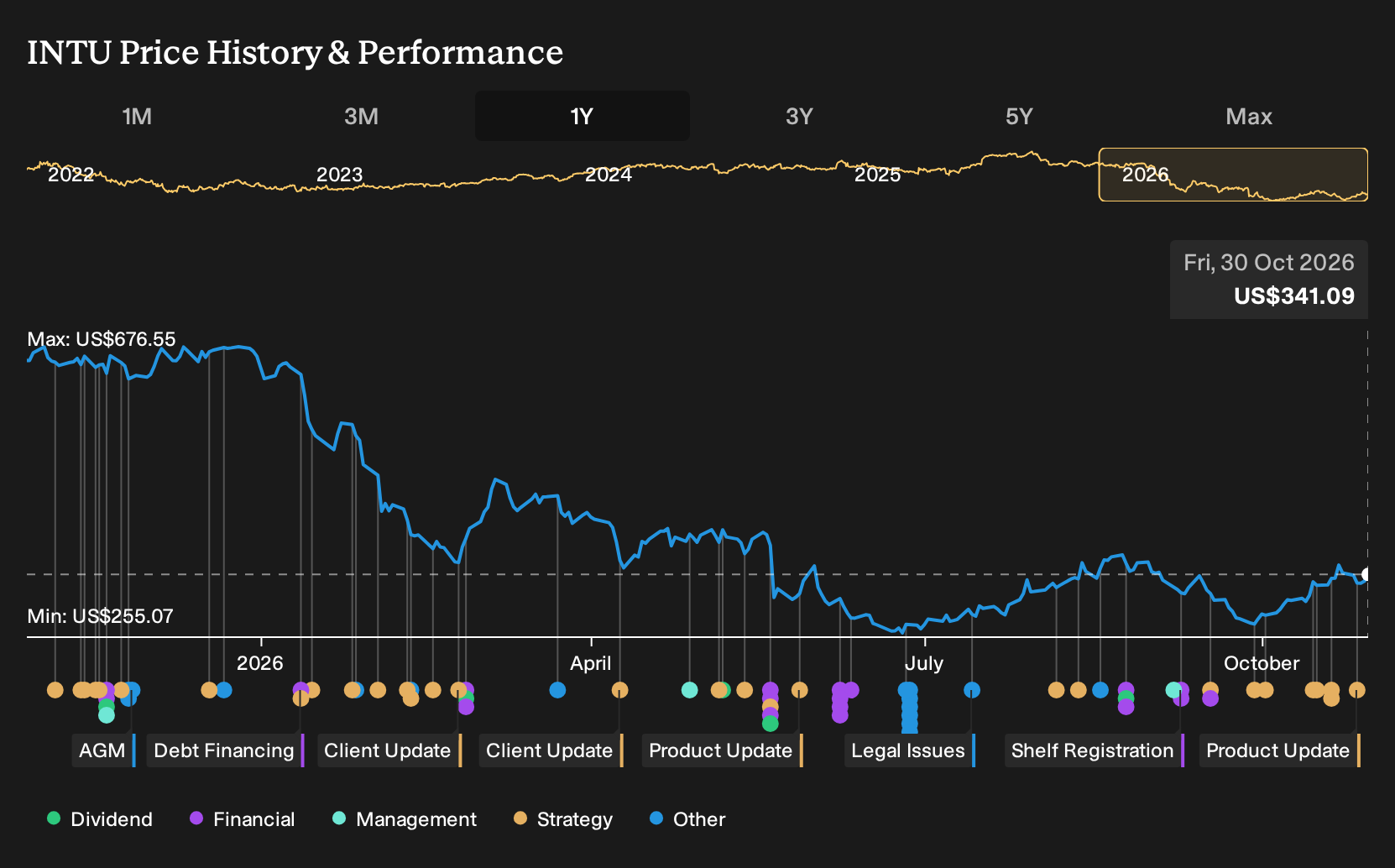
To stay invested in Intuit, you need to believe its AI led “financial system of intelligence” keeps deepening product usage across QuickBooks, Credit Karma, TurboTax and Enterprise Suite. The near term swing factor is whether this Intuit Intelligence rollout actually supports customer growth and engagement after a share price drop of almost 50% over the past year.
The biggest near term risk is that price sensitivity and prior misses on new customer targets persist, so lower entry price points and automation features fail to refill the funnel. This latest AI expansion looks directionally helpful for Intuit’s operating efficiency story, but the core risk around user growth and Mailchimp execution remains very much alive.
The Credit Karma Tax launch with US$0 federal and flat US$15 state filing sits right in the middle of this catalyst and risk mix. It pushes Intuit toward volume and data richness by lowering tax entry pricing while leaning on AI agents to reduce manual work, flag errors and speed up refunds. That is directly tied to the small business and consumer funnel thesis.
For you as an investor, the question is whether Credit Karma Tax becomes a meaningful on ramp into Intuit’s wider ecosystem, from debt payoff agents to longer term money tools, without eroding economics through heavy discounting. Execution risk is clear, since prior IRS share loss was tied to pricing, so adoption and retention data around the 2026 and 2027 tax seasons will matter far more than the headline launch itself.
What The Current Intuit Forecasts Are Asking You To Believe
Intuit's narrative projects US$27.7b revenue and US$6.9b earnings by 2029. This lines up with analyst models that build in 8.9% yearly top line growth and an earnings increase of about US$2.3b from US$4.6b today.
Those figures sketch out the financial bar that Intuit Intelligence and the wider product changes now need to clear. Analysts are effectively assuming that automation, accountant centric tools and lower tax price points translate into both higher profit margins and materially larger profits over the next few years.
The earnings bridge from US$4.6b today to US$6.9b in 2029 would imply the business adding roughly US$450m of profit per year on average across that span. For you as a shareholder or prospective buyer, that kind of step up may feel reasonable only if the AI workflow story and funnel rebuild across QuickBooks, Credit Karma and Enterprise Suite keep pulling more activity onto the Intuit rails.
Uncover why Intuit's fair value indicates a 19% potential upside to its current price that may not last much longer.
Exploring Other Perspectives
One alternate angle focuses less on customer funnels and more on how far Intuit can push AI led pricing power. The most optimistic analysts, who were already modeling revenue of about US$30.0b and earnings of US$7.4b by 2029, see the new Intuit Intelligence rollout as exactly the kind of shift that could reshape those assumptions. You can treat this as a reminder that views on Intuit vary widely and use the latest AI announcements as a prompt to compare several narratives rather than anchor on a single forecast.
Explore 14 other Intuit fair value estimates, including one that suggests as much as 118% upside from the current price.
Form Your Own Verdict
Disagree with existing narratives? Extraordinary investment returns rarely come from following the herd, so go with your instincts.
- A great starting point for your Intuit research is our analysis highlighting 5 key rewards that could impact your investment decision.
- See our latest analysis for Intuit. The report includes a comprehensive fundamental analysis summarized in a single visual, the Snowflake, making it easy to evaluate Intuit's overall financial health at a glance.
Looking For More Investment Ideas Beyond Intuit?
If the Intuit story has sharpened your thinking and you want to pressure test your thesis against other opportunities, the Simply Wall St Screener can help you quickly filter for businesses that better match your risk appetite, income needs, or value focus.
- If downside protection matters most to you, start with a shortlist of 29 resilient stocks with low risk scores that may suit a more cautious approach.
- If you want staying power and cleaner finances, focus on companies from our list of solid balance sheet and fundamentals (24 results) to see which ones align with your quality checklist.
- If you are hunting for earlier stage potential, scan through a curated set of 19 high quality undiscovered gems that might not yet be widely followed.
Have feedback on this article? Concerned about the content? Get in touch with us directly. Alternatively, email editorial-team@simplywallst.com