


EN
Should COO Retirement Require Action From ABM Industries Stock Investors?
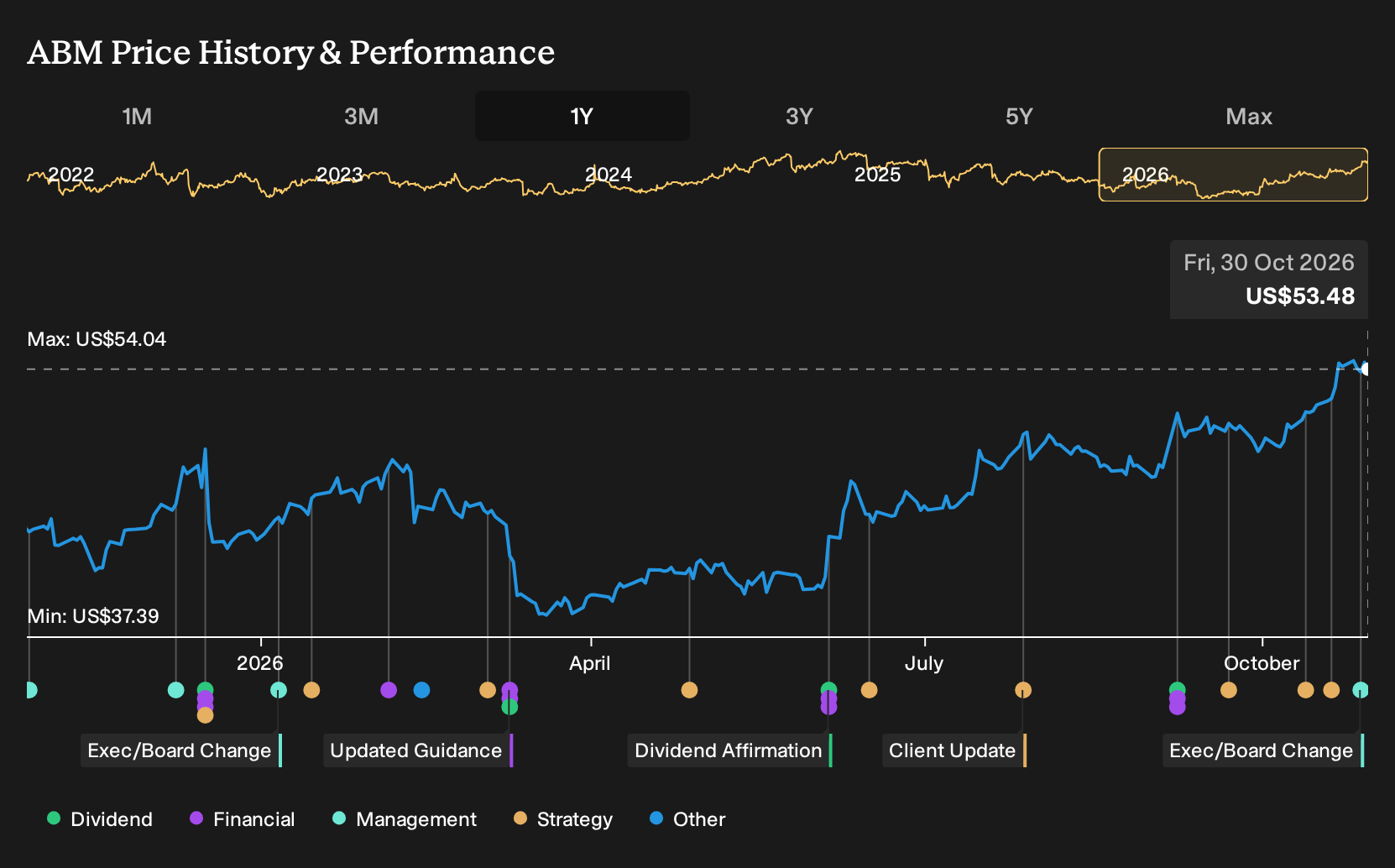
- ABM Industries reported that long serving Chief Operating Officer Rene Jacobsen retired, while Richard Sykes and Mark Hawkinson moved into newly created global leadership roles that split facility solutions from engineering and infrastructure services.
- The reshaped leadership structure puts a single executive over ABM Industries wide ranging facility services footprint and another over its engineering, HVAC, energy and power capabilities, directly tying senior accountability to how well each platform executes for large contracts and complex technical work.
- We will now see what this leadership reshuffle could mean for ABM Industries investment narrative and its evolving facility solutions mix.
Scan how other facility services and infrastructure players are positioned by running through our curated 95 robotics and automation stocks that intersect with complex venues, energy systems, and large scale operational contracts.
ABM Industries Investment Narrative Recap
To own ABM Industries, you need to believe the business can keep shifting its mix toward higher margin technical infrastructure work while still running its core janitorial and facility contracts cleanly and reliably. The new split between Facility Solutions and Engineering & Infrastructure Solutions ties leadership directly to that goal and does not change the basic thesis.
The key near term swing factor remains how effectively ABM converts its US$1.9b of FY25 bookings and US$1.2b from the first half of FY26 into durable revenue. Execution risk sits in semiconductor, data center, and microgrid pipelines, not in this leadership reshuffle, which appears more organizational than financial at this point.
The Buffalo Bills and Highmark Stadium contract is a useful lens. It shows ABM Industries applying its playbook from large venues such as SoFi Stadium, Allegiant Stadium, and Levi’s Stadium to another high profile, complex site. That kind of multi year facility work can support the base of recurring cash flow that underpins its more specialized projects.
For catalysts, investors may look for operational evidence that these big venue relationships feed into broader facility and technical wins, rather than remaining trophy references. A key risk is that high touch sports and entertainment work absorbs management attention without materially affecting overall margin mix, particularly if semiconductor, microgrid, and data center contracts slow or renew on weaker terms.
What The ABM Industries Consensus Is Pricing In
Analysts are effectively sketching out a version of ABM Industries where facility services grow steadily and earnings scale a bit faster than sales, helped by a higher mix of technical infrastructure work and some support from buybacks. The sell side base case builds off annual revenue growth assumptions of 3.3% over the next few years, slightly higher profit margins, and a lower P/E multiple by the time those earnings arrive. Together these factors shape how much upside or downside investors might see from today’s share price.
On the earnings side, the consensus blueprint is specific. Forecast earnings are US$272.9 million by 2029 compared with US$166.4 million today, which implies an increase of about US$106 million over that period, while analysts frame this outcome alongside an earnings per share figure of US$4.62 and a P/E multiple that drifts from 17.2x now to 13.9x on those 2029 profits.
ABM Industries' narrative projects US$10.1b revenue and US$272.9 million earnings by 2029. This setup assumes 3.3% yearly revenue growth and an earnings increase of about US$106 million from US$166.4 million today.
Valuation expectations in the consensus numbers rely on investors being comfortable with a lower earnings multiple as the business mix leans further into complex engineering and infrastructure. For that price target to line up with your own work, you would need to be comfortable with roughly US$10.1b of revenue and US$272.9 million of profit in 2029 and a P/E around 13.9x, which is below the current sector average quoted in the research and below where the stock reportedly trades today.
The spread in analyst targets tells you how differently people are weighing those assumptions. One end of the range points to US$68.00 a share and a more generous interpretation of ABM Industries technical growth avenues, while the low end at US$49.00 is closer to the current US$48.97 price and implies limited confidence that semiconductor, microgrid, and data center work will reshape earnings quality in a material way by the end of the decade.
Instead of anchoring on any single target, it can help to treat these figures as scenario markers. If you think revenue can reasonably track something like 3.3% a year and margins hold near the 2.7% level analysts outline, then the 2029 earnings line becomes a reference point to compare with your own expectations for backlog conversion in semiconductors, the durability of large venue contracts, and how aggressively ABM Industries might keep shrinking its share count through buybacks.
Uncover why ABM Industries' fair value indicates a 5% potential upside to its current price that could narrow quickly.
Exploring Other Perspectives
For ABM Industries, the bullish twist in the story is centered on higher value technical work. The most optimistic analysts were already penciling in roughly US$10.0b of revenue and US$284.8 million of earnings by 2029, supported by microgrid and semiconductor projects. With the new leadership split, those forecasts may shift. Treat this as one of several viewpoints to explore, not the final word.
Explore another ABM Industries fair value estimate, including one that suggests up to 78% upside from the current price!
Decide For Yourself
Don't just follow the ticker; dig into the data and build a conviction that's truly your own.
- A great starting point for your ABM Industries research is our analysis highlighting 4 key rewards and 1 important warning sign that could impact your investment decision.
- See our latest analysis for ABM Industries. The report includes a comprehensive fundamental analysis summarized in a single visual, the Snowflake, making it easy to evaluate ABM Industries' overall financial health at a glance.
Looking For More Investment Ideas Beyond ABM Industries?
If you want to pressure test your view on ABM Industries against other opportunities, casting a wider net with the Simply Wall St Screener can help you see where risk, quality, and valuation line up more cleanly.
- For investors who care most about resilience and capital preservation, a good next step is to review 29 resilient stocks with low risk scores that show relatively defensive profiles on our risk checks.
- If you are hunting for value with solid underlying businesses, compare ABM Industries to a list of solid balance sheet and fundamentals (24 results) where cash, debt, and fundamentals look more robust on our models.
- Those looking for under-the-radar stories can scan a 19 high quality undiscovered gems that combine quality signals with lower market attention.
Have feedback on this article? Concerned about the content? Get in touch with us directly. Alternatively, email editorial-team@simplywallst.com