


EN
How Investors Are Reacting To Rockwell Automation (ROK) Dividend Hike
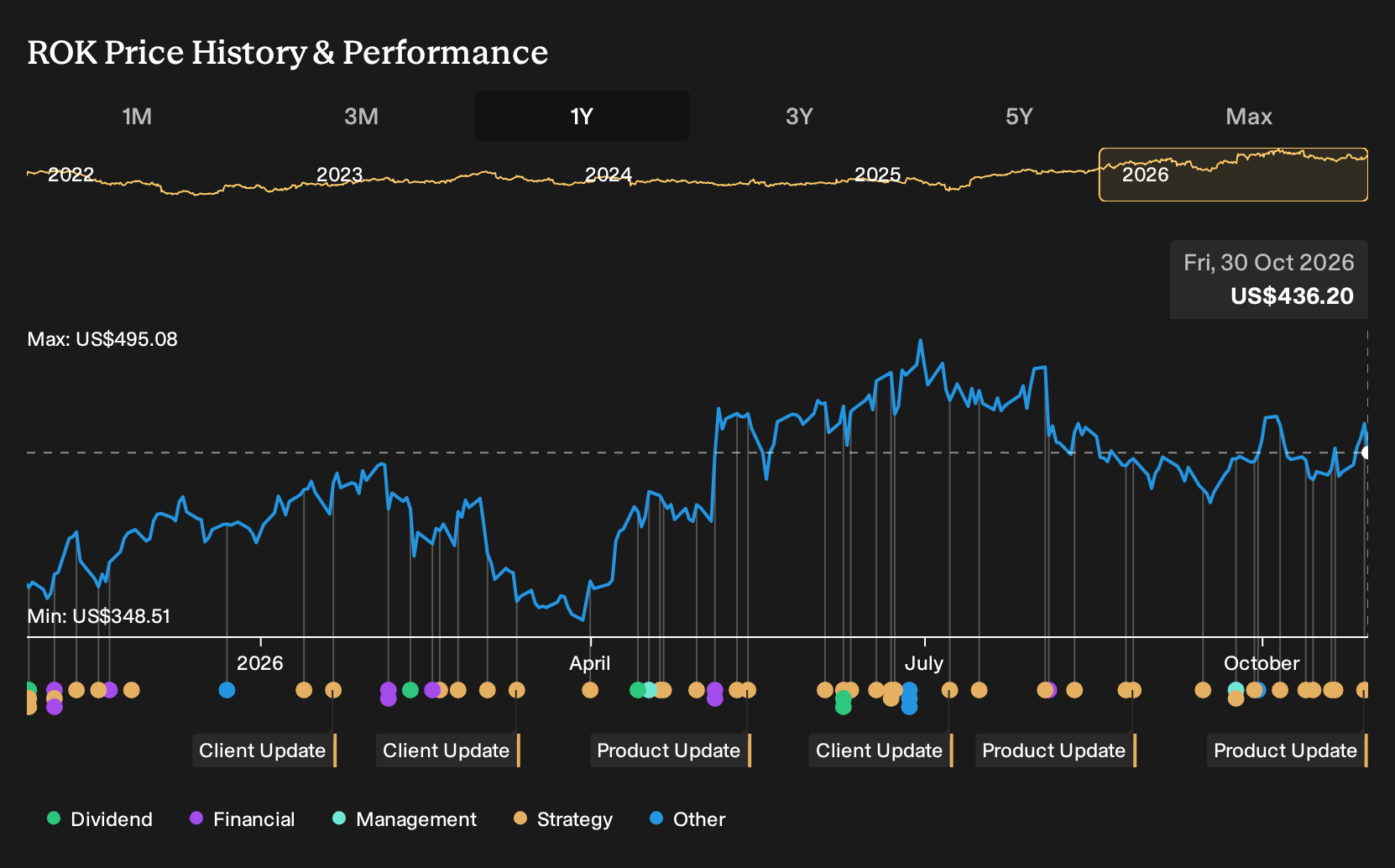
- Rockwell Automation increased its quarterly dividend to $1.45 per share, payable on December 10, 2026, and rolled out new AI native FactoryTalk Conductor software along with expanded SecureOT cybersecurity tools aimed at OEMs facing tighter regulations in 2026 and 2027.
- The combination of a higher cash payout and a deeper push into software, cybersecurity and AI indicates that Rockwell Automation is emphasizing recurring, higher value offerings that depend on execution in areas such as regulatory readiness, lifecycle services and machine level visibility.
- This article examines how Rockwell Automation's investment narrative is shaped by the dividend increase alongside its SecureOT cybersecurity initiatives.
Rockwell Automation Investment Narrative Recap
To own Rockwell Automation, you need to believe that long term demand for industrial automation, software and AI tools outweighs pockets of slower customer spending. The near term swing factor is whether order intake in areas like North America and Software & Control keeps converting into steady project work despite delays in some Food & Beverage and process projects.
The key risk remains softer recurring Lifecycle Services, where organic annual recurring revenue growth of 6% in Q3 2026 fell short of internal aims. The dividend increase signals confidence in ongoing cash generation, but it does not materially change that the biggest watchpoint is execution on higher margin software and services adoption.
The SecureOT expansion is the announcement that most directly ties into the current catalyst story around Rockwell Automation. OEM focused assessments, advisory services, machine level visibility and compliance reporting line up with tightening cybersecurity rules in 2026 and 2027, which keeps operational technology security firmly in customers’ budgets.
For you as an investor, the appeal is that SecureOT leans into software, recurring services and lifecycle support rather than one off hardware. The flip side is execution risk. If customers keep deferring broader projects or if recurring services stay slower than planned, the uplift from SecureOT and related offerings could take longer to filter through.
Rockwell Automation's current analyst narrative ties forecast revenue of US$10.5b and earnings of US$1.9b in 2029 to an assumed 5.3% yearly revenue growth rate, with profits projected to rise from US$1.2b today to US$1.9b by that year, an increase of about US$0.7b.
Uncover why Rockwell Automation's fair value indicates a 10% potential upside to its current price that could narrow quickly.
Exploring Other Perspectives
One alternate view focuses on Rockwell Automation’s valuation risk rather than SecureOT or AI as a catalyst. The most bearish analysts were working off revenue near US$10.1b and earnings of about US$1.8b by 2029 before this dividend and product news. That group sees limited upside and a stretched P/E, so you are encouraged to compare both narratives yourself.
Explore 3 other Rockwell Automation fair value estimates, including one that suggests up to 20% downside from the current price.
Decide For Yourself
Disagree with existing narratives? Extraordinary investment results rarely come from following the herd, so consider trusting your own analysis.
- A great starting point for your Rockwell Automation research is our analysis highlighting 1 key reward and 1 important warning sign that could impact your investment decision.
- See our latest analysis for Rockwell Automation. The report includes a comprehensive fundamental analysis summarized in a single visual, the Snowflake, making it easy to evaluate Rockwell Automation's overall financial health at a glance.
Looking for more Rockwell Automation style investment ideas?
If the Rockwell Automation story has you thinking about how to balance income, resilience and long term compounding, it can help to compare it with a wider watchlist built around the same themes.
- For investors who want a mix of value and quality, scan through 33 high quality undervalued stocks to find companies that combine stronger fundamentals with more modest pricing.
- If capital preservation sits higher on your list, start with 29 resilient stocks with low risk scores that score well on resilience and more measured risk profiles.
- When you are hunting for fresh ideas beyond the usual large caps, cast a wider net with 19 high quality undiscovered gems that pair solid business metrics with lower market attention.
Have feedback on this article? Concerned about the content? Get in touch with us directly. Alternatively, email editorial-team@simplywallst.com