


EN
Realty Income (O) Heads Into Q3 Results As Dividend And Debt Narrative Tests Valuation
Realty Income (O) heads into its third quarter 2026 report on Monday after the close, with investors weighing rental income trends, portfolio expansion and dividend coverage against higher borrowing costs and a larger debt load.
Over the past month, Realty Income has picked up momentum with a 30 day share price return of 5.17%, even though the 90 day share price performance is down 10.32% and the year to date share price return is slightly negative. That mix of short term strength and recent weakness sits against a 1 year total shareholder return of 3.61% and a 3 year total shareholder return of 32.13%. This indicates the stock has rewarded patient holders, while near term moves reflect shifting views on growth, interest rate risk and how comfortably the dividend is covered ahead of the third quarter numbers.
Capitalize on the focus around Realty Income's dividend and debt story by scanning a curated 5 dividend fortresses, which is built to highlight payout strength with resilience in tougher rate conditions.Realty Income now trades at a clear discount to analyst targets and some fair value estimates, even as higher debt and rate sensitivity keep many holders cautious. Is that markdown compensation for risk or a warning signal?
Most Popular Narrative: 8.3% Undervalued
At a last close of $56.93 versus a narrative fair value of $62.11, Realty Income screens as modestly discounted. This is exactly what has attracted long term income focused holders, according to andre_santos.
Realty Income is the standard in REITs. Having paid a monthly dividend over 32 years ininterrupted (starting at 1994), every investor that wants to have a secure and reliable source of dividend income has a position or had some kind of investment in this company over time.
Don't take the key metrics above for this type of business very seriously. Yes, the growth for a REIT company will be slow and overall tedious. However, the security and reliability its dividend payment offers is hard to come by in other industries, namely because this type of business is regulated to return most if not all of its free cash flow in dividend payments to its shareholders.
See why 114 investors see Realty Income as 8% undervalued.
Result: Fair Value of $62.11 (UNDERVALUED)
Still, higher borrowing costs on Realty Income’s sizeable debt, along with any slowdown in rental collections, could quickly challenge the current undervalued narrative.
Find out about the key risks to this Realty Income narrative.
Another View: Realty Income Looks Expensive On Earnings
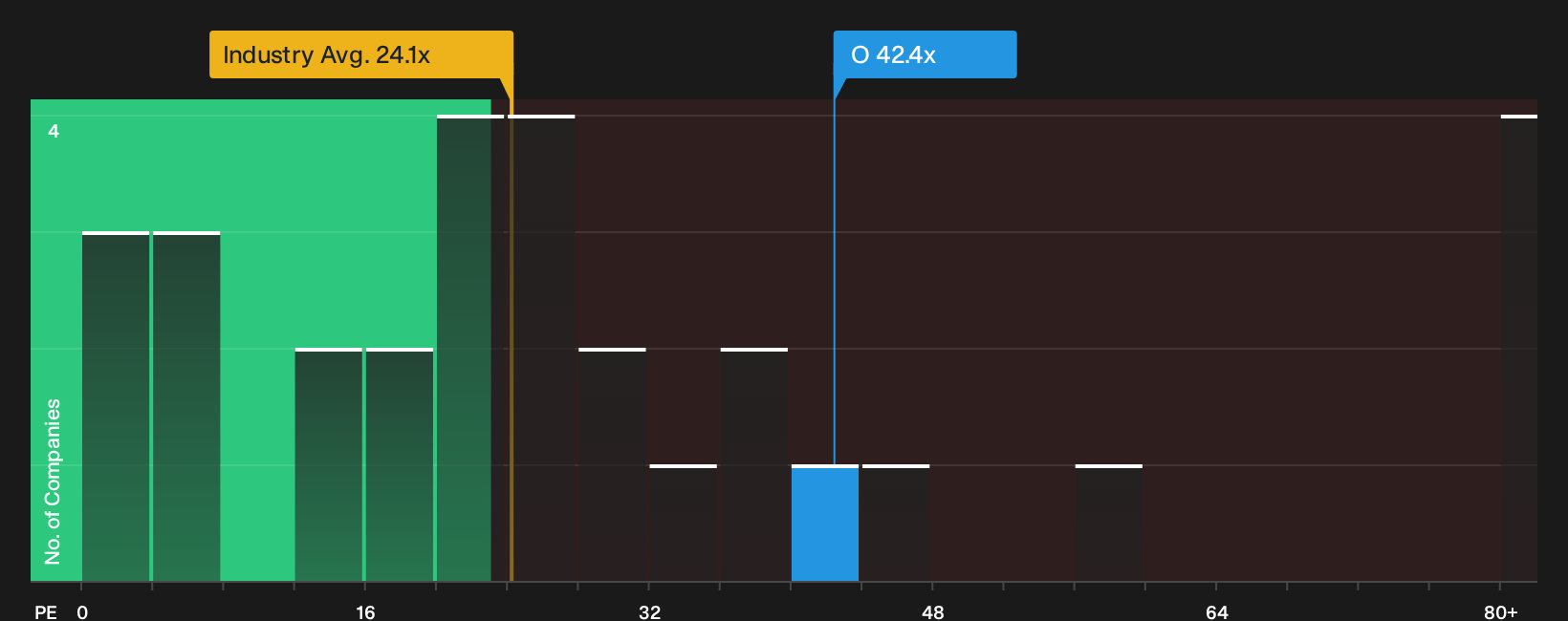
The narrative fair value work points to Realty Income trading at an 8.3% discount, yet the simple P/E check paints a very different picture. At 42.4x earnings versus a fair ratio of 35.3x, the stock screens as expensive on this metric.
That premium is also steep against both the US Retail REITs industry at 24.1x and direct peers at 25.1x. Paying that much more for each dollar of profit can limit room for error if earnings growth cools. The question becomes which signal carries more weight: the income focused narrative or the earnings multiple.
See what the numbers say about this price — find out in our valuation breakdown.
Next Steps
Mixed signals on Realty Income's valuation and fundamentals can either feel like a red flag or a fresh opportunity, so act quickly by checking both sides of the debate and weighing the 4 key rewards and 1 important warning sign.
Looking for more investment ideas beyond Realty Income?
If the mixed picture on Realty Income has you thinking about diversification, this is the moment to widen your watchlist with fresh, data driven ideas.
- Target resilient compounding potential by focusing on businesses that screen well for quality and value using our 33 high quality undervalued stocks.
- Prioritise capital protection first and focus on steadier compounding with our 29 resilient stocks with low risk scores, built to surface tickers with more robust risk profiles.
- Look for tomorrow's quiet overachievers by scanning the 19 high quality undiscovered gems, which filters for strong fundamentals hiding outside the usual headlines.
Have feedback on this article? Concerned about the content? Get in touch with us directly. Alternatively, email editorial-team@simplywallst.com