


EN
Earnings Beat Could Be A Game Changer For Linde (LIN)
- Linde reported Q3 2026 sales of US$9,404 million compared with US$8,615 million a year earlier, with net income of US$1,692 million and diluted EPS from continuing operations of US$3.66. The board also affirmed a quarterly dividend of US$1.60 per share payable in December 2026.
- The business highlighted 15% growth in the electronics end market and a record project backlog supported by large semiconductor and industrial gas projects. It also expanded long term supply for Tata Steel in India to serve higher steel output and regional gas demand.
- This article examines how Linde’s investment narrative is shaped by electronics growth and a record gas project backlog.
Scan how Linde’s electronics exposure compares with other industrial gas and chip supply plays by reviewing our curated 54 AI infrastructure stocks built around the semiconductor buildout theme.
Linde Investment Narrative Recap
Linde appeals to shareholders who buy into a long pipeline of industrial gas contracts, particularly in electronics, clean energy and high value projects, while accepting near term earnings noise. Q3 results fit that pattern. Sales rose to US$9,404 million, but quarterly net income and EPS from continuing operations softened versus last year as restructuring and mixed demand showed up in the numbers.
The near term swing factor is how efficiently Linde converts its record project backlog and electronics strength into cleaner earnings growth while restructuring lands. The biggest risk is that weaker European industrial activity and ongoing pressure from the U.S. homecare business keep margins under strain, making the current premium P/E harder to justify.
The Tata Steel Kalinganagar expansion is one of the clearest operational links between the latest earnings and Linde’s catalyst list. Doubling on site capacity there adds long duration industrial gas volumes, raises asset utilization in India and can support regional merchant sales. This matters when European plant closures remain a threat to network density.
For an investor, that agreement sits alongside the record project backlog as a concrete example of how Linde is trying to convert contract wins into more resilient sale of gas revenue. Execution risk is real. Large on site deals must ramp on time, and any cost overrun or demand shortfall could dilute the benefit that the backlog and Q3 electronics momentum currently signal.
Linde Long Term Forecasts And Valuation Set Up
Analyst models around Linde lean heavily on a steady build in electronics, clean energy and broader gas projects, then layer on earnings improvement from higher margins and fewer shares. Revenue is assumed to expand by 5.7% each year over the next three years, while profit margins are projected to move from 20.4% today to 23.4% over the same stretch. Those inputs do a lot of work in the story that Q3 electronics strength is not a one off, but instead part of a multi year ramp that needs to show up cleanly in future income statements.
On current consensus numbers, earnings are expected to reach about US$9.8b by 2029, up from US$7.2b today, which implies roughly a 36% increase in profit dollars over that period. That step up is what underpins the analyst price target of US$544.40 and the implied future P/E of 31x, compared with about 29.3x today and 22.7x for the broader US chemicals group. For an investor, the key question is not whether the figures are precise, but whether a roughly mid single digit top line growth rate with margin expansion to the low 20s feels realistic given Linde’s electronics, helium and hydrogen pipeline and the drag from weaker European industry and U.S. homecare.
Linde's narrative projects US$41.9b revenue and US$9.8b earnings by 2029. This assumes 5.7% yearly revenue growth and around a US$2.6b earnings increase from US$7.2b today.
Those forecasts also sit on specific capital market assumptions that matter if you care about how the current share price tries to discount the future. The framework uses a discount rate of 7.9% to 7.93% and assumes the share count shrinks by about 1.28% per year over the next three years, which helps earnings per share grow faster than total profit. In simple terms, the models assume that Linde can keep funding large semiconductor and clean energy projects, expand margins, retire stock and do all of that while still earning an equity return in line with that discount rate.
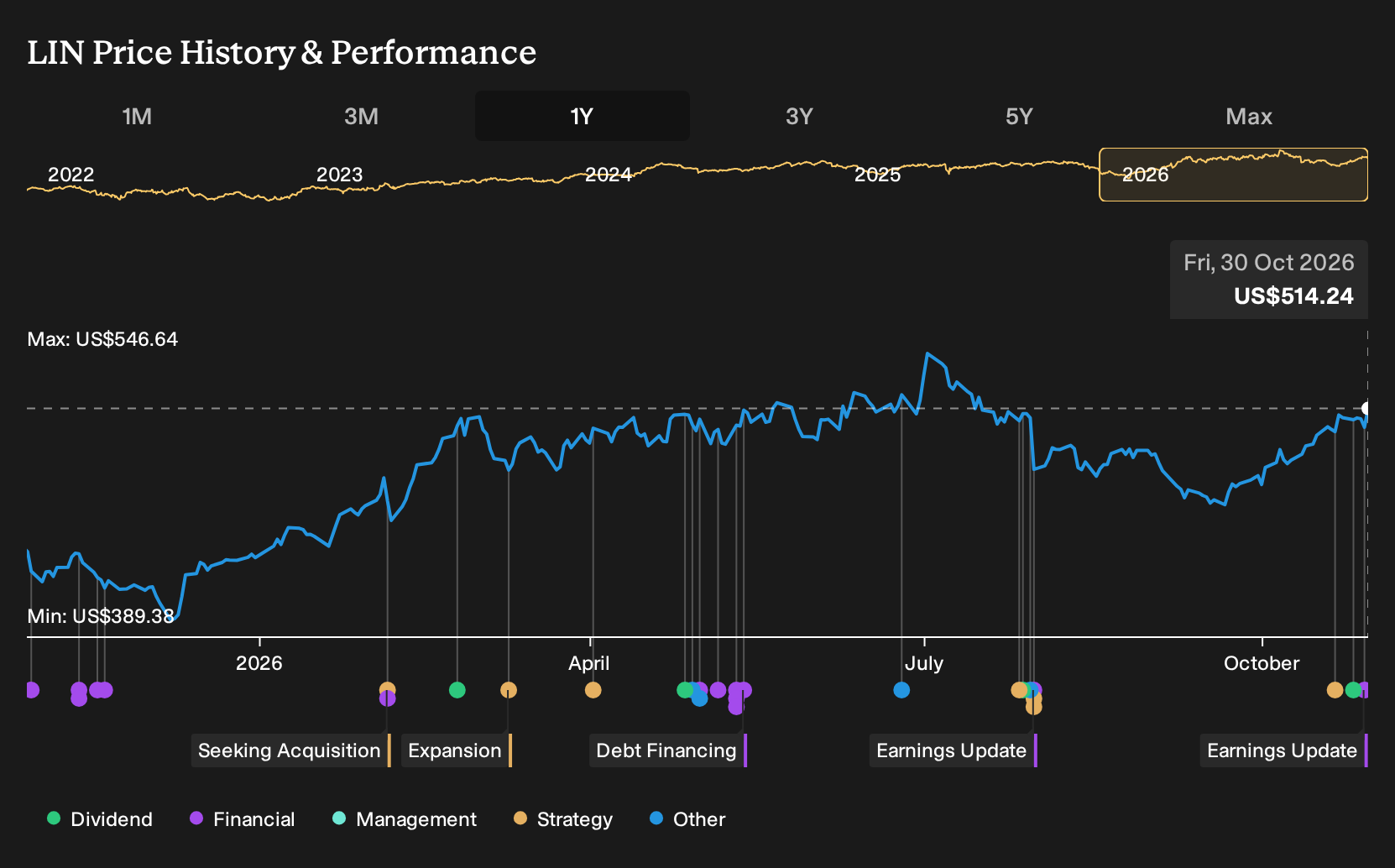
Price targets cluster around that setup but with a wide enough spread to remind you that these are scenarios, not facts. The consensus sits at US$544.40 with the most optimistic forecast at US$580 and the lowest at US$400, versus a current share price of about US$460.40. That implies upside of 15.4% to the average target, but it also tells you that some analysts already see limited headroom if the margin story or electronics demand cools.
Uncover why Linde's fair value indicates a 6% potential upside to its current price that could narrow quickly.
Exploring Other Perspectives
Five fair value estimates from the Simply Wall St Community span a wide band, from about US$337 per share at the low end to roughly US$549 at the top. You can read that range against Linde’s record gas backlog, electronics projects and ongoing European and U.S. homecare risks, then weigh which scenario fits your own expectations.
Explore 4 other Linde fair value estimates, including one that suggests as much as 34% downside from the current price.
Form Your Own Verdict
Don't just follow the ticker. Dig into the data and build a conviction that's truly your own.
- A great starting point for your Linde research is our analysis highlighting 1 key reward and 1 important warning sign that could impact your investment decision.
- See our latest analysis for Linde. The report includes a comprehensive fundamental analysis summarized in a single visual, the Snowflake, making it easy to evaluate Linde's overall financial health at a glance.
Looking For More Investment Ideas Beyond Linde?
If Linde's mix of long term contracts and capital projects has your attention, it can help to compare it with other opportunities that fit different risk and income profiles using the Simply Wall St Screener.
- If you want a wider set of potential bargains with solid fundamentals, scan our 19 high quality undiscovered gems and identify which stories may be worth a deeper look.
- For investors who focus on balance sheet strength and staying power, sort through the list of solid balance sheet and fundamentals (24 results) to find businesses built on sturdier financial foundations.
- If lower volatility and resilience matter more than rapid growth, filter for defensively positioned companies through the 29 resilient stocks with low risk scores and compare how they stack up against Linde.
Have feedback on this article? Concerned about the content? Get in touch with us directly. Alternatively, email editorial-team@simplywallst.com