


EN
Unilever (LSE:ULVR) Flags Q3 Sales And Dividend, Is It Fully Priced?
Unilever (LSE:ULVR) has stepped into the spotlight after its Q3 2026 sales and trading statement call on 28 October, paired with a fresh quarterly interim dividend declaration.
At a £48.705 share price on 30 October, Unilever has just posted a 1-day share price return of 2.07% and a 1-month share price return of 8.63%. Its 1-year total shareholder return of 2.67% and 5-year total shareholder return of 37.98% point to steady, dividend backed compounding rather than sharp momentum moves, with the latest Q3 update and dividend announcement giving the stock a short term lift as investors reassess both growth prospects and perceived risk.
Scan how Unilever compares with other resilient consumer-focused businesses by checking a curated list of 5 resilient stocks with low risk scores before the next round of earnings and dividend updates reshapes the field.
The share price has just moved, analyst targets sit higher and intrinsic value estimates point to a wider gap again. So where does fair value for Unilever really land on that spectrum right now?
Most Popular Narrative: 15% Overvalued
Unilever last closed at £48.71 while the most followed narrative on Simply Wall St pegs fair value at £42.28. This points to a premium price and puts the fresh Q3 update in sharper focus.
Overall, I think Unilever is probably fairly valued in the current market. It is difficult to make a compelling case that the shares are dramatically undervalued, but equally, the valuation does not appear excessive given the quality of the underlying business, its strong brands, cash generation and potential for improving margins.
See why 12 investors see Unilever as 15% overvalued.
Result: Fair Value of £42.28 (OVERVALUED)
Still, a weaker consumer backdrop that pressures volumes or slower progress on margin improvement could challenge the idea that Unilever is only modestly overvalued.
Find out about the key risks to this Unilever narrative.
Another View: Unilever Through The SWS DCF Lens
The Simply Wall St DCF model produces a very different result. On this view, Unilever shares at £48.71 trade below an estimated future cash flow value of £61.05, which suggests the stock may be undervalued rather than 15% expensive.
This kind of gap reflects a clash between what cash flow assumptions support and what shorter term sentiment or peer P/E comparisons suggest. For an investor trying to price Unilever today, which perspective seems more useful: the crowd narrative or the cash flow analysis?
Look into how the SWS DCF model arrives at its fair value.
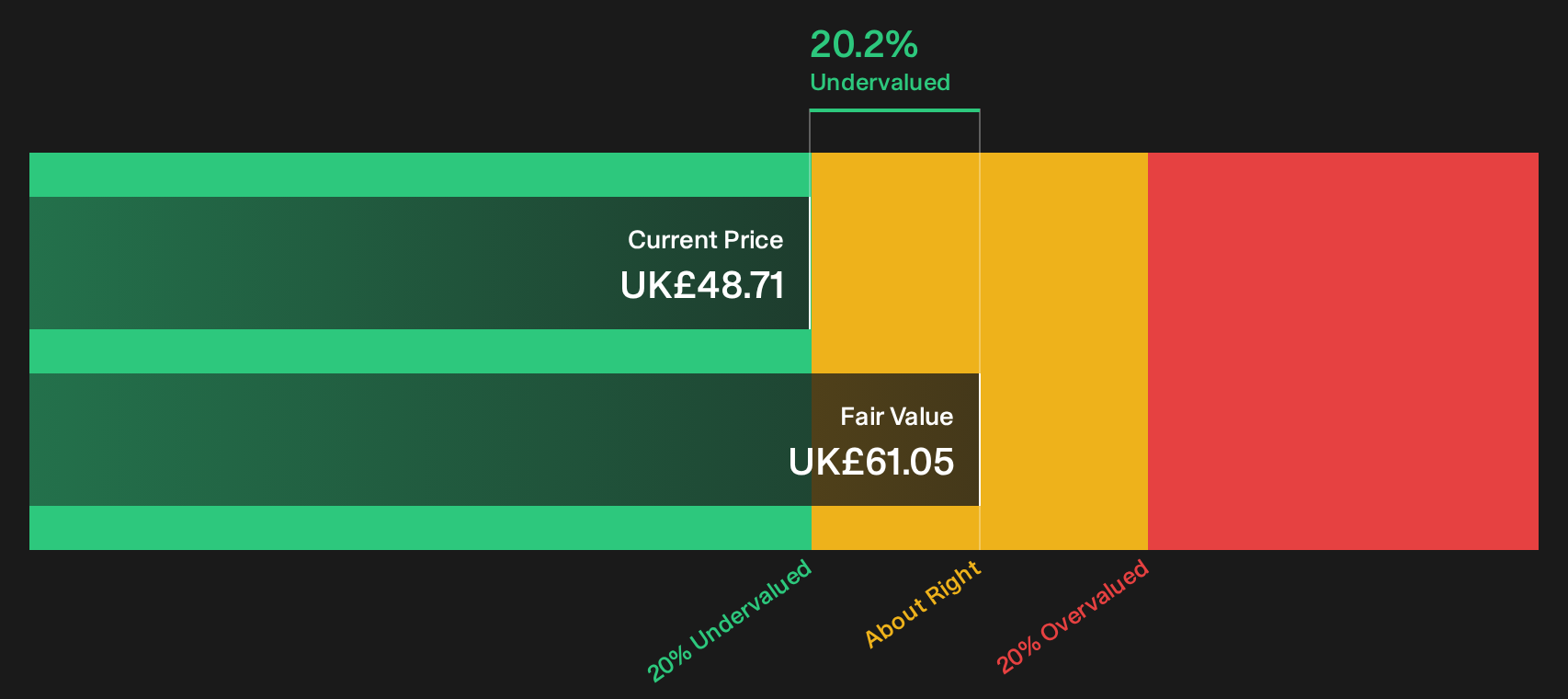
Simply Wall St performs a discounted cash flow (DCF) on every stock in the world every day (check out Unilever for example). We show the entire calculation in full. You can track the result in your watchlist or portfolio and be alerted when this changes, or use our stock screener to discover 14 high quality undervalued stocks. If you save a screener we even alert you when new companies match - so you never miss a potential opportunity.
Next Steps
If the split views on Unilever leave you undecided, let that be the cue to move fast and dig into the underlying data yourself. To weigh the potential upsides against the issues investors are worried about, start with the 4 key rewards and 1 important warning sign.
Looking for more investment ideas beyond Unilever?
If Unilever leaves you thinking about what else might deserve a spot on your watchlist, use this moment to scan other opportunities before they move without you.
- Target resilient income by reviewing 5 dividend fortresses, which is built to emphasise yield and balance sheet strength for investors who care about getting paid while they wait.
- Hunt for potential bargains using the 14 high quality undervalued stocks, which focuses on companies with strong fundamentals trading below their estimated worth.
- Spot under-the-radar prospects through the 5 high quality undiscovered gems, which highlights quality businesses the broader market may not be watching yet.
Have feedback on this article? Concerned about the content? Get in touch with us directly. Alternatively, email editorial-team@simplywallst.com