


EN
What Rigel Pharmaceuticals Holders Saw Early
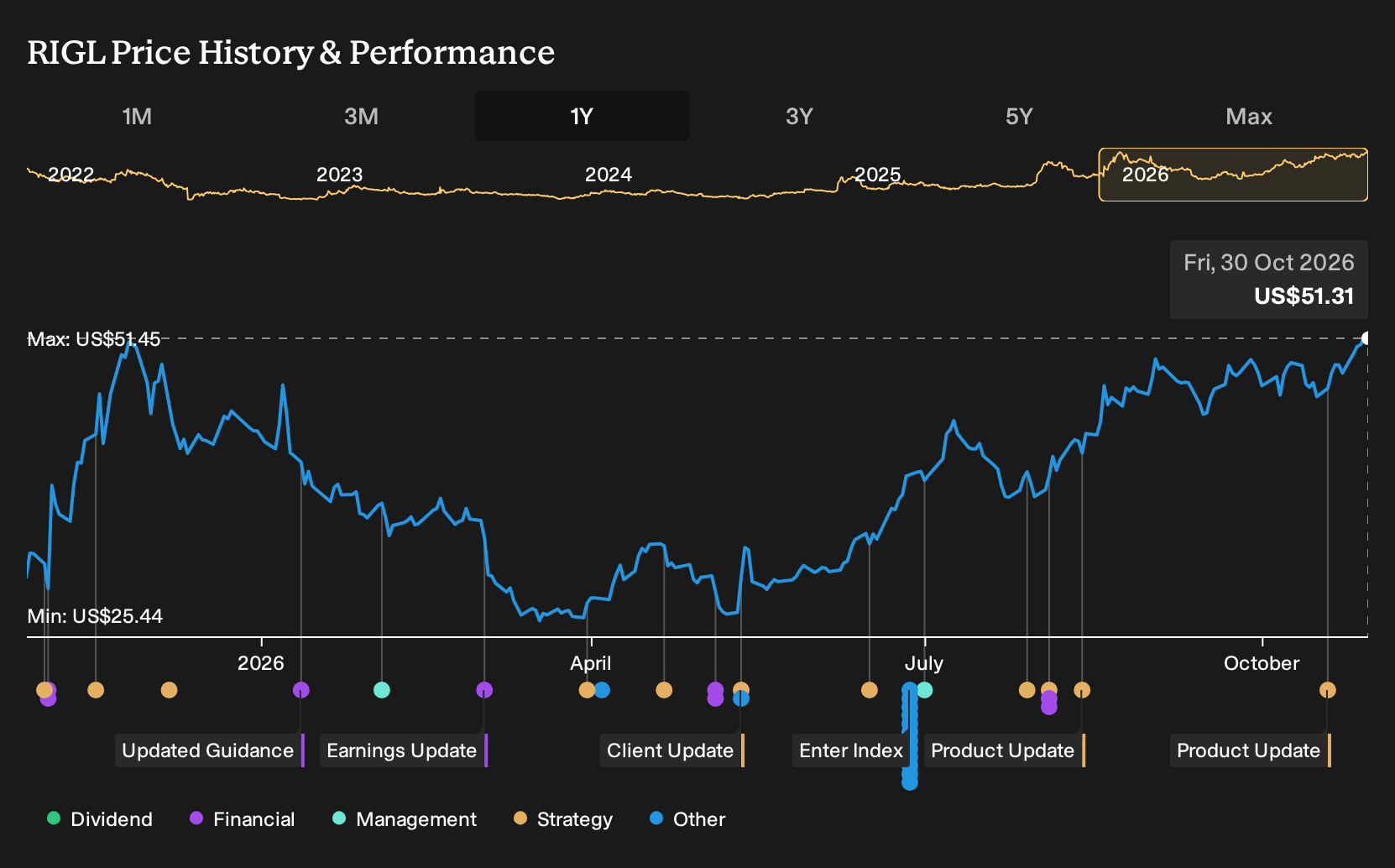
For Rigel Pharmaceuticals shareholders, the return over the past year was 62.8%, including dividends. If you had been weighing a buy on 30 October 2025, you were staring at two clashing views. One view argued that expansion and a richer clinical portfolio justified a valuation 21% above the screen. The other warned that regulatory pressure and dependence on a few drugs pointed 30% below. Faced with those forecasts, which risk seemed more important to you?
Rigel Pharmaceuticals is not the only name tied to this theme. Zero in on 34 healthcare AI stocks and compare how each one is priced.
The Argument You Would Have Had To Settle On Rigel Pharmaceuticals
The shares cost US$31.62 at the start of the period, and Rigel Pharmaceuticals sat between two sharply different stories about what came next.
The bullish narrative saw expansion and a broader clinical pipeline as the key, pointing to a Fair Value of US$38.33, a level those assumptions treated as justified if revenue rose 3.5% a year and profit margins settled at 14.3% on a future P/E of 20.9x.
The bearish view focused on regulatory pressure and concentration risk, arguing for a Fair Value of US$22.02 while assuming revenue would decline 0.8% annually and margins would compress toward 12.9% even if the shares traded on a 14.9x P/E.
What The Results Changed For Rigel Pharmaceuticals
Rigel Pharmaceuticals landed an exclusive global license for FDA-approved VEPPANU, which backed the bullish focus on a richer oncology portfolio. At the same time, Q2 2026 figures showed revenue falling to US$78.703 million and net income down to US$17.29 million, with net margin dropping to 22.0%. The evidence cut both ways for the original cases.
The key assumption here was that a broader pipeline would also support resilient profitability. When you assess another drug developer, check whether new assets arrive alongside stable or improving net margin, not just fresh product headlines.
What Rigel Pharmaceuticals’ Price Already Assumes
Rigel Pharmaceuticals now trades at US$51.4, after a 62.8% gain over the past year. The selected Narrative’s Fair Value sits below that level, because it frames the recent rally against heavy in-licensing commitments and a still concentrated oncology and hematology portfolio.
For today’s price to hold up, Rigel Pharmaceuticals would need to keep turning late stage deals like VEPPANU into cash flows that comfortably exceed milestones, royalties and development funding.
"Although Rigel Pharmaceuticals secured VEPPANU through a global in-license and highlights it as a key late stage oncology asset, the company must first work through a US$70 million upfront payment, up to US$15 million in near term transition milestones, up to US$320 million in further milestones and tiered mid-teens to mid-20s royalties. These obligations could compress future net margins if commercial uptake or pricing do not keep pace with these fixed payments."
Not everyone reads the same price the same way. → See the lower figure this Narrative lands on, and how it gets there
Another Route Beyond Rigel Pharmaceuticals
Rigel Pharmaceuticals pulls you into specialist drugs and significant clinical risk. That narrow focus can amplify both breakthrough potential and business uncertainty.
Some healthcare giants pursue a different kind of resilience. They combine prescription treatments with devices and tools used directly in operating rooms.
This mix lets them balance multiple therapeutic areas when one therapy line confronts pricing pressure or patent loss.
It remains entirely within healthcare, but spread across medicines and medical technology. The unresolved question is how much that broader base matters to you.
The case is on the record, with the assumptions it rests on. → See the Narrative that values this company 17% above its price
Have feedback on this article? Concerned about the content? Get in touch with us directly. Alternatively, email editorial-team@simplywallst.com