


EN
Is Earnings Optimism Altering The Investment Case For Charter Communications (CHTR)?
- Charter Communications has already declared a regular quarterly cash dividend of $0.43750001 per share on its Series A Cumulative Redeemable Preferred Stock, payable on January 15, 2027 to holders of record on December 31, 2026.
- The combination of preferred dividends, mobile subscriber gains at Spectrum Mobile, and the completed Cox Communications purchase highlights how Charter Communications is balancing capital returns with customer acquisition and footprint expansion.
- Next, the focus will be on how Charter Communications’ Cox acquisition and Spectrum Mobile rollout could influence the broader investment narrative.
Scan how Charter Communications’ mix of preferred dividends, Spectrum Mobile growth and the Cox deal compares with other telecoms by reviewing our hand picked list of solid balance sheet and fundamentals (25 results).
Charter Communications Investment Narrative Recap
To own Charter Communications, you need to believe the bundling thesis and Cox integration can offset pressure in the core broadband line. The key short term swing factor is whether Spectrum Mobile and converged offers can slow internet customer losses that reached 172,000 in Q2 2026. The preferred dividend news itself is not a major operational catalyst.
The biggest current risk is simple. Broadband competition from fixed wireless and fiber, combined with weaker affordability support, continues to weigh on subscriber trends and already appears in lower revenue and standalone EBITDA. If those pressures deepen while interest costs stay heavy, earnings progress could remain muted even as the footprint grows.
The recent preferred dividend declaration of US$0.43750001 per Series A share, payable in January 2027, reinforces that Charter Communications continues to honor fixed capital commitments while it works through an earnings soft patch. That matters because interest payments are already not well covered by earnings, so any extra cash obligation draws attention.
For common shareholders, this announcement is most relevant as a reminder that cash has to stretch across debt service, preferred payouts and ongoing Cox integration. With EBITDA under pressure and capital spending still elevated in 2026, the main execution test remains the same. Management needs to convert the enlarged 70m passing footprint, Spectrum Mobile cross sell and planned capex step down into steadier earnings without overextending the balance sheet.
Charter Communications' narrative projects US$63.5b revenue and US$4.9b earnings by 2029. This assumes 5.3% yearly revenue growth, with earnings remaining flat at US$4.9b compared with earnings today of US$4.9b.
Uncover why Charter Communications' fair value indicates a 55% potential upside to its current price that could close sooner than many investors expect.
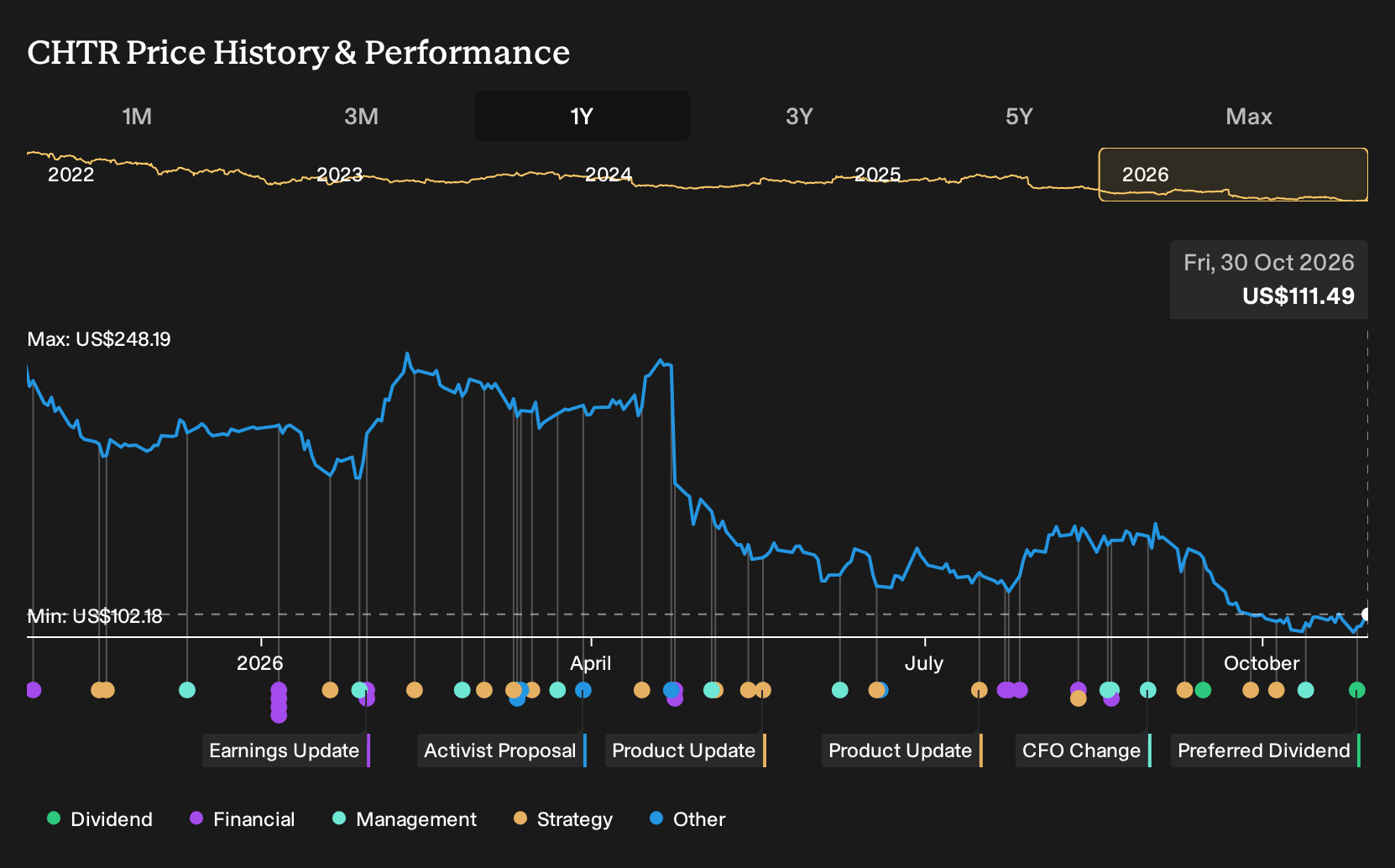
Exploring Other Perspectives
The lowest analysts focus on a different angle for Charter Communications. They worry that broadband pressure and higher costs could blunt free cash flow, even if Cox synergies arrive. Before this dividend news, they were pencilling in about US$66.5b revenue and US$5.3b earnings by 2029. That more cautious story is worth comparing with the baseline.
Explore 6 other Charter Communications fair value estimates, including one that suggests as much as 39% downside from the current price!
Decide For Yourself
Don't just follow the ticker; dig into the data and build a conviction that's truly your own.
- A great starting point for your Charter Communications research is our analysis highlighting 2 key rewards and 1 important warning sign that could impact your investment decision.
- See our latest analysis for Charter Communications. The report includes a comprehensive fundamental analysis summarized in a single visual, the Snowflake, making it easy to evaluate Charter Communications' overall financial health at a glance.
Looking For More Investment Ideas Beyond Charter Communications?
Once you have a view on Charter Communications, it can help to compare its setup with other opportunities that match your risk tolerance, income needs and return goals. The Simply Wall St Screener gives you a fast way to filter for businesses that fit a specific profile rather than scrolling through tickers at random.
- If capital protection matters most to you, focus on companies that pair steady fundamentals with fewer red flags by reviewing our 30 resilient stocks with low risk scores.
- For investors who prefer strong balance sheets and cleaner financial footing, sort for businesses with healthier leverage and coverage metrics through our list of solid balance sheet and fundamentals (25 results).
- If you are hunting for stocks the market may be overlooking, scan for quality enterprises that screen well on fundamentals yet fly under the radar using our 18 high quality undiscovered gems.
Have feedback on this article? Concerned about the content? Get in touch with us directly. Alternatively, email editorial-team@simplywallst.com