


EN
FieldOps Rollout Could Be A Game Changer For CNH Industrial Stock (CNH)
- CNH Industrial recently reported year over year revenue growth in Q2 2026 while continuing to invest in automation, autonomy, digital tools, alternative fuels and electrification, and is rolling out the FieldOps platform with integrated Raven technology across new machines.
- The company is also scaling its crop residue management programme in India to 25 locations across 11 states and has opened a dedicated parts warehouse in Ludhiana, which together point to tighter customer support, a sustainability focus and potentially lower downtime for farmers in a key growth market.
- This article examines how CNH Industrial's investment narrative is influenced by this mix of precision technology progress and expanded support in India.
Scan for other agriculture and automation plays moving on similar themes by checking the hand picked 96 robotics and automation stocks list of companies that are building precision tools and support systems for farmers.
CNH Industrial Investment Narrative Recap
To own CNH Industrial, you need to believe the precision ag and connectivity push can turn hardware sales into higher margin recurring tech and service revenue, while farmer spending remains tight. The latest Q2 2026 revenue growth and FieldOps rollout support that thesis, but profit margins at 1.7% and tariff pressure keep execution firmly in focus.
The key near term swing factor still looks like margin recovery from sourcing, manufacturing efficiency and dealer optimization. High leverage around 9x net debt to EBITDA and weaker profitability versus last year leave less room for shocks, so the fresh investments in autonomy, electrification and India need to translate into disciplined, cash generative growth.
The India crop residue management program is the news item that most clearly aligns with current catalysts. Scaling to 25 locations across 11 states, and handling 60,000 tonnes of paddy straw with avoided CO₂ emissions, highlights CNH Industrial’s focus on both product relevance and sustainability outcomes in a price sensitive, mechanizing farm base.
The new Ludhiana parts warehouse fits the same theme. Better spares availability and potentially lower downtime during harvest link directly to customer uptime, brand stickiness and replacement demand when cycles turn. For an investor watching CNH Industrial, both moves in India sit alongside FieldOps and autonomy as practical tests of whether the growth story can outrun credit, tariff and leverage risks.
CNH Industrial's current analyst script points to revenues of US$20.9b and earnings of US$1.5b by 2029, based on assumed 4.8% yearly top line growth. That profile implies earnings rising by about US$1.2b from US$311.0m today, a very large step up that investors need to weigh against the execution and leverage risks already on display in the core agriculture and construction franchises.
Discover why CNH Industrial's fair value indicates a 21% potential upside to its current price, which could narrow quickly.
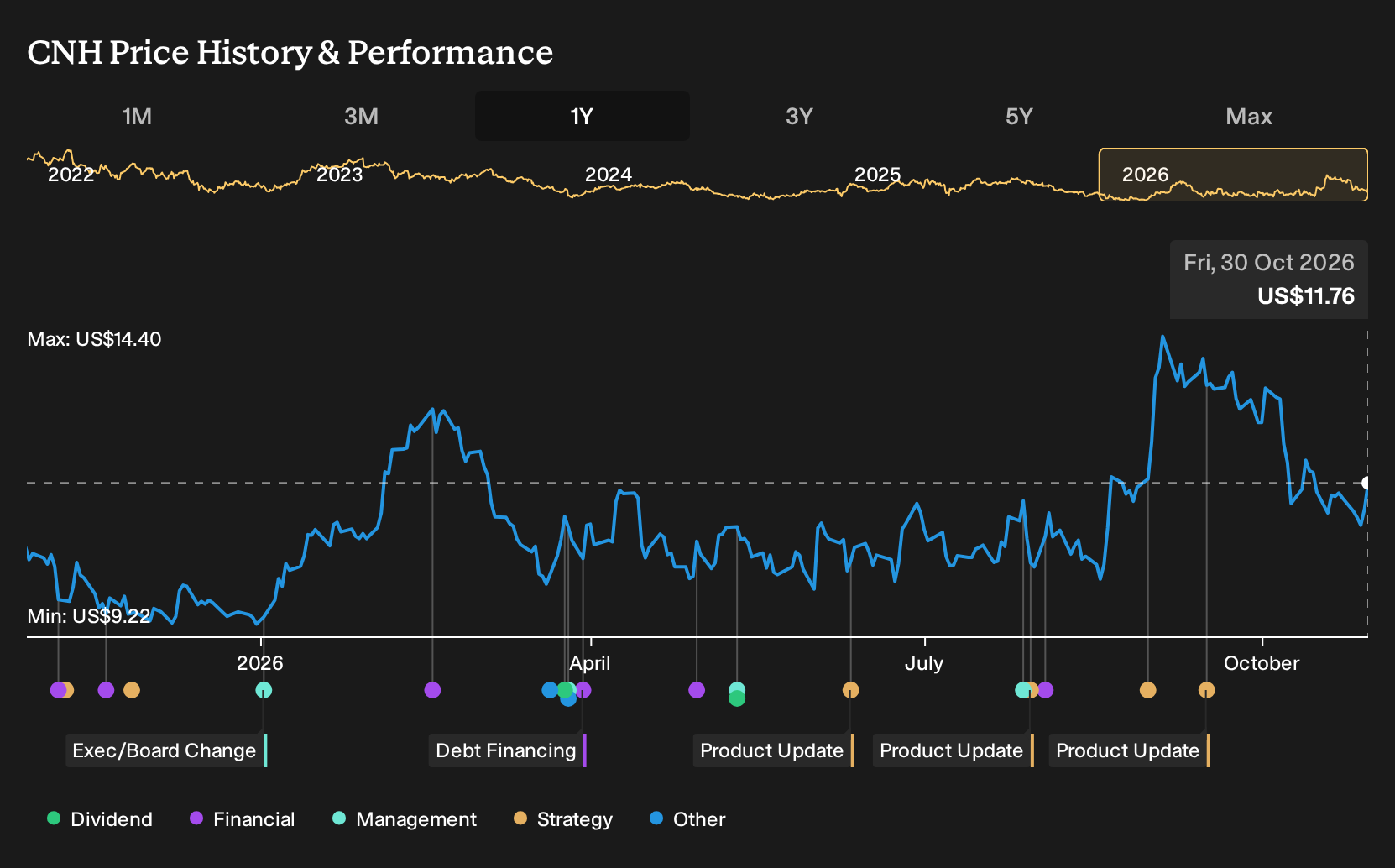
Exploring Other Perspectives
Some of the lowest CNH Industrial forecasts lean hard into leverage and margin risk, which sits in sharp contrast to the India progress you just read about. Those analysts were only pencilling in US$20.9b of revenue and about US$1.1b of earnings by 2029. Use that gap to test your own view, since this fresh news could easily reshape both narratives.
Explore 3 other CNH Industrial fair value estimates, including one that suggests as much as 23% downside from the current price.
The Verdict Is Yours
Don't just follow the ticker; dig into the data and build a conviction that's truly your own.
- A great starting point for your CNH Industrial research is our analysis highlighting 1 key reward and 2 important warning signs that could impact your investment decision.
- See our latest analysis for CNH Industrial. The report includes a comprehensive fundamental analysis summarized in a single visual, the Snowflake, making it easy to evaluate CNH Industrial's overall financial health at a glance.
Looking For More Investment Ideas Beyond CNH Industrial?
If CNH Industrial has sharpened your focus on where capital intensive sectors and real assets meet long term themes, you can use that momentum to scan a wider field of listed businesses with different risk and income profiles.
- For investors who want income to do more of the heavy lifting, check out 5 dividend fortresses to help anchor a portfolio in regular payouts while you weigh growth stories like CNH Industrial.
- If capital preservation and steadier balance sheets sit at the top of your checklist, start with a 30 resilient stocks with low risk scores to screen for companies with more resilient profiles than a highly geared machinery producer.
- When you are hunting for under followed stories before attention really builds, use a 18 high quality undiscovered gems to highlight companies with solid fundamentals that are not yet heavily owned.
Have feedback on this article? Concerned about the content? Get in touch with us directly. Alternatively, email editorial-team@simplywallst.com