


EN
How Reserve Charges Will Impact Everest Group Stock
- Everest Group is facing securities class action lawsuits tied to its U.S. casualty reserving while also reporting lower Q3 2026 revenue of US$3.7b and net income of US$233m.
- The insurer has added more than US$850m above actuarial central estimates to casualty reserves, signaling a clear focus on balance sheet strength over premium volume.
- In this article, we examine how Everest Group's investment narrative is affected by this substantial casualty reserve strengthening and the related legal scrutiny.
Everest Group Investment Narrative Recap
To stay invested in Everest Group, you need to be comfortable with a business that is consciously trading near term growth for balance sheet resilience. The central thesis is that pulling back from U.S. casualty, pushing reserves more than US$850m above actuarial central estimates, and leaning into short tail and specialty risks ultimately supports more predictable earnings.
The main near term swing factor is how casualty loss trends and reserve development affect reported results. Securities class actions around past disclosures add legal and reputational overhang, while weaker revenue in Q3 2026 illustrates execution risk if portfolio reshaping and Legacy runoff do not offset pressure on premium volume.
The Q3 2026 earnings release provides the clearest operational anchor for this legal story. Revenue of US$3.7b and net income of US$233m came alongside higher catastrophe losses and adverse prior year reserve development, as well as a deliberate decision to hold casualty reserves well above actuarial central estimates to limit future volatility.
This combination matters for potential catalysts because it shows Everest Group tightening risk appetite at the same time that lawsuits question prior reserving and exposure disclosures. Pulling back from casualty reinsurance, focusing on specialty and international lines, and continuing capital return plans all depend on a single condition: the reserving rebuild needs to stay ahead of emerging claims experience.
Everest Group's consensus narrative points to revenue of US$10.7b and earnings of US$2.4b by 2029, built on an assumed yearly revenue decline of 13.9% and an earnings increase of about US$500m from US$1.9b today.
Uncover why Everest Group's fair value aligns with its current price.
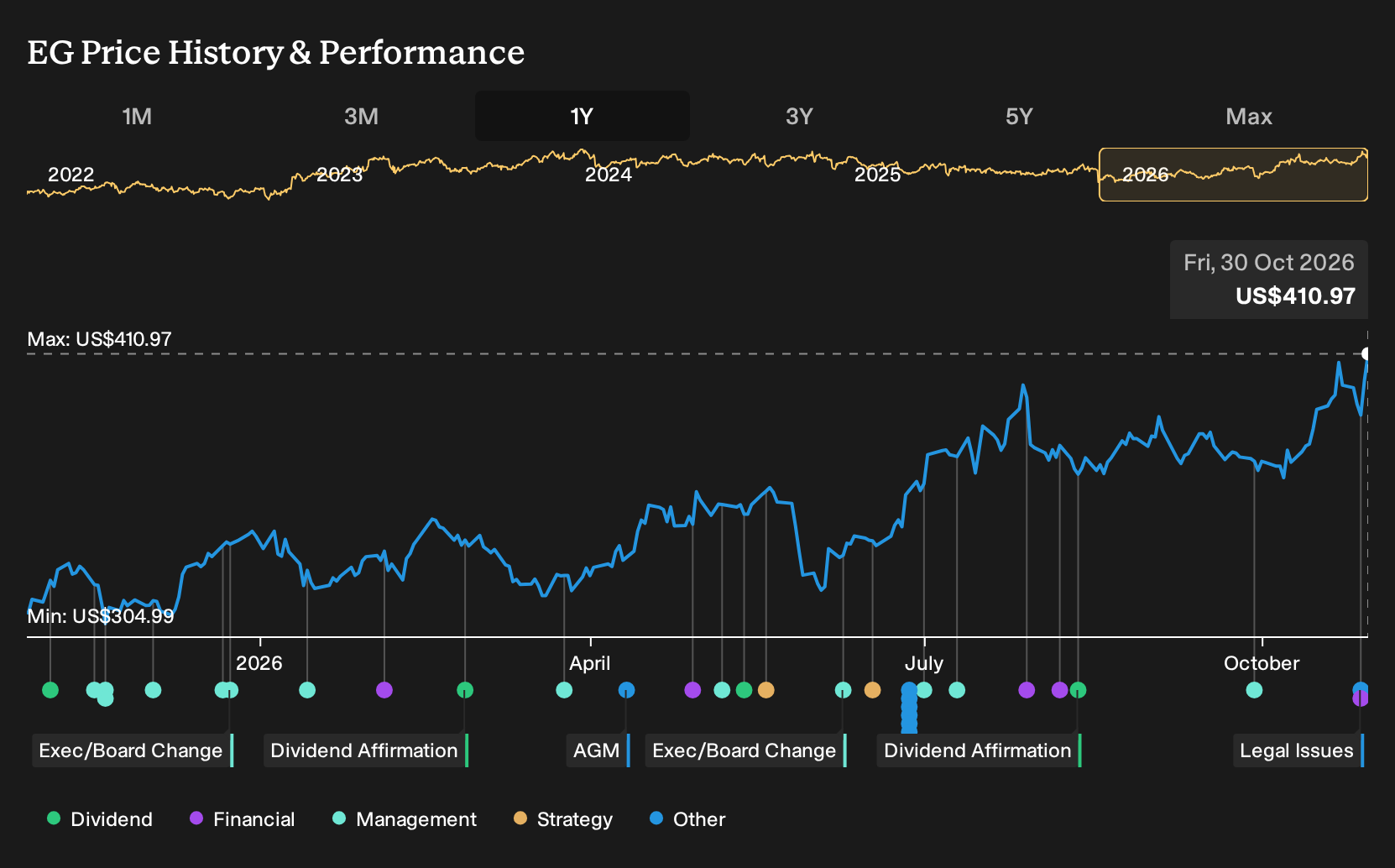
Exploring Other Perspectives
Four fair value estimates from the Simply Wall St Community stretch from about US$408 to roughly US$1,366 per share, so Everest Group looks wildly different depending on whose spreadsheet you read. Set that against securities class actions and casualty reserve uncertainty, and you get a reminder that opinions differ sharply. It may be useful to explore several viewpoints before deciding where you stand.
Explore 3 other Everest Group fair value estimates, including one that suggests it could be worth just $408.47.
Reach Your Own Conclusion
Don't just follow the ticker. Dig into the data and build a conviction that's truly your own.
- A great starting point for your Everest Group research is our analysis highlighting 5 key rewards that could impact your investment decision.
- See our latest analysis for Everest Group. The report includes a comprehensive fundamental analysis summarized in a single visual, the Snowflake, making it easy to evaluate Everest Group's overall financial health at a glance.
Looking For More Ideas Beyond Everest Group?
If the Everest Group story leaves you wanting a broader watchlist, use that curiosity to widen your opportunity set. The Simply Wall St Screener can help you quickly filter for different styles of companies so you are not relying on a single insurer or thesis.
- For investors who care most about financial resilience, start with a list of solid balance sheet and fundamentals (25 results) that keeps funding strength and debt profiles front and center.
- If you prefer potential mispricing opportunities, scan a 29 high quality undervalued stocks that narrows in on quality businesses trading below their assessed worth.
- Income focused readers can zero in on a 5 dividend fortresses that highlights companies offering higher yields with an emphasis on durability.
Have feedback on this article? Concerned about the content? Get in touch with us directly. Alternatively, email editorial-team@simplywallst.com