


EN
Did Strong Earnings Just Shift Union Pacific (UNP) Investment Narrative?
- Union Pacific reported third quarter 2026 revenue of US$7,197 million and net income of US$2,076 million, with diluted EPS from continuing operations of US$3.49, and affirmed high single digit reported EPS growth guidance for the full year.
- The combination of higher third quarter and nine month earnings per share versus a year earlier and management reaffirming full year EPS guidance highlights how Union Pacific is balancing cost pressures with ongoing demand across its freight network.
- Next comes a look at how Union Pacific's reaffirmed full year earnings guidance could reshape the investment narrative built before this update.
Scan how Union Pacific's reaffirmed earnings outlook compares across the rail and transport space by lining it up against 29 high quality undervalued stocks that appear positioned for stronger risk and reward trade offs.
Union Pacific Investment Narrative Recap
To own Union Pacific, you need to believe this railroad can keep squeezing more earnings out of its network despite higher fuel and wage bills and a heavy capital program. The reaffirmed high single digit EPS growth guidance indicates that management still sees enough pricing, productivity, and volume support to offset those headwinds, at least for now.
The near term swing factor remains execution on efficiency projects and intermodal volume. The biggest risk is cost inflation or fuel staying elevated without matching productivity gains. The fresh guidance does not remove that risk, but it does suggest no obvious near term crack in the operating story.
The most relevant update here is the third quarter and nine month 2026 earnings release. Revenue for the quarter was US$7,197 million, with net income of US$2,076 million and diluted EPS from continuing operations of US$3.49, compared with US$3.01 a year earlier. That context helps frame the guidance reaffirmation in hard numbers.
Across the first nine months, Union Pacific reported US$20,278 million of revenue and US$5,770 million of net income. That profile supports a view that efficiency work, intermodal focus, and ongoing capex are currently translating into higher earnings, while also highlighting that any shock to fuel costs, wages, or the proposed Norfolk Southern merger review remains important to track.
What The Union Pacific Forecasts Are Really Asking You To Believe
Union Pacific's analyst case leans heavily on a clear set of numbers rather than vague optimism. Forecasts point to revenue of US$29.9b and earnings of US$9.4b by 2029, with that profit figure tied to an earnings per share estimate of US$16.28 and an implied P/E multiple of 26.9x on those projected earnings.
To get there, the consensus view assumes Union Pacific can sustain 5.5% yearly revenue growth over the next three years and lift profit margins from 28.8% today to 31.4% in the same timeframe. That combination implies more than just volume support. It leans on cost discipline, rail pricing power, and follow through on efficiency initiatives across the network.
The earnings bridge is also explicit. Analysts see profits moving from US$7.3b today to US$9.4b by 2029, an increase of about US$2.1b. For you as an investor, the question is whether that step up in earnings, alongside modest share count growth of 0.15% a year, feels realistic in the face of fuel, wage and capex demands.
Valuation assumptions layer on top of that operational story. The current consensus price target of US$329.88, with a bullish end at US$375.00 and a cautious case at US$245.00, is built using an 8.5% discount rate and the idea that Union Pacific could trade on a 26.9x P/E in 2029. That multiple sits below the quoted 32.6x P/E for the wider US Transportation peer group in the same framework.
Union Pacific's narrative projects US$29.9b revenue and US$9.4b earnings by 2029. This requires 5.5% yearly revenue growth and an earnings increase of about US$2.1b from US$7.3b today.
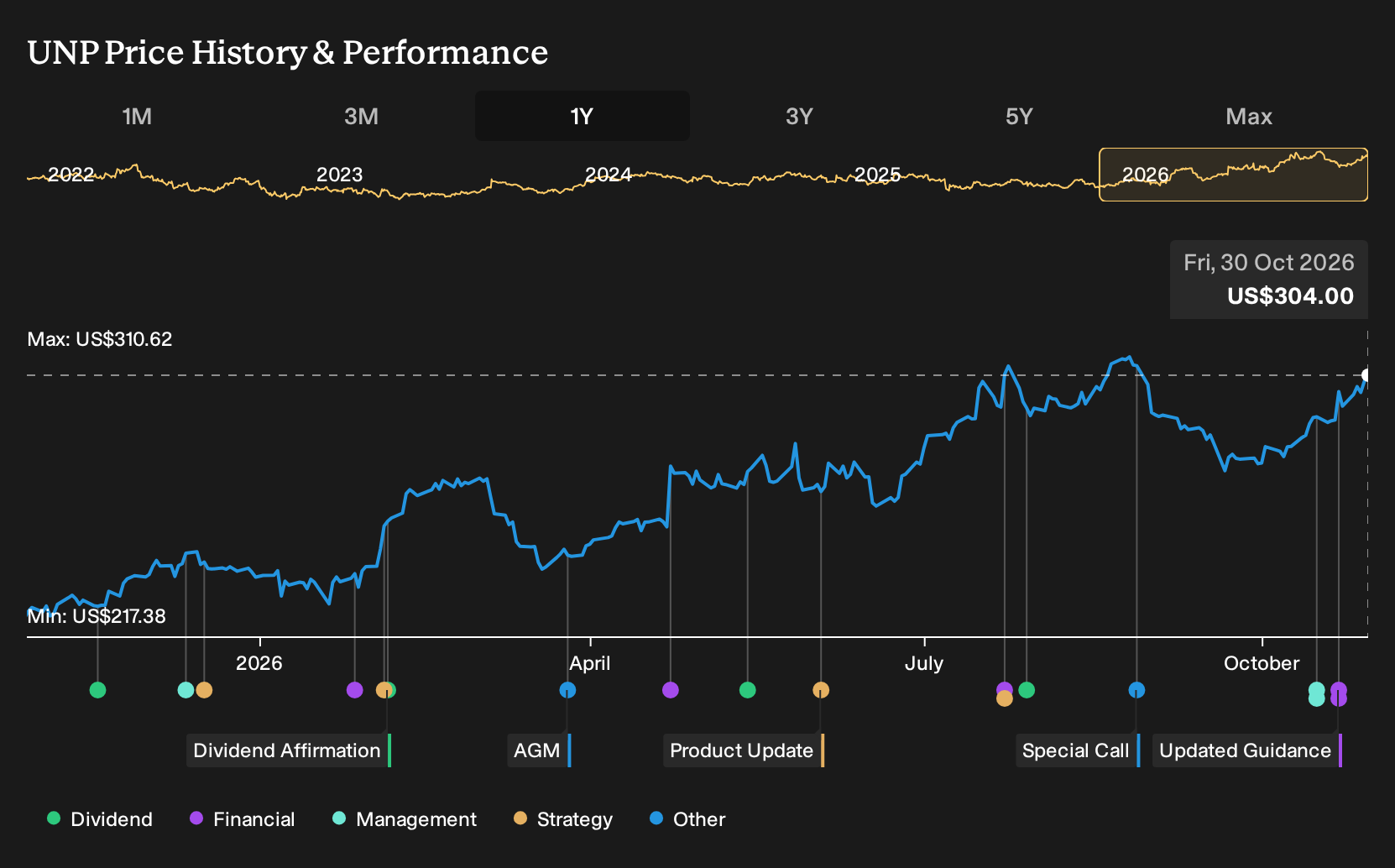
The gap between the current share price of US$269.63 and the US$329.88 consensus target, which is 18.3% higher, only holds if those revenue, margin and earnings assumptions stack up under your own scrutiny. Cross checking that story against your expectations for fuel costs, wage trends and the Norfolk Southern merger review helps you decide whether these projections feel conservative, demanding, or somewhere in the middle.
Uncover why Union Pacific's fair value indicates a 9% potential upside to its current price that may not last much longer.
Exploring Other Perspectives
Two fair value views from the Simply Wall St Community cluster between about US$258 and US$330, with one estimate effectively matching the current US$329.88 consensus target for Union Pacific. Those private forecasts sit beside rising fuel and wage costs, as well as the unresolved Norfolk Southern merger review, which together keep future earnings outcomes wide open. Explore several alternative viewpoints before leaning on any single scenario.
Explore another Union Pacific fair value estimate, including one that suggests there may be as much as 15% downside from the current price.
Reach Your Own Conclusion
Disagree with existing narratives? Extraordinary investment returns rarely come from following the herd, so go with your instincts.
- A great starting point for your Union Pacific research is our analysis highlighting 4 key rewards and 1 important warning sign that could impact your investment decision.
- See our latest analysis for Union Pacific. The report includes a comprehensive fundamental analysis summarized in a single visual, the Snowflake, making it easy to evaluate Union Pacific's overall financial health at a glance.
Looking For More Union Pacific Investment Ideas?
If Union Pacific has sharpened your view on freight and infrastructure, the next step is to stress test that thesis against other listed businesses. Use the Simply Wall St Screener to compare different balance sheets, dividend profiles, and valuation setups so you can see where Union Pacific fits in your wider watchlist.
- For investors who care most about resilient fundamentals and low financial strain, start with the list of solid balance sheet and fundamentals (25 results) to see which businesses pair strong finances with consistent operating profiles.
- If you want potential value on your side, line up Union Pacific against the 29 high quality undervalued stocks and see which stocks combine quality metrics with more modest pricing.
- Income focused readers can round out their research by scanning the 5 dividend fortresses to find higher yielding companies that might complement a position in Union Pacific.
Have feedback on this article? Concerned about the content? Get in touch with us directly. Alternatively, email editorial-team@simplywallst.com