


EN
Quarterly Earnings Outlook Could Be A Game Changer For Con Edison Stock (ED)
- Consolidated Edison is in focus after recent reports on a decade long billing error, a gas pipeline inspection fraud case tied to outside misconduct, and fresh forecasts for the latest quarter that point to earnings of $2.07 per share on revenue of $4.77b.
- The key thread is operational execution and oversight, covering grid billing accuracy, gas safety compliance, and how quarterly earnings align with expectations for a regulated utility investing heavily in infrastructure.
- We will now look at how Consolidated Edison's upcoming earnings expectations, including the US$2.07 EPS forecast, may reshape its investment narrative.
Consolidated Edison Investment Narrative Recap
To own Consolidated Edison, you need to be comfortable with a slow burn story. Regulated returns, heavy capital spending and tight oversight from New York regulators shape almost everything. The near term hinge is simple: execution on grid, gas and billing operations has to stay solid enough that regulators keep supporting future rate base growth and climate resiliency projects.
The recent billing error and gas inspection fraud sit squarely in that execution bucket. They appear operational and reputational rather than financial in scale. Unless similar issues prove widespread, the larger short term swing factor still appears to be how Con Edison manages reliability during stress events and controls costs on its large investment program.
The gas pipeline inspection fraud case is the most relevant event for that operational story. A contractor faked safety checks, which cost Con Edison more than US$60m and directly touches gas network integrity in Westchester and New York City. For a regulated utility, anything that raises questions about pipeline safety can influence future scrutiny of capital plans and reliability metrics.
For catalysts, the key question is whether this incident prompts tighter inspection processes and higher compliance spending. More rigorous oversight can support long term safety but could push operating costs higher in the near term. For a shareholder, the link to earnings expectations comes through any change in allowed cost recovery, potential penalties and how regulators weigh this track record in future rate cases.
What The Current Forecasts Assume For Consolidated Edison
Analysts sketch a fairly specific roadmap for Consolidated Edison. Their base case leans on revenue rising at about 3.5% a year over the next three years, with profit margins moving from 12.5% today to 14.2% by around 2029. On that view, earnings are projected to increase from US$2.2b now to US$2.8b by the 2029 financial year, which is a rise of roughly US$600m in total profit. That implies the US$2.07 EPS forecast for the upcoming quarter is just one checkpoint along a longer earnings path that analysts have already tried to model into the next rate cycle.
This playbook also bakes in modest dilution. The analyst set expects the share count to expand by about 2.46% per year for the next three years, which means any investor focusing only on earnings per share needs to remember the underlying business profits are being spread across more stock. In short, the consensus view on Consolidated Edison ties together three moving parts that matter directly to you as a shareholder: slower but steady revenue growth, slightly higher margins, and a gradual increase in shares outstanding.
The valuation overlay builds on those same inputs. To line up with the current analyst case, you would need to think Consolidated Edison can generate about US$19.6b of revenue and US$2.8b of earnings by 2029, and that the stock could be valued at roughly 18.9x those projected profits. That multiple would sit slightly below both the present P/E of 19.4x for the utility and the 20.9x figure quoted for the wider US integrated utilities group. In effect, the consensus assumes the stock keeps its regulated utility profile without needing a premium rating above sector peers.
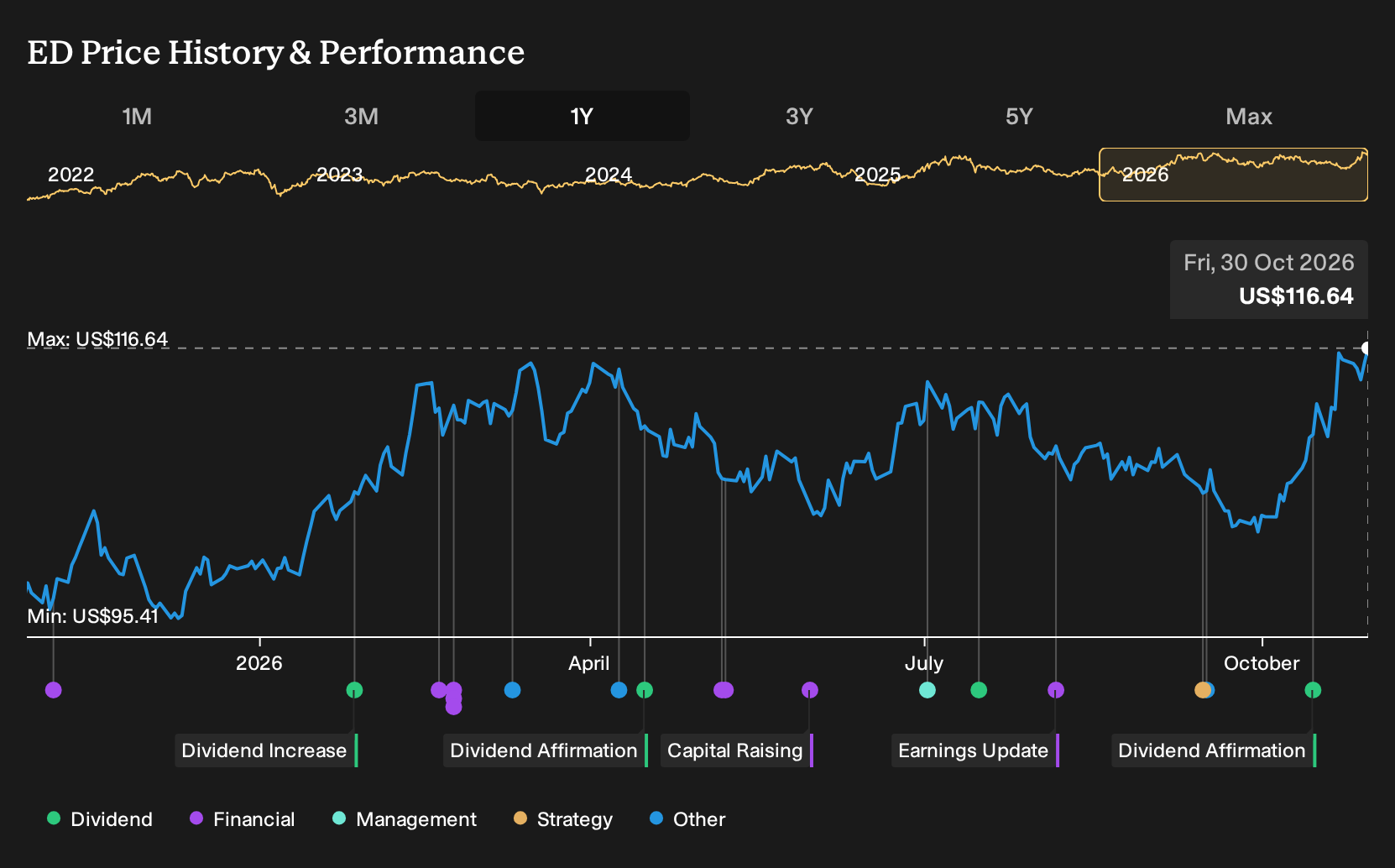
Pricing is where the story gets tight for new money. With Consolidated Edison at US$116.26 and the average analyst target at US$107.44, the Street is signaling that the shares trade about 8.2% above where their models land. Some analysts still see room on the upside, with targets up to US$130, while others mark it down at US$87. That spread underlines a simple point for you: the big disagreements are less about whether Consolidated Edison can execute a regulated grid plan and more about what investors should be willing to pay for that earnings stream by 2029.
Consolidated Edison's narrative projects US$19.6b revenue and US$2.8b earnings by 2029. This assumes 3.5% yearly revenue growth and an earnings increase of about US$600m from US$2.2b today.
Uncover why Consolidated Edison's fair value indicates an 8% potential downside to its current price, a premium that may not hold.
Exploring Other Perspectives
The Simply Wall St Community has only three fair value estimates for Consolidated Edison, all tightly grouped around US$107.4 to US$107.7, so retail opinion clusters near the current analyst average. You are still dealing with wide real world uncertainty, including billing oversight issues, gas inspection fraud fallout and future New York rate decisions.
Explore 2 other Consolidated Edison fair value estimates, including one that suggests it could be worth as much as $107.70.
Reach Your Own Conclusion
Disagree with existing narratives? Extraordinary investment returns rarely come from following the herd, so go with your instincts.
- A great starting point for your Consolidated Edison research is our analysis highlighting 3 key rewards and 2 important warning signs that could impact your investment decision.
- See our latest analysis for Consolidated Edison. The report includes a comprehensive fundamental analysis summarized in a single visual, the Snowflake, making it easy to evaluate Consolidated Edison's overall financial health at a glance.
Looking For More Investment Ideas Beyond Consolidated Edison?
If the Consolidated Edison story leaves you wanting a wider watchlist, the Simply Wall St Screener can help you build a line up that fits your own risk, income and quality preferences rather than relying on a single regulated utility.
- For investors who care most about resilience and capital preservation, start with a basket of 30 resilient stocks with low risk scores that score well on our risk filters and operate with sturdier fundamentals.
- If income is your priority, target payout strength by scanning 5 dividend fortresses that combine higher yields with a focus on durability.
- To widen the search for quality beyond the usual large caps, run through 18 high quality undiscovered gems that pair solid financial profiles with relatively low market attention.
Have feedback on this article? Concerned about the content? Get in touch with us directly. Alternatively, email editorial-team@simplywallst.com