


EN
Should Fleet Expansion Require Action From SFL (SFL) Investors?
- SFL Corporation reported that it previously agreed to acquire two 8,800 TEU container vessels for 2027 delivery and one dual fuel 93,000 cbm Very Large Ammonia Carrier for 2028 delivery, at a total cost of about US$365 million, all backed by multi year time charters adding roughly US$333 million to fixed rate backlog.
- The mix of long duration container contracts with purchase and profit share options, together with a dual fuel ammonia carrier on multi year charter, gives SFL a larger pipeline of contracted revenue while tilting capital spending toward lower emission cargo capacity.
- We will now see how SFL's investment narrative could be reshaped by this multi vessel expansion backed by long term charter coverage.
Scan other shipping and infrastructure plays that add long term contracted cash flow, starting with our curated list of list of solid balance sheet and fundamentals (25 results) that echo parts of the SFL story.
SFL Investment Narrative Recap
To own SFL, you need to believe the fleet renewal and long term charter model can keep turning contracted backlog into solid cash flows while the balance sheet carries sizeable debt and dividends. The new US$365 million vessel package fits that story by adding contracted revenue and more modern, lower emission tonnage without changing the basic thesis.
In the near term, the key swing factor is still how SFL funds remaining growth capex while interest coverage and dividend sustainability are live concerns. This announcement is sizeable but not a clear game changer for those risks. It slightly increases capital commitments and pushes more execution risk into 2027 to 2028.
The fresh order for two 8,800 TEU container ships and a dual fuel Very Large Ammonia Carrier ties directly into SFL's earlier push into modern, fuel efficient vessels fixed on multi year contracts. Minimum charter coverage of about US$333 million feeds into the existing multi billion dollar backlog and reinforces the focus on contract visibility with larger clients.
For catalysts, this move extends the same playbook that already includes LNG capable container ships, PCTCs and upgrades. The operational upside still hinges on SFL executing these builds on time and on budget while keeping funding costs under control. The main risk remains that high capex, interest obligations and dividends strain financial flexibility if charter conditions or financing terms become less favourable.
What The SFL Consensus Is Pricing In
SFL's current analyst storyline leans heavily on measurable targets rather than vague optimism. The consensus view ties the fleet expansion and charter coverage to specific revenue and earnings levels, along with clear assumptions about how quickly the top line grows and how profitability shifts over time.
Analysts are building their SFL models around revenue growth of 6.6% each year over the next three years, with profit margins moving from 9.0% today to 16.6% by 2029. On the earnings side, the same forecasts point to current profit of US$63.9 million rising to US$143.7 million by 2029. That implies earnings a little more than doubling, roughly a 2.2x step up from today's level, if the forecast is met.
SFL's narrative projects US$863.5 million revenue and US$143.7 million earnings by 2029. This assumes 6.6% yearly revenue growth and an earnings increase of about 2.2x from US$63.9 million today.
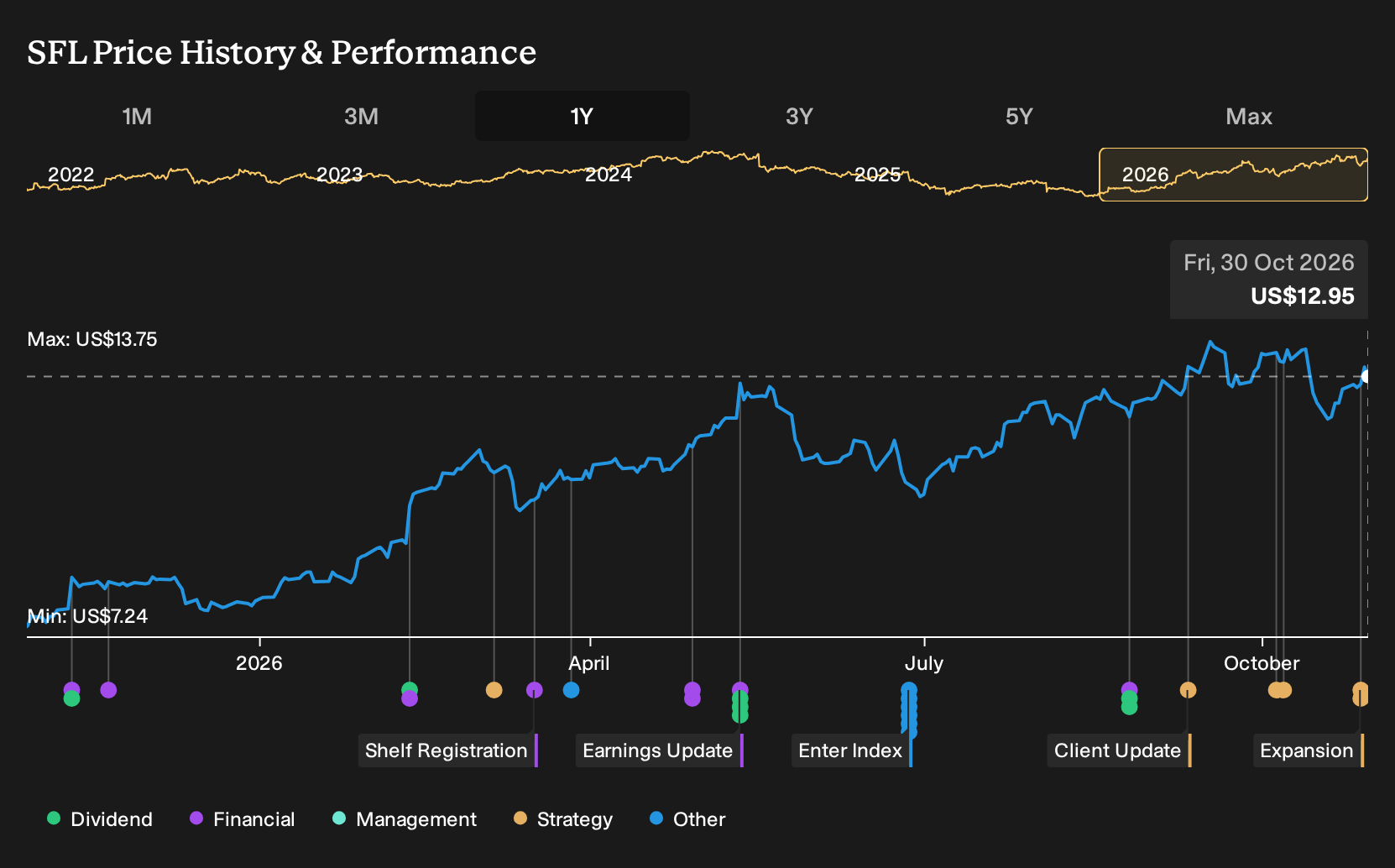
On valuation, the consensus anchor is a price target of US$13.17, very close to the late October 2026 share price of US$13.45. For that target to make sense, analysts are effectively asking readers to accept the 2029 scenario where SFL generates US$863.5 million of revenue and US$143.7 million of earnings and trades on a P/E of 17.8x. That multiple would be lower than the roughly 29.2x implied today, but still higher than the 12.3x currently ascribed to the wider US oil and gas peer group referenced in the report.
The gap between the market price and the consensus target is small at about 2.2%. That narrow spread suggests analysts on average see SFL as roughly in line with their fair value estimates rather than deeply mispriced. For readers, the more useful takeaway is the set of conditions that need to hold true. Revenue growth near 6.6% a year, margins climbing into the mid teens and earnings more than 2x higher by 2029 are the core moving parts behind the models.
Those metrics intersect directly with the vessel package just announced. The two 8,800 TEU container ships and the dual fuel Very Large Ammonia Carrier slot into that 2027 to 2028 capex and earnings bridge. If the new tonnage delivers on the contracted backlog and comes in on time and on budget, it helps close the gap between US$63.9 million of earnings today and the US$143.7 million that sit in the consensus spreadsheets. If funding costs rise or utilization disappoints, the same bridge starts to look stretched.
Uncover why SFL's fair value indicates a valuation gap that is approximately aligned with its current price.
Exploring Other Perspectives
Some of the most optimistic analysts frame this newbuild wave as a financing opportunity rather than a funding risk. Before this news, the bullish camp was already pencilling in revenue of about US$918.3 million and earnings of US$175.5 million by 2029. You can treat this expansion as a fresh test of that higher bar and explore how your own view compares.
Explore 4 other SFL fair value estimates, including one that suggests it could be worth as much as $13.17.
Decide For Yourself
Don't just follow the ticker; dig into the data and build a conviction that's truly your own.
- A great starting point for your SFL research is our analysis highlighting 2 key rewards and 2 important warning signs that could impact your investment decision.
- See our latest analysis for SFL. The report includes a comprehensive fundamental analysis summarized in a single visual, the Snowflake, making it easy to evaluate SFL's overall financial health at a glance.
Looking for more investment ideas beyond SFL?
If SFL has sharpened your focus on contracted cash flows and balance sheet strength, use that same checklist to look at other opportunities through the Simply Wall St Screener.
- For investors who want a clearer margin of safety, start with a curated pool of potential value ideas drawn from our 29 high quality undervalued stocks.
- If resilience and capital protection sit at the top of your checklist, narrow the field with a 30 resilient stocks with low risk scores that filters for sturdier financial profiles.
- When you want quality businesses that are not yet crowded trades, cast a wider net across the 18 high quality undiscovered gems and see which ones fit your framework.
Have feedback on this article? Concerned about the content? Get in touch with us directly. Alternatively, email editorial-team@simplywallst.com