


EN
3 Automation Stocks To Watch As Tariffs Reshape North American Supply Chains
Trade policy keeps throwing punches at global supply chains, and industrial automation sits close to the impact zone. Tariffs keep input costs uncertain, yet they also push manufacturers to rethink where and how work gets done. That mix of pressure and possibility is creating openings that some firms are better placed to exploit than others. This article walks through 3 stocks exposed to the tariff story and explains why each one could matter for your watchlist.
The three stocks covered below are just a sample set. The same screen surfaced 54 more North American automation and robotics companies with equally detailed stories that do not fit into a single article. To go straight to the source and identify your own highest conviction ideas, analyze the full Trade-Resilient North American Industrial Automation & Robotics screener.
IPG Photonics (IPGP)
Overview: IPG Photonics supplies industrial laser systems and laser based tools that power automated cutting, welding, and materials processing on factory lines.
Operations: The business generates about US$1.1b in revenue from Laser Systems and Components, with sales spread across China, North America, Europe, Japan, and other Asian markets.
Market Cap: US$3.2b
IPG Photonics matters for this automation screen because its fiber lasers effectively act as the cutting and welding muscles behind many reshoring ready production lines.
"IPG Photonics is shifting its Industrial Solutions mix toward higher value welding, cleaning, marking and additive systems. Emerging growth products already account for 58% of total revenue in Q2 2026, which can support higher average selling prices and improved gross margin over time."
The real question for investors is how that higher value mix interacts with one unresolved pressure that could sharply sway profitability.
That unresolved pressure is exactly where IPG Photonics becomes interesting for deeper research, so read the full narrative for IPG Photonics to see what might be masking or accelerating returns.

Novanta (NOVT)
Overview: Novanta builds motion, sensing, and photonics subsystems that sit inside industrial robots, factory automation platforms, and advanced medical devices.
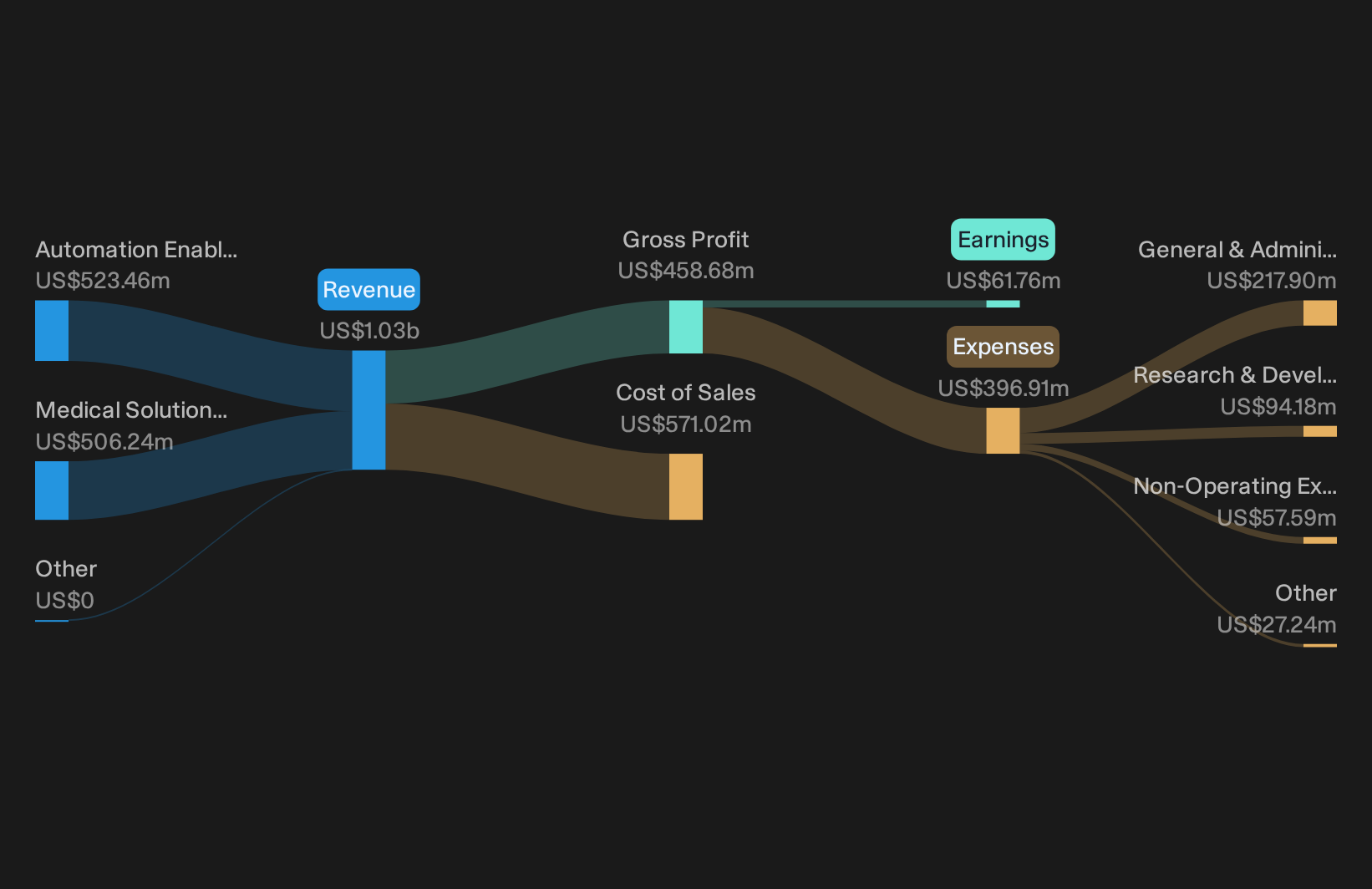
Operations: Novanta generates about US$523 million from Automation Enabling Technologies and roughly US$506 million from Medical Solutions, with around US$521 million coming from US customers.
Market Cap: US$5.7b
Novanta fits this trade resilient automation screen because its hardware sits inside the motion systems and robotic tools factories rely on when they regionalize production.
"Expansion of minimally invasive and robotic surgery, together with the Riverpoint Medical acquisition that roughly doubles recurring medical consumables revenue to about US$300 million and lifts medical exposure to around 60% of sales, increases Novanta's mix of repeat consumables that can support more resilient revenue and gross margin over time."
The real tension for investors is what happens to that margin story if a single key assumption on cost discipline or pricing power breaks.
If that assumption feels fragile, read the full narrative for Novanta to see how Novanta’s recurring consumables, automation exposure and tariff risks interact.
Symbotic (SYM)
Overview: Symbotic builds automated robotics and software systems that move pallets, cases, and items in large warehouses to support resilient supply chains.
Operations: Symbotic generates about US$2.6b from Industrial Automation & Controls, with roughly US$2.5b from the United States and about US$170 million from international customers.
Market Cap: US$22.6b
Symbotic matters for this tariff focused automation screen because its warehouse robots and AI software sit directly in the path of retailers and distributors trying to keep goods flowing despite higher trade friction and shifting cross border logistics patterns.
"While management is investing heavily to evolve Symbotic into an AI driven warehouse operating system with added software layers and acquired technologies, integrating Fox Robotics, ARMS, and cellumation into a cohesive platform could take longer or cost more than expected. This may cap software mix expansion and limit the uplift to gross margin and net margin."
The piece investors have to weigh is what happens to Symbotic’s profitability story if a single key assumption about that platform shift breaks.
When that profitability story matters for your thesis, read the full narrative for Symbotic to see whether Symbotic’s warehouse OS push is accelerating or quietly stalling.

Seeking Fresh Alternatives Before They Fly
Fresh ideas move first, and the early momentum often goes to investors who spot quiet breakouts before the crowd. Do not get caught reacting after prices start flying, act now.
- Hunt for overlooked quality by scanning a curated 18 high quality undiscovered gems that have strong balance sheets and fundamentals while they are still under the radar for now.
- Ride structural momentum in automation by checking a focused 97 robotics and automation stocks that captures businesses building long term warehouse, factory, and logistics solutions before attention surges.
- Target resilient cash generators by reviewing a pre filtered 30 resilient stocks with low risk scores that aim to pair lower risk scores with steady operations before the window tightens.
Have feedback on this article? Concerned about the content? Get in touch with us directly. Alternatively, email editorial-team@simplywallst.com