


EN
Did Quarterly Sales Growth Just Shift Woolworths Group's (ASX:WOW) Investment Narrative?
- Woolworths Group reported first quarter sales of A$19,353 million for the period to 4 October 2026, compared with A$18,483 million a year earlier, with group e-commerce sales at A$3.1 billion.
- The quarter highlighted how customer engagement tools such as the Disney Ooshies collectibles campaign can support Woolworths Group sales alongside growing online demand.
- We will now look at how Woolworths Group's investment narrative aligns with this quarter's reported sales and e-commerce contribution.
Woolworths Group Investment Narrative Recap
To own Woolworths Group, you need to believe its mix of supermarket scale, e-commerce capability and loyalty data can keep customers choosing its stores and apps first, even as value competition and regulation stay tight. The latest quarter, with A$19,353 million in sales and A$3.1b from online, supports that basic thesis without radically changing it.
The key near term swing factor is whether cost efficiencies from automation and AI can keep offsetting value programs and pricing rules that pressure gross margins. The biggest risk still sits in operating costs and fuel sensitive logistics. This sales update is more a confirmation of current execution than a new catalyst.
The most relevant update is the first quarter sales report to 4 October 2026. Group sales reached A$19,353 million compared with A$18,483 million a year earlier, while e-commerce contributed A$3.1b. For you as a shareholder, the interest is less the headline number and more the mix between stores, online and complementary businesses.
That online figure links directly to Woolworths Group catalysts around scaling e-commerce and lifting fulfilment productivity. Stronger digital volumes can help absorb the fixed costs of automated distribution and AI driven picking, which analysts see as important for EBIT margins. The operational watchpoint is whether higher logistics and fuel expenses erode those efficiency gains over time.
Woolworths Group Forecasts and Analyst Assumptions
Analysts frame Woolworths Group's current quarter against a longer revenue and profit roadmap. They model annual top line expansion of 4.3% over the next three years, with profit margins moving from 1.6% today to 2.7% by around 2029. In earnings terms, the consensus view points to A$1.1 billion today and A$2.2 billion by October 2029, which would roughly double the profit pool that supports dividends, reinvestment and debt service.
That projected lift in profitability sits alongside expectations for a very modest decline in the share count, with analysts assuming the number of shares outstanding falls by about 0.19% each year for the next three years. The analysis also relies on a discount rate of 7.33% to pull those future cash flows back into today's money. This matters because even strong earnings potential can look less appealing if investors demand a higher hurdle rate. For Woolworths Group, the numbers only fully add up for analysts if the stock trades on a P/E of 27.2x by 2029, compared with 44.1x today and against an AU Consumer Retailing sector level of 36.7x.
That future multiple is more than just a statistic. It reflects an implied step down from today's valuation premium while still baking in confidence that earnings in 2029 are achievable. For you as an investor, the question is whether a business with forecast A$2.2 billion of profit and higher margins deserves a P/E that is below the current sector level yet still materially above many slower growing retailers. Your personal answer to that question shapes how you treat short term sales updates like this quarter's and how much weight you give to the longer horizon narrative built into these models.
On the revenue side, consensus expectations call for Woolworths Group to reach around A$81.2 billion of sales by 2029, at the same time as earnings are forecast at A$2.2 billion. These headline targets link back directly to the operational story in the latest quarter. Higher e-commerce volumes, collectibles driven engagement and automation benefits in logistics all feed into the argument that a larger revenue base can support a thicker margin structure than the 1.6% in place today.
Earnings forecasts also interact closely with cost and regulation risks flagged in the short term commentary. If fuel and logistics inflation bite harder than expected, or new pricing rules constrain Woolworths Group's ability to recover supplier cost increases, then that path to 2.7% margins becomes harder to reach. On the other hand, successful deployment of AI tools and automated warehouses that raise productivity on each A$ of sales would help the business move toward the A$2.2 billion profit mark discussed in the analyst work.
These assumptions do not guarantee any outcome. They do, however, give you a clear set of pressure points to watch in future trading updates. For this quarter's sales line and A$3.1b of digital revenue to matter to your investment case, they need to be read alongside the longer term expectations for revenue growth, margin shifts and the P/E multiple that analysts think could apply by 2029.
Woolworths Group's narrative projects A$81.2 billion revenue and A$2.2 billion earnings by 2029. This requires 4.3% yearly revenue growth and about a 2x earnings increase from A$1.1 billion today.
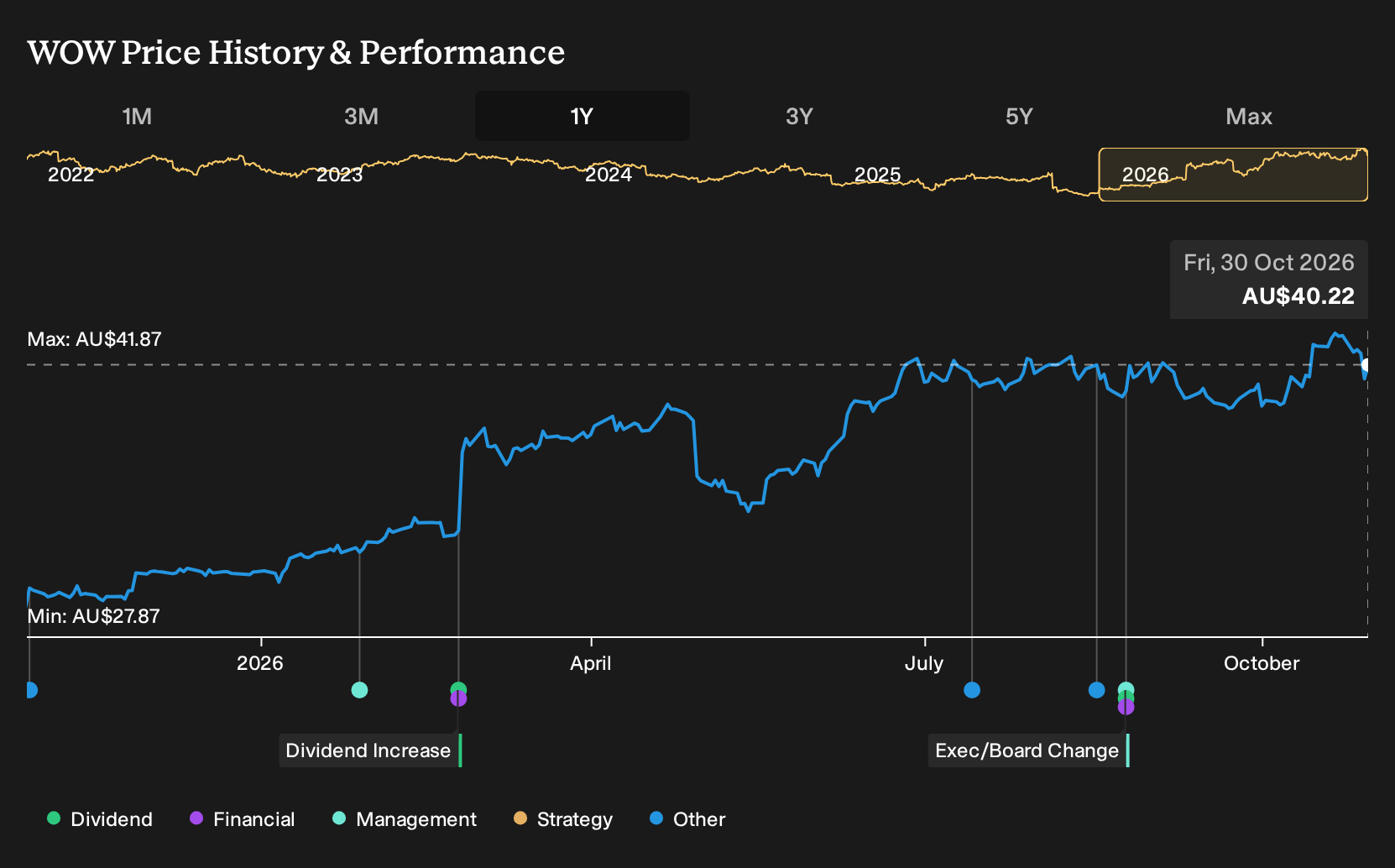
Uncover why Woolworths Group's fair value indicates Woolworths Group is roughly in line with its current price.
Exploring Other Perspectives
Three fair value estimates from the Simply Wall St Community span roughly A$39 to A$60, which suggests some investors see Woolworths Group as heavily mispriced while others are more cautious. Set that against margin risks from pricing rules, fuel and logistics costs, and the potential uplift from AI, e-commerce and Moorebank efficiencies. Opinions can differ widely, so it pays to weigh several of these community viewpoints yourself.
Explore 2 other Woolworths Group fair value estimates, including one that indicates there could be as much as 50% potential upside from the current price.
Decide For Yourself
Disagree with existing narratives? Extraordinary investment returns rarely come from following the herd, so trust your own analysis.
- A great starting point for your Woolworths Group research is our analysis highlighting 3 key rewards and 1 important warning sign that could impact your investment decision.
- See our latest analysis for Woolworths Group. The report includes a comprehensive fundamental analysis summarized in a single visual, the Snowflake, making it easy to evaluate Woolworths Group's overall financial health at a glance.
Looking for more investment ideas beyond Woolworths Group?
If the Woolworths Group story has sharpened your view on what you want from a retail stock, take that same lens to a wider watchlist. The Simply Wall St Screener can help you quickly filter for businesses that match your own priorities on value, resilience and income.
- If capital preservation is top of mind, start with companies that pair steady operations with measured risk and review our 6 resilient stocks with low risk scores for ideas that fit that profile.
- If you prefer to focus on price and fundamentals, look through the 1 high quality undervalued stocks to see candidates where current expectations are lower than the underlying financial strength suggests.
- If balance sheet strength is your anchor, filter for companies with robust finances and study the list of solid balance sheet and fundamentals (12 results) as a base for your next round of research.
Have feedback on this article? Concerned about the content? Get in touch with us directly. Alternatively, email editorial-team@simplywallst.com