


EN
How Strong Q3 Earnings Will Impact Imperial Oil Stock Investors
- Imperial Oil reported third quarter 2026 sales of C$16,205 million and net income of C$2,454 million, with basic EPS from continuing operations of C$5.13, all above the prior year period.
- The nine month figures, including C$44,713 million in sales and C$5,584 million in net income, show how the integrated model converted refining and production conditions into earnings.
- The focus now turns to how Imperial Oil’s sharp third quarter earnings increase could influence the existing investment narrative around cost and cash generation.
Scan other energy players showing similar earnings power and balance sheet resilience by reviewing our hand picked list of solid balance sheet and fundamentals (6 results) alongside Imperial Oil’s latest numbers.
Imperial Oil Investment Narrative Recap
To own Imperial Oil, you have to believe the integrated model can keep turning upstream production and downstream refining into consistent cash, even when commodity conditions move around. The Q3 2026 results, with higher sales and net income versus a year ago, point to strong execution on that thesis in the near term.
The key short term swing factor remains operating efficiency at oil sands sites like Kearl and Cold Lake. Cost performance at these assets can support margins if pricing softens. The biggest risk is still external, with the potential for faster tightening of decarbonization rules that could pressure emissions intensive assets and future capital allocation.
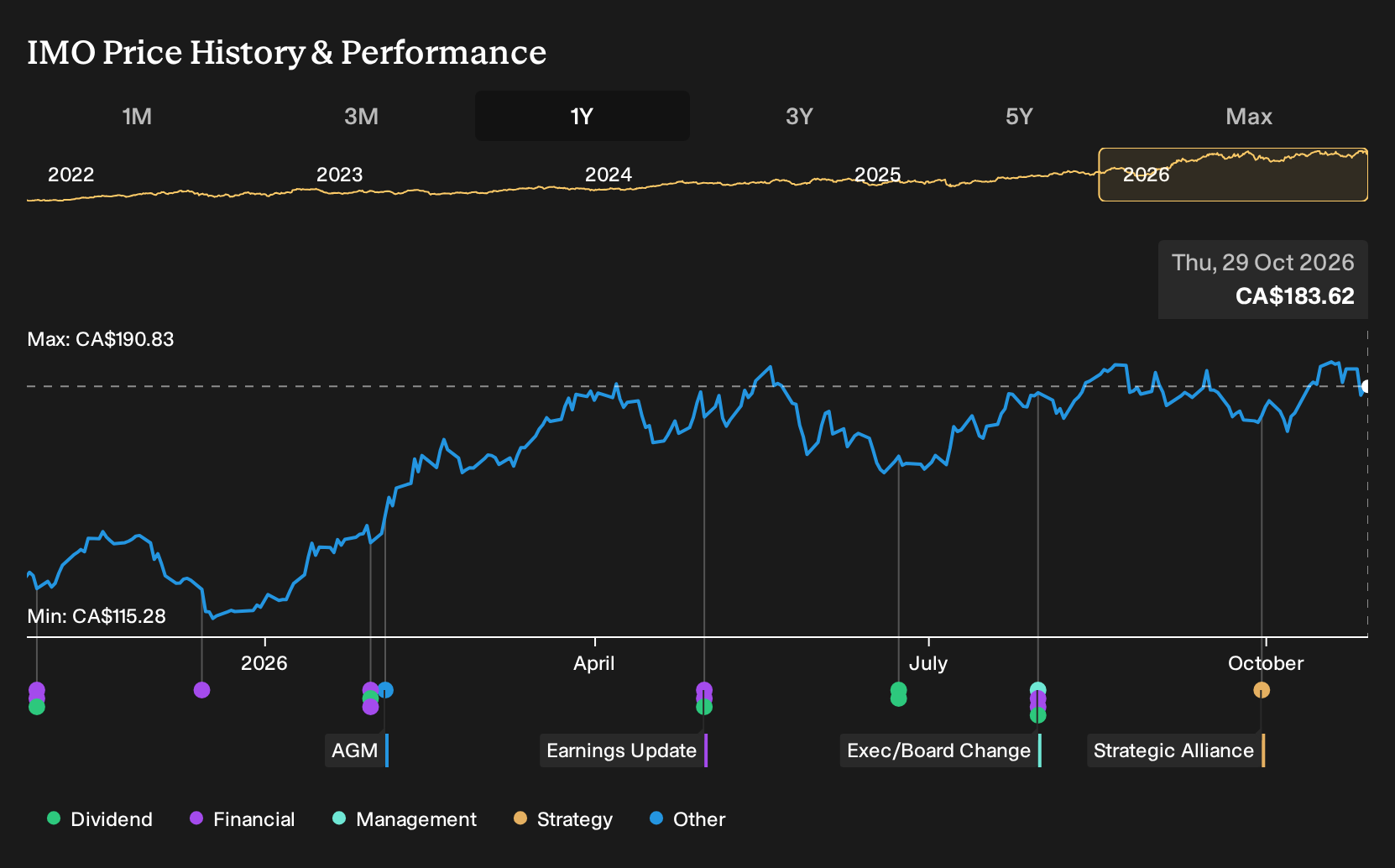
The most relevant recent marker is the Q3 2026 earnings release itself. Imperial Oil booked C$16,205 million of sales and C$2,454 million of net income for the quarter, with basic EPS from continuing operations of C$5.13. Nine month sales reached C$44,713 million and net income was C$5,584 million, reflecting the benefit of the integrated structure.
For catalysts, investors now have fresh numbers to measure against plans for lower unit costs at Kearl, solvent assisted volumes at Cold Lake, and the multi year restructuring program that targets leaner overhead. On the risk side, the strong profit print does not remove exposure to higher sustaining capital needs or the possibility that tighter emissions policy could raise long term compliance costs.
Imperial Oil Consensus Forecasts And Valuation Setup
Imperial Oil now sits under a fairly clear analyst framework. The story links modest revenue growth, slightly wider margins and steady buybacks into a single earnings path that investors can test for themselves.
On the top line, analysts are working with revenue expanding by 1.1% a year over the next three years. That is a low gear assumption rather than a high growth call, which keeps the focus on execution at the asset and cost level rather than on big volume bets.
Earnings today are pegged at about C$4.2b, with consensus pointing to C$5.0b by 2029 and a more optimistic camp looking for up to C$5.6b. That implies an increase of roughly C$0.8b from the current base to the core consensus figure, driven more by margin work than by significant sales growth.
Analysts also expect profit margins to move from 8.1% to 9.4% over the next three years. If Imperial Oil can keep trimming unit costs and overhead while holding throughput steady, that extra margin would do a lot of the work for earnings, even with only small revenue gains.
Share count is expected to shrink by about 2.67% per year over the next three years. For investors, that means any earnings growth does not need to be large in order to translate into higher earnings per share, provided buybacks and profits move in tandem.
The framework uses a discount rate of 6.44% in the Simply Wall St workup and assumes Imperial Oil trades on a P/E of 17.8x in 2029, compared with 21.5x today and 21.6x for the broader Canadian oil and gas group. The analysts are incorporating business improvement but also a lower valuation multiple than both the stock today and the sector snapshot.
Imperial Oil's narrative projects C$53.3b revenue and C$5.0b earnings by 2029. This setup leans on 1.1% yearly revenue growth and an earnings increase of about C$0.8b from roughly C$4.2b today.
Uncover how Imperial Oil's fair value indicates a 10% potential downside to its current price, which leaves little room for error.
Exploring Other Perspectives
One alternate view leans hard into Imperial Oil’s buyback story. The most optimistic analysts were pencilling in C$76.1b of revenue and C$5.6b of earnings by 2029 before this Q3 release. That group treats aggressive share repurchases as a key catalyst. You can compare that outlook with the new numbers and decide which perspective you lean toward.
Explore 3 other Imperial Oil fair value estimates, including one that suggests potential upside of as much as 53% from the current price.
Reach Your Own Conclusion
Don't just follow the ticker. Dig into the data and build a conviction that's truly your own.
- A great starting point for your Imperial Oil research is our analysis highlighting 2 key rewards and 1 important warning sign that could impact your investment decision.
- See our latest analysis for Imperial Oil. The report includes a comprehensive fundamental analysis summarized in a single visual, the Snowflake, making it easy to evaluate Imperial Oil's overall financial health at a glance.
Looking For More Investment Ideas Beyond Imperial Oil?
If you want to stress test your thesis on Imperial Oil, it helps to compare it with other businesses that have different balance sheet strength, income profiles and risk levels. The Simply Wall St Screener lets you scan for stocks that fit specific filters so you can build a wider watchlist that matches your goals.
- For investors who care most about financial resilience and clean balance sheets, start with a hand picked list of solid balance sheet and fundamentals (6 results) that share strong fundamentals.
- If value is your priority and you are hunting for quality at a reasonable price, take a look at 4 high quality undervalued stocks that combine solid cash generation with attractive metrics.
- For those who want to broaden their watchlist with less volatile candidates, consider scanning 8 resilient stocks with low risk scores screened for more measured risk profiles.
Have feedback on this article? Concerned about the content? Get in touch with us directly. Alternatively, email editorial-team@simplywallst.com