


EN
If the AI Bubble Scare Gets Worse, This Is the Chip Stock I'd Still Hold
Key Points
TSM manufactures advanced chips for all of the biggest chip designers, giving investors broad exposure to the sector.
On the company's Oct. 15 earnings call, management highlighted growing demand from agentic AI and the wider adoption of open-source AI models.
Analysts' average price target for the stock points to 23% gains over the next year, but its high price-to-earnings ratio and Taiwan-based production are both risk factors for investors.
As the market's fears of an artificial intelligence (AI) bubble grow, investors would be well advised to focus on companies that have real earnings, durable competitive advantages, and exposure to long-term demand. Taiwan Semiconductor Manufacturing (NYSE: TSM) stands out for its dominance in chip manufacturing, making it one of the strongest stocks to hold even if the AI hype fades.
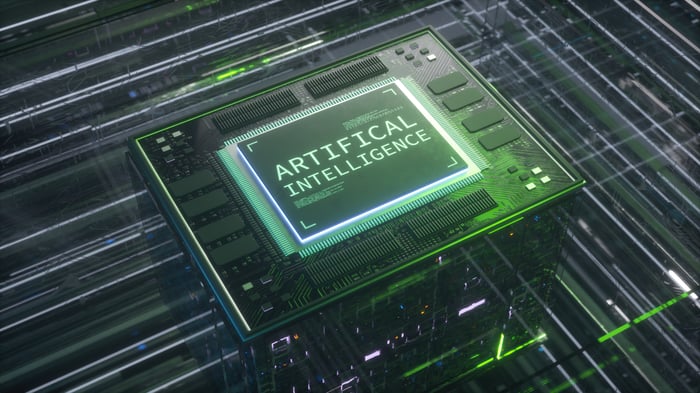
Image source: Getty Images.
Missed AI’s "Act 1"? Act 2 Could Be 15x Bigger. Most investors think they missed the AI boat because they didn't buy Nvidia in 2005. But according to our analysts, we’re only at the end of "Act 1"—the R&D phase. "Act 2" is the global rollout. Continue »
TSM gives investors AI exposure without tying them to one chip designer
Chipmakers like Nvidia and AMD continue to design processors capable of handling ever more demanding computing workloads. What most of the designers don't do is manufacture them in-house. Churning out high-end chips at scale requires specialized technology, expertise, and foundries that are neither cheap nor easy to build.
That's where Taiwan Semiconductor Manufacturing comes in.
TSM runs the world's largest third-party foundry business, manufacturing chips designed by its customers for use not only in AI, but also in smartphones and other electronics.
It's one of the few that has the technological capability to produce the advanced, transistor-dense chips that power the AI industry, so essentially all of the leading designers make use of its services. As a result, TSM's success is not tied to the success of any single AI application or chip designer.
This business model gives TSM shareholders broad exposure to the AI race, and spares them from having to predict which chip designers will emerge as its biggest winners. That advantage will matter even more if and when investor sentiment toward the sector turns sour.
Even if the market begins to question the valuations of individual AI stocks, demand for chip manufacturing could remain strong as businesses continue to develop and deploy compute-heavy technologies.
That said, TSM would not be immune to an AI sector downturn. If data center customers and other chip-using businesses cut their spending or delay orders, the foundry giant could feel the effects. TSM also faces geopolitical risks because its manufacturing base is concentrated in Taiwan, where a conflict with China could disrupt production.
The opportunity extends beyond Nvidia's GPUs
Graphics processing units (GPUs) are essential to training and running AI models. But as AI systems become more advanced, demand for compute power is spreading across several chip categories. Agentic AI workloads, for example, require data centers to have a larger proportion of central processing units (CPUs). And hyperscalers are also designing and deploying larger numbers of application-specific integrated circuits (ASICs) that are custom-built to handle their AI workloads.
TSM is well positioned to benefit from this diversifying demand because it manufactures all of those types of chips.
If AI adoption continues to expand into enterprise software, consumer devices, and other applications, chip demand could remain healthy even if investor sentiment toward top AI companies weakens. TSM doesn't need every AI application to succeed; it just needs enough customers to keep investing in advanced chips.
Its next-generation manufacturing technology creates further growth opportunities
Beyond the chips themselves, TSM is also investing heavily in its manufacturing technology.
It began volume production using its 2-nanometer (2nm) process node in the fourth quarter of 2025. But the company continues to improve its manufacturing technology, with volume production for its N2P and A16 nodes ramping up in the second half of 2026. Its longer-term roadmap includes the even more powerful A14 process node, which is expected to enter volume production in 2028.
These steady advancements are important because AI developers demand chips that can deliver more compute without letting power consumption and operating costs spiral out of control.
For investors worried about how long the AI boom can last, TSM's roadmap offers a reason to look beyond short-term sentiment. The company is investing in manufacturing capabilities to support future generations of advanced chips, rather than relying on a single product cycle, which makes TSM much more resilient to cracks in the AI bubble.
But how do analysts and the valuation view the stock?
What analysts and valuation say about investing in TSM
Wall Street remains bullish on TSM: Among 19 analysts covering the stock, 16 rate it a strong buy, two a buy, and just one a hold. Their average price target, meanwhile, suggests 23% potential upside over the next year. And based on its current price-to-earnings (P/E) ratio of over 27, investors are expecting AI-driven chip demand to continue fueling growth.
The company's manufacturing expertise and strong position in the AI supply chain give it a compelling long-term bull case. With that, TSM may be one of the strongest ways to invest in AI, even if fears that the sector is in a bubble intensify.
Rick Orford has no position in any of the stocks mentioned. The Motley Fool has positions in and recommends Advanced Micro Devices, Nvidia, and Taiwan Semiconductor Manufacturing. The Motley Fool has a disclosure policy.