


EN
Net profit increased by more than 30% in a single quarter, and CGN Power's (01816) performance market value may enter an “upward channel”
A three-quarter report that exceeded expectations is pushing CGN Power (01816), a leading nuclear power company, from a “defensive bottom” to a “trend leader.”
The Zhitong Finance App learned that on October 28, CGN Electric Power released its 2026 three-quarter report. Operating revenue and shareholders' net profit for the first three quarters were 51,098 billion yuan and 9.603 billion yuan, up 3.98% and 12.75%, respectively. Among them, the third quarter's performance was even stronger, with operating income and net shareholders' profit of 19.615 billion yuan and 3.498 billion yuan, exceeding market expectations, with year-on-year increases of 16.99% and 36.08%, respectively.
Driven by favorable performance, the company's stock price opened higher the next day. At one point, H shares rose more than 6%, and A shares rose more than 7% in the intraday period. At the close of trading, AH stock prices closed up 7.22% and 3.48% respectively. Furthermore, the company's H share price has been rising for four consecutive years, with a cumulative increase of more than 135%.
In fact, in 2026, AI computing power will push global electricity demand to a new level. The International Energy Agency (IEA) predicts in its “Energy and AI” report that global data center electricity consumption will double to about 945 billion kilowatt-hours by 2030, slightly exceeding the electricity consumption of Japan; China's data center electricity consumption will rise from about 400 billion kilowatt-hours in 2024 to more than 600 billion kilowatt-hours in 2026, accounting for nearly 6% of the entire society's electricity consumption.
Electricity has been pushed from backstage “utilities” to the front of computing power infrastructure, and can CGN Power continue the bullish trend with a quarterly increase in growth rate?
Revenue and profit both increased, and profit in a single quarter accelerated
In terms of quarterly results, CGN Power's Q1, Q2 and Q3 revenue increased by -13.25%, 11.8%, and 16.99%, respectively. Performance growth resumed in the second quarter, while profits also grew at the same time, and profit margins continued to rise. In the first three quarters of 2025, the net shareholder interest rate was 18.79%. Shareholder returns also showed a quarterly upward trend, but due to the low overall level of return on heavy asset investment, the annualized ROE for the first three quarters was 6.63%.
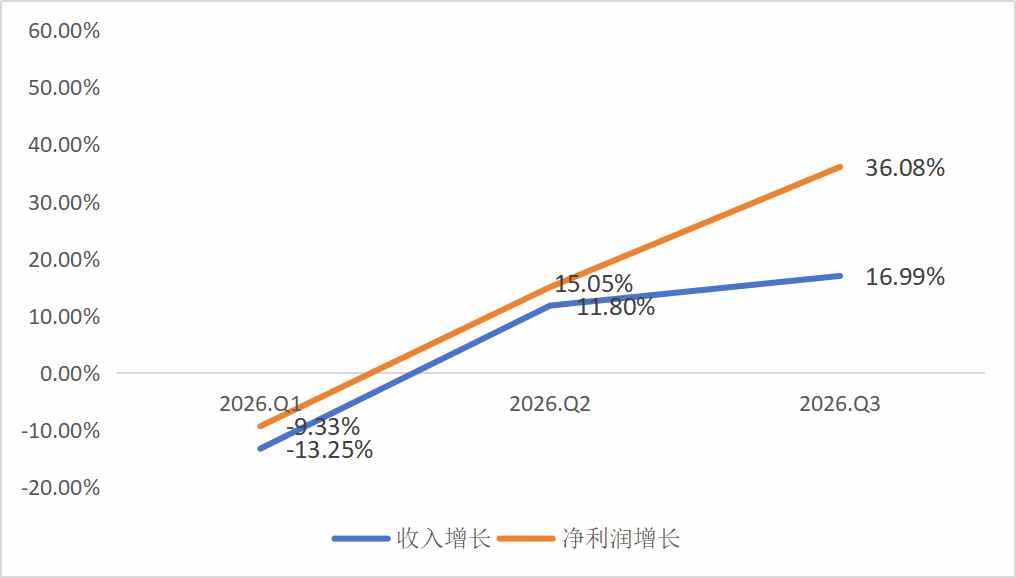
Data source: financial data and processing
The company's performance growth was mainly due to Huizhou Unit 1 and Unit 2 and Cangnan Unit 1 being put into commercial operation in 2026. Huizhou 1 is commercial on April 19, Huizhou 2 is commercial on August 3, and Cangnan 1 is commercial on April 29. The three units just happened to be in the window of the second and third quarter. They were put into operation and released electricity one after another. In the first three quarters, the total feed-in capacity of nuclear power units managed by the company was 176.749 billion kilowatt-hours, an increase of 2.65% over the previous year. Among them, the subsidiary's feed-in capacity was 141,491 billion kilowatt-hours, an increase of 4.23% over the previous year.
Profit quality improved simultaneously. The company's gross profit margin for the first three quarters was 43.54%, an increase of 3 percentage points over the previous year. Expenses remained stable during the period, R&D expenses increased 20%, and the R&D expense ratio was 2.08%. Cash flow is healthy. Net cash flow from operating activities in the first three quarters was 26.567 billion yuan, up 19.00% year on year. In 2023-2025, the company's net operating cash flow was 33.12 billion yuan, 37.506 billion yuan and 29.971 billion yuan respectively, which can basically cover investment and financing expenditure requirements.
CGN Electric's debt ratio is high. As of September 2026, the balance ratio reached 68%, of which the interest-bearing debt ratio was 51.38%. Structurally, short-term loans were 60.55 billion yuan, long-term loans were 249.536 billion yuan, while cash equivalents were only 24.288 billion yuan, and there was some financial pressure. However, as an asset-heavy industry, the company's asset profit level was far higher than the level of interest expenses. In the first three quarters, its financing cost was 3.848 billion yuan, accounting for 18% of operating profit.
The growth curve is clear and is expected to remain in an “upward channel”
CGN operates 30 nuclear power units, including the Daya Bay Nuclear Power Plant, Lingao Nuclear Power Plant, Lingdong Nuclear Power Plant, Yangjiang Nuclear Power Plant, Taishan Nuclear Power Plant, Huizhou Nuclear Power Plant, Fangchenggang Nuclear Power Plant, Ningde Nuclear Power Plant and Cangnan Nuclear Power Plant, and the Hongyanhe Nuclear Power Plant from a joint venture. The company's main business includes sales of electricity and building installation and design services, of which sales account for more than 95% of electricity sales.
In the first 9 months of 2026, the total feed-in capacity of the nuclear power units managed by the company was about 176.749 billion kilowatt-hours, an increase of 2.65% over the previous year, and the subsidiary's feed-in electricity capacity was about 141,491 billion kilowatt-hours, an increase of 4.23% over the previous year. In addition, the company's nuclear motor assembly capacity reached 35,450 megawatts, with 19 units under construction. In the third quarter, Huizhou Units 5 and 6 were approved by the State Council, and full construction of Zhaoyuan Unit 2 began.
Internet electricity drives companies' performance growth, and the pace of maintenance determines short-term electricity flexibility. In the third quarter, the company completed 1 annual replacement overhaul and 1 ten-year overhaul, and also began 2 new annual material replacement overhauls and 1 10-year overhaul; in the fourth quarter, it plans to carry out 4 more annual replacement overhauls. Overhauls are “regular medical examinations” that nuclear power companies cannot avoid. Centralized maintenance in a single quarter will inevitably reduce some of the power generation capacity, but in exchange for full capacity for the next cycle.
Furthermore, through continuous capital expansion, the company acquired 46% of Cangnan Nuclear Power's shares and 51% of Cangnan No. 2 Nuclear Power's shares from the controlling shareholder; Ningde No. 2 Nuclear Power changed from a joint venture to a subsidiary holding 51% of the shares on January 5; and Lu Feng Unit 3 and 4 were co-funded by six parties, including Ningde Era (Zhaoqing), China Yizhong, and Mingyang Intelligence. The company held 70% of the shares, tying industry chain partners into the project company.
From an industry perspective, AI data centers, the spread of electric vehicles, climate warming, and manufacturing expansion are jointly driving up electricity demand. In particular, AI development requires a large amount of electricity, and nuclear energy is the key to solving the power gap. Tech giants such as Meta, Google, and Amazon spend nearly a trillion dollars on AI infrastructure, and nuclear energy is also one of the key areas. In the first half of the year, the country's cumulative installed power generation capacity was 4.04 billion kilowatts, up 10.8% year on year, of which nuclear power was 66 million kilowatts, up 8.6% year on year, accounting for only 1.63%, and there is plenty of room for improvement.
In 2022 to 2026, 8 to 11 units are approved domestically each year. In July 2026, the Executive Meeting of the State Council approved 8 nuclear power units at once: Zhejiang Jinqimen II Phase 3 and 4; Guangdong Taipingling Phase III No. 5 and 6; Liaoning Zhuanghe Phase I No. 1 and No. 2; and Shandong Laiyang Phase I No. 1 and No. 2. According to estimates by the China Nuclear Energy Industry Association, the number of domestic units put into operation every year from 2026 to 2030 is 8, 7, 5, and 7, respectively, corresponding to 8.6 GW, 8.1 GW, 9.0 GW, 6.2 GW, and 8.6 GW. This will be the certainty driving the growth of the industry.
As an industry leader, CGN Electric Power is undoubtedly one of the biggest beneficiaries. According to the China Nuclear Energy Industry Association, as of the end of June 2026, China had 62 nuclear power units in operation, with an installed capacity of about 66 GW, while CGN Electric Power managed 30 units in operation, accounting for 44.47% of the total installed nuclear power plants in operation and under construction in the country. Moreover, the company is also actively increasing its market share through acquisitions, etc., and it is difficult to shake its dual oligopoly position in domestic and Chinese nuclear power.
In the capital market, the company's H shares have been rising for four years, and the market value has doubled, but the valuation is not high. The AH premium is still as high as 39.2%, PE (TTM) is 13.8 times, and PB is 1.1 times, and the valuation is not high. Moreover, most investment banks are optimistic. Among them, Citi raised the company's net profit forecast for 2026 to 2028 by 12% to 17%, with a target price of HK$3.8, an increase of 55% from the previous time; Bank of America Securities said that CGN Power's performance for the next quarter beat expectations. Currently, it maintains a positive view of its operations for the next few quarters, raising the target value to HK$4, an increase of 8%.
Overall, CGN Electric Power's 2026 performance was strong. Revenue and profit grew by double digits for two consecutive quarters, profitability continued to improve, and the company's feed-in power and installed capacity maintained a steady growth trend. In addition, it continued to expand through acquisitions and other means to stabilize its leading position in the industry. The wave of AI infrastructure is driving the development of nuclear power. As a leading domestic nuclear power company, the company's valuation is low, investment banks are optimistic, and the market value is expected to remain on an upward channel.