


EN
Gold Just Dipped Below $4,000 Per Ounce. Is It Time to Buy the SPDR Gold ETF?
Key Points
Gold peaked at around $5,400 per ounce earlier this year, but it has since lost more than 25% of its value.
Elevated inflation, geopolitical tensions, and jitters in the artificial intelligence industry should be bullish for a safe-haven asset like the yellow metal.
Conditions look great for more upside in gold over the long term, but investors need to be realistic about its potential returns.
Gold is one of the world's oldest stores of value. It's still legal tender in many U.S. states to this day, but you probably won't find anybody trading it for gas or groceries given its ability to deliver consistent returns.
Gold soared to an all-time high of $5,400 per ounce at the start of 2026, but it's currently in the throes of a correction and briefly dipped below $4,000 on Oct. 24 for the first time since July. Conventional wisdom suggests the shiny yellow metal should be soaring right now given the persistent rise in inflation, ongoing geopolitical tensions, and the economic uncertainty caused by artificial intelligence.
Missed Nvidia in 2009? This Rare Signal Is Flashing Again. In 2009, a "Double Down" signal flashed for a little-known chipmaker called Nvidia. For the first time in years, that same "Total Conviction" signal is flashing for a company 1/100th the size of Nvidia. Continue »
Therefore, should investors take this opportunity to buy the SPDR Gold ETF (NYSEMKT: GLD), an exchange-traded fund (ETF) that directly tracks gold's performance?
Image source: Getty Images.
Conditions favor more long-term upside in gold
Gold's value is often tied to its scarcity. A mere 222,600 tons have been extracted from the ground throughout human history, compared to 1.7 million tons of silver, and billions of tons of other commodities like iron ore and coal. Gold supply also grows at a very slow pace of 1% to 2% per year, and there eventually won't be any left to mine.
Those factors give governments, central banks, and investors confidence in gold's ability to maintain value, particularly compared to cash. What I mean by that is the yellow metal doesn't produce any revenue or earnings, so its long-term rise in price is mainly a function of the declining value of fiat currencies like the U.S. dollar.
America used to operate under the gold standard, which prevented the government from printing more money unless it had an equivalent amount of physical metal to match. But this mechanism was abandoned in 1971, so money supply has since exploded, causing the U.S. dollar to lose over 90% of its purchasing power. Hence, gold has surged in value in dollar terms.
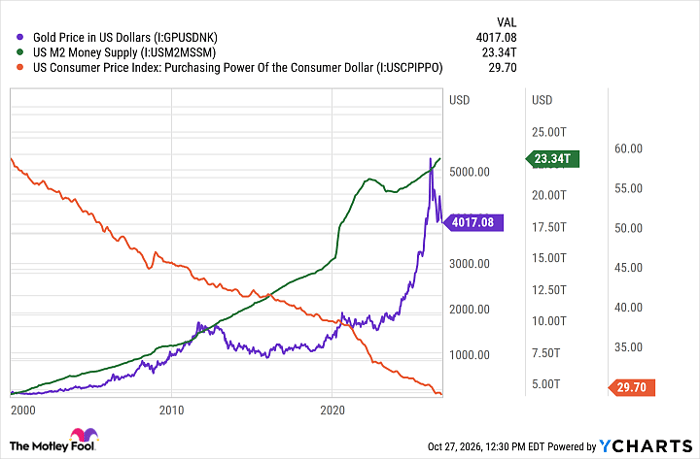
Gold Price in US Dollars data by YCharts
The U.S. government ran a staggering $1.8 trillion budget deficit in fiscal 2025, and followed that up with an even bigger $2 trillion deficit in fiscal 2026. As a result, the national debt is now over $40 trillion, and global investors have protested the excessive spending by selling U.S. government bonds this year, thus driving up borrowing costs. This fiscal turbulence is very bullish for safe-haven assets like gold.
High levels of government spending can drive up inflation, but so can rising oil prices, which are also a factor right now due to the ongoing conflicts in the Middle East. West Texas Intermediate crude oil trades for over $100 per barrel as I write this (Oct. 28), a 75% increase from its 2026 opening price of $57. As a result, consumers face higher prices for practically every product that travels by truck, boat, or plane.
In fact, the Consumer Price Index (CPI) measure of inflation rose at an annualized rate of 3.7% in September, significantly higher than the Federal Reserve's target of 2%. Again, inflationary environments are typically great for hard assets like gold.
Gold could face volatility in the near term
Given the immense structural tailwinds for gold right now, why is it down so sharply from its peak? In order to combat the recent spike in inflation, the Federal Reserve raised the federal funds rate (overnight interest rates) by 25 basis points at its September meeting, and chairman Kevin Warsh signaled more hikes might be on the horizon.
Since rising interest rates will gradually drive down the inflation rate, investors are now pricing in a reversal of the conditions that supported higher gold prices. That doesn't mean the yellow metal will plummet even further, but investors should definitely temper their expectations from here.
Gold has delivered a fairly modest average annual return of just 7.2% over the last 50 years, so its staggering 64% return in 2025 was certainly an outlier. In fact, the yellow metal typically underperforms the S&P 500 stock market index, which returned an average of 11.9% per year over the last five decades.
This highlights the importance of diversification. Gold is most useful as part of a broad portfolio of stocks, bonds, and real estate, because it has the potential to deliver outsized returns during turbulent years, when other assets typically falter.
Buying physical gold might seem like the way to go, but it can be expensive to store and insure, and it's difficult to sell quickly in a pinch. Owning the SPDR Gold ETF is probably a better alternative for most investors, because it can be bought and sold with the click of a button through any major investment platform. Plus, with an expense ratio of 0.4%, an investment of $10,000 will incur an annual fee of just $40.
Anthony Di Pizio has no position in any of the stocks mentioned. The Motley Fool has no position in any of the stocks mentioned. The Motley Fool has a disclosure policy.