


EN
Cerebras Fell After Culper Research Issued a Short Call. What This Means for CBRS Stock.
Cerebras Systems (CBRS) shares have continued to fall. The stock closed at $112.56 on Oct. 28, dropping almost 6% for the day and ending the session near multi-month lows. On Oct. 29, CBRS stock regained 2% and closed the day at $115.16, but shares still sit 70% below the 52-week high of $386.34.
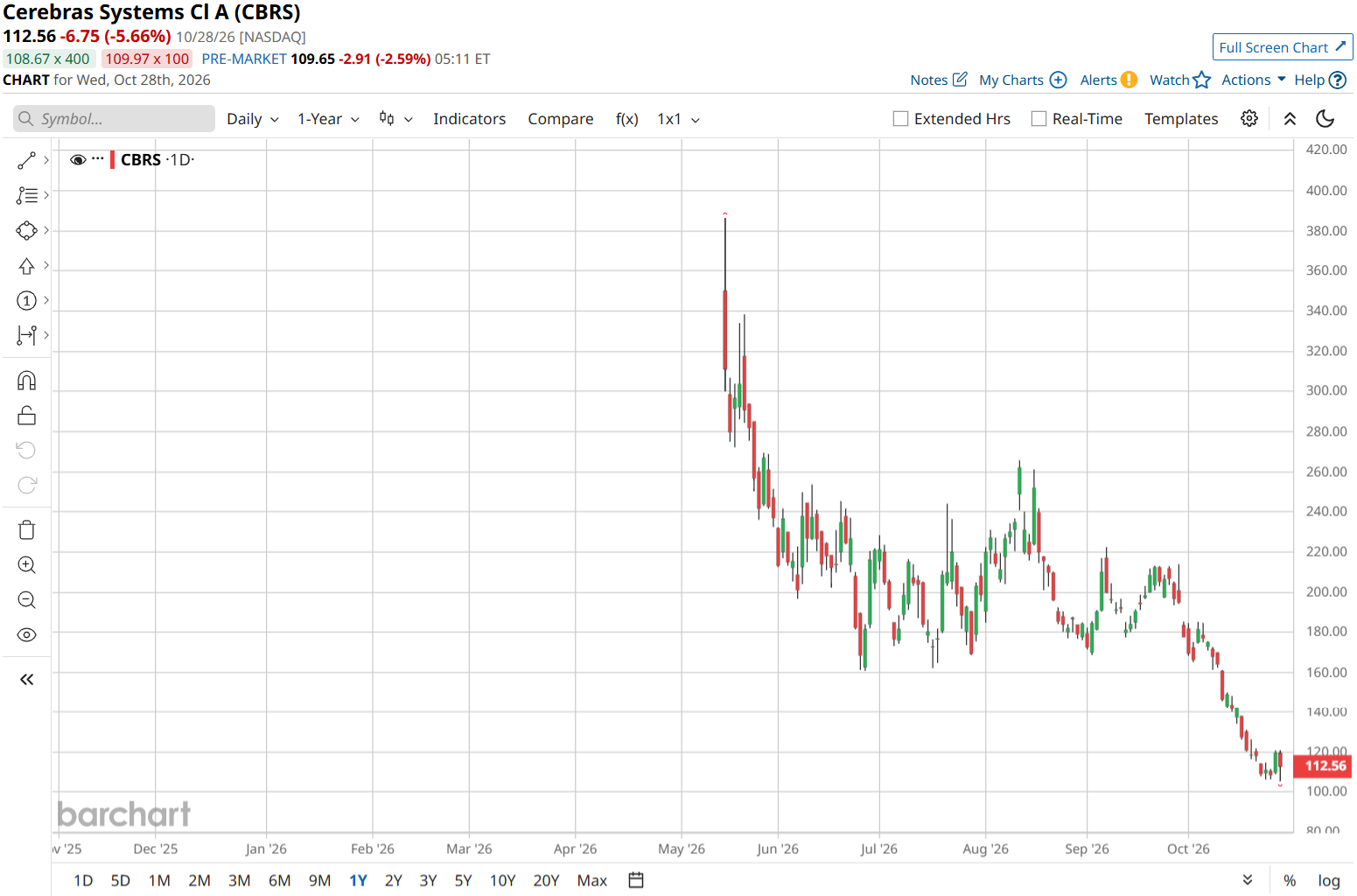
The company's partnership announcement with Oracle (ORCL) on Oct. 27 did little to stop the slide. The companies plan to bring Cerebras’ artificial intelligence (AI) inference technology to Oracle Cloud Infrastructure (OCI). Recently, Cerebras also raised its 2026 core revenue forecast to $880 million to $890 million, up from a prior range of $855 million to $865 million.
But investors still have concerns. Shares fell on Oct. 28 after Culper Research issued a bearish report and disclosed a short position. Does the Culper short report give investors a reason to rethink CBRS stock? Or has the selling gone too far? Let’s take a closer look.
Inside Culper Research’s Case Against Cerebras
On Oct. 28, Culper Research disclosed a short position in Cerebras and released a report questioning how long its wafer-scale chips last. The short seller claims the chips last just 1.5 to 2.5 years in actual use. That is below the 3-to-5-year lifespan Cerebras cited in its April 2026 S-1 filing, which was increased from a 1.5-to-3-year range in earlier drafts.
Culper Research argues that Cerebras has not fully fixed the problems caused by its chips expanding and contracting as temperatures change. Culper claims the company relies on PariPoser, a material developed by Paricon Technologies in the 1980s, rather than its own breakthrough. The report also alleges that Cerebras keeps its wafers running “dummy operations” to prevent them from cooling down.
To support its case, Culper pointed to a June 2026 comment from a Cerebras solutions architect, an examination of client software, customer accounts of early failures and replacements, and data suggesting the CS-3 uses roughly 80% of its peak power even when idle. Using a model of how heat affects aging, the firm estimates that the wafers age 3 to 3.5 times faster than conventional GPUs.
If true, these claims could mean higher replacement costs, lower margins, and less profitable contracts, including the OpenAI deal. The report also comes as restrictions on selling some shares begin to expire. Shares of CBRS stock fell more than 6% during trading on Oct. 28, while Cerebras did not immediately respond to requests for comment.
What Cerebras’ Numbers Actually Show
Cerebras reported sharp revenue growth in its second-quarter fiscal 2026 results. Core total revenue rose 103% year-over-year (YOY) to $209.9 million, with core cloud and other services revenue up 287% YOY to a record $127.7 million. Core gross margin reached 41%, up roughly 940 basis points, while core operating margin improved by about 2,600 basis points to -16%.
Cerebras finished the quarter with $8.6 billion in cash, cash equivalents, restricted cash, and short-term investments, plus $850 million in available debt capacity. Remaining performance obligations, or contracted revenue yet to be recognized, totaled $25.4 billion as of June 30. Management raised its full-year 2026 core forecast to $880 million to $890 million in revenue, a gross margin of 41% to 43%, and an operating margin of -19% to -17%.
Meanwhile, Cerebras has continued to add partnerships. On Oct. 27, the company announced plans with Oracle to offer its fast AI inference through OCI. The aim is to deliver quicker AI responses as applications handle more complex tasks. In September, Cerebras also secured a 165 megawatt AI data-center partnership with Compute Nordic Finland, adding capacity under a multiyear agreement. These deals give the business room to grow, although growth has not been enough to stop CBRS stock's decline.
Wall Street’s Expectations After the Selloff
Cerebras is scheduled to release its next earnings report on Nov. 12 after the market closes. Analysts expect a loss of $0.13 per share for the quarter ended September 2026, as well as a loss of $0.52 per share for full-year fiscal 2026.
Despite those expected losses, some analysts remain bullish. Earlier this year, Mizuho analyst Vijay Rakesh initiated coverage with an “Outperform” rating and a $300 price target. Rakesh pointed to Cerebras’ ability to deliver fast AI responses with less complicated networking and chip packaging. However, that coverage predates Culper Research’s report, so it should not be read as a response to the allegations.
Morgan Stanley, Rosenblatt, and Needham also assigned positive ratings on CBRS stock earlier this year. Targets across these firms range from $279 to $300.
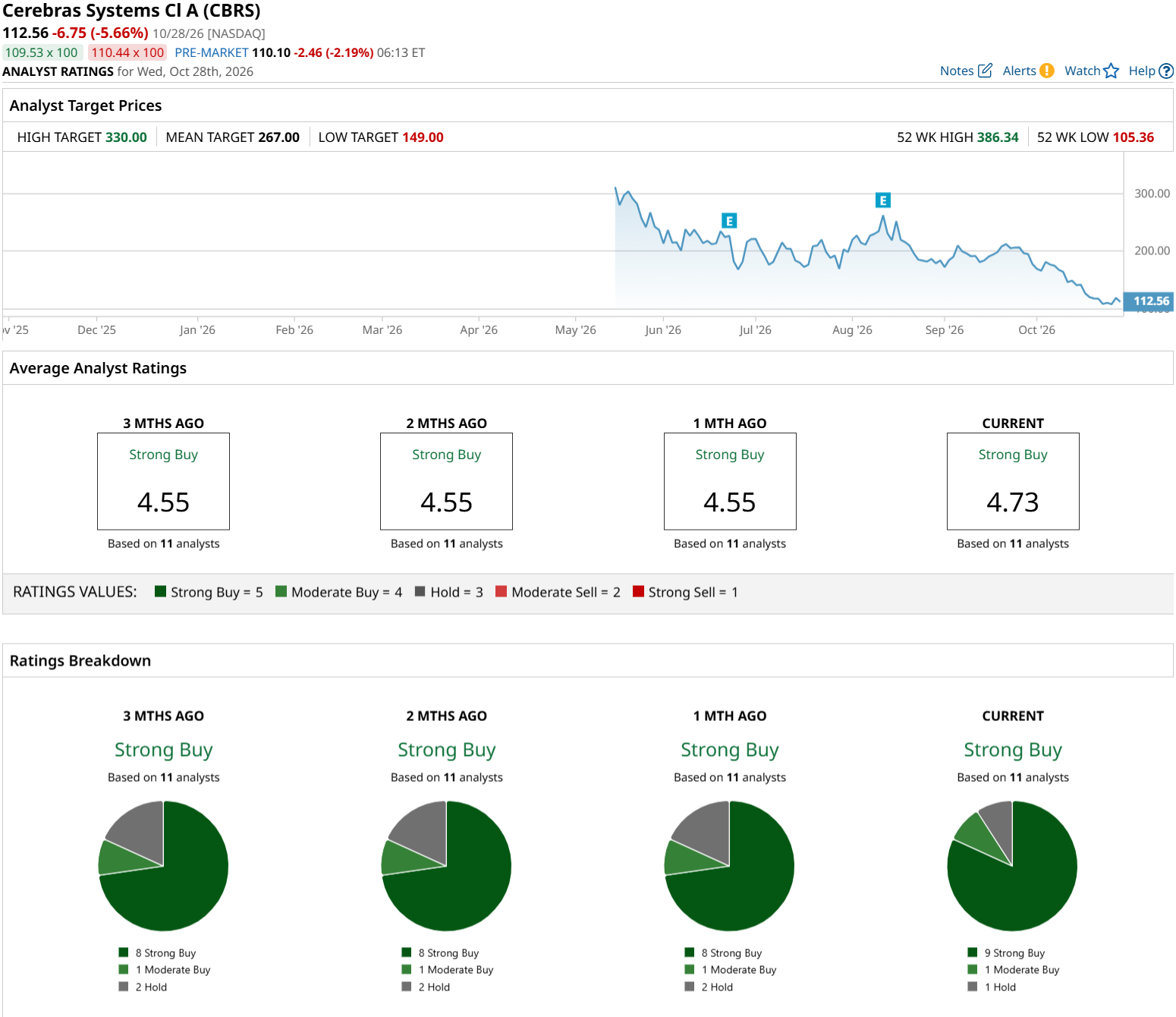
Overall, Cerebras stock has a consensus “Strong Buy” rating on Wall Street. The average price target of $267 implies potential upside of 132% from current levels.
Conclusion
Cerebras looks more like a “wait-and-see” stock than an obvious bargain. Strong growth, expanding partnerships, and bullish analyst targets support the opportunity, but they do not settle Culper’s claims about hardware durability and replacement costs. My view is that shares will remain under pressure in the near term as investors wait for clearer answers, with the Nov. 12 earnings report offering a potential turning point. Existing shareholders have reason to watch management’s response closely, while prospective buyers can afford some patience. A lower price is appealing, but evidence that the business can deliver sustainable returns would make a stronger buying case.
On the date of publication, Ebube Jones did not directly have a position in any of the securities mentioned in this article. All information and data in this article is solely for informational purposes. For more information please view the Barchart Disclosure Policy here.