


EN
Roboco (03757): Cash flow surged 646%, surged 2.3 billion on-hand order performance, and a break in Hong Kong stocks
In the pricing logic of the capital market, the leap from “driven by expectations” to “implementation of performance” is often accompanied by intense valuation games and clear chips. For Roboco (03757), the implementation of the three-quarter report became a late verification. The company's net profit for a single quarter was 54.928,600 yuan, a year-on-year increase of 232.62%. Net operating cash flow reached 418 million yuan in the first three quarters, an increase of 646.20% year-on-year. The company's Silicon Light story, which has been repeatedly told by the market over the past two years, left a mark on both profit statements and cash flow statements for the first time. Stimulated by favorable performance, H shares surged 9.17% in early trading.
Profit and cash flow resonate
Judging from the core financial data of this three-quarter report, Robotec's revenue for a single quarter was 393 million yuan, up 134.13% year on year; net profit to mother was 54.9286 million yuan, up 232.62% year on year. If we only focus on growth, it is easy to misinterpret it as a simple low base effect brought about by overseas mergers and acquisitions, but through data, from drastic changes in profit quality, cash flow conditions, and balance sheet, we can clearly outline that this company is making a substantial leap from being “driven by expectations” to “driving production capacity and delivery” in the AI silicon light and CPO equipment industry chain.
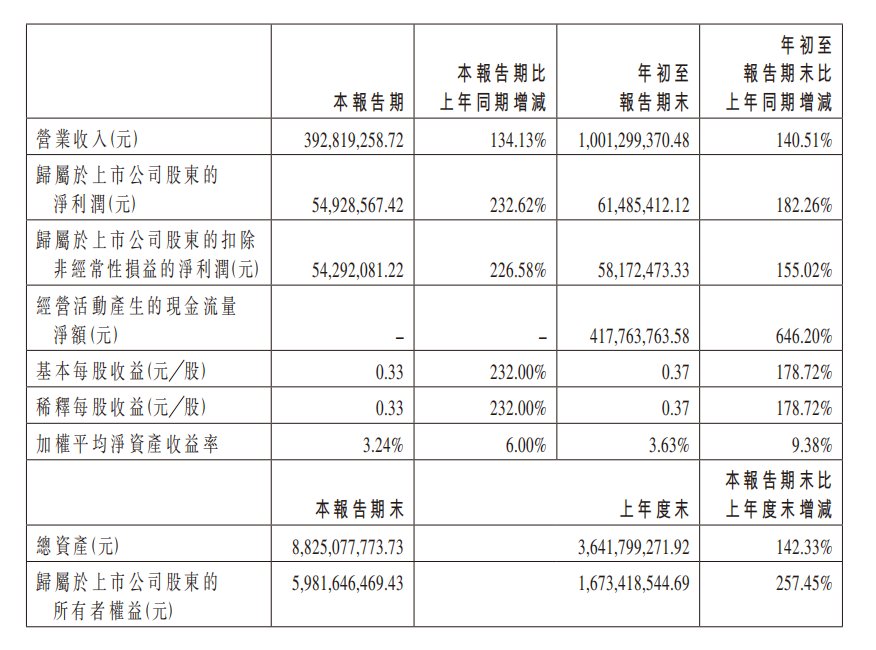
First, the most valuable aspect of this financial report is the resonance between profit quality and operating cash flow. The company's net profit for the first three quarters was 61.4854 million yuan, and the net profit after deducting non-net profit reached 58.1725 million yuan. The two are highly compatible. This means that the explosion of performance was entirely driven by large-scale delivery of the main business of optoelectronics and semiconductor equipment, and there was no trace of non-recurring profit or loss. An even more shocking indicator is cash flow. Net cash flow from operating activities in the first three quarters reached 418 million yuan, a sharp increase of 646.20% over the previous year. In the high-end precision equipment manufacturing industry, a large net inflow of operating cash flow is the strongest endorsement of the industry chain's voice and order authenticity. It proved that ficonTec's equipment not only confirmed revenue on the book, but also substantially completed a high percentage of customer payments, and its profit model has completely worked.
Reflected on the industrial side, Robotec's high growth and high gross profit (49.02% gross margin in a single quarter in Q3) accurately positioned the “shortest wooden barrel” of the AI optical interconnection manufacturing process. As the CPO architecture pushes optical coupling accuracy to the sub-micron level, and the testing process moves forward from the module level to the wafer level, high-precision coupling and test equipment has become the physical gate that determines the rate at which the industry's production capacity climbs. Relying on FiConTec's market share of about 25.5% in the global silicon light intelligent manufacturing equipment field and end-to-end technical barriers, the company has demonstrated strong irreplaceability in the top production lines of core customers. As of the three-quarter report, unconfirmed revenue orders of 2,359 billion yuan for the optoelectronics and semiconductor business provided solid support for the release of results for the next 2 to 3 quarters.
It received more than 1.7 billion single silicon optical/CPO orders during the year, taking absolute dominance
According to the Zhitong Finance App, the AI computing power cluster's pull on optical interconnection is no longer limited to the “strong demand for optical modules” narrative. Citing TrendForce data, the global CPO market is expected to reach 2 billion US dollars in 2026, an increase of more than 400% over the previous year; the CPO/NPO market will jump from about 100 million US dollars in 2025 to more than 39 billion US dollars in 2030, and the compound growth rate will reach 218.7% from 2025 to 2030. Silicon light solutions account for nearly 50% of 400G/800G optical modules, and silicon light is expected to account for more than half in the 1.6T era.
However, the market's tracking of “optical module shipments” is already quite adequate, and the real difference in expectations is hidden further upstream. In optical module manufacturing, optical coupling is the process with the highest process complexity and the greatest value, accounting for about 40% of the total value of the equipment; test equipment accounts for 27% in total, including 15% for R&D testing and 12% for reliability testing. The CPO architecture further extends the testing process from traditional module testing to multiple stages such as PIC wafers, EIC-PIC wafers, optical engines, and advanced packaging modules. PIC wafer-level testing is becoming a bottleneck process in mass production.
In other words, when CPO changes from an “alternative to pluggable optical modules” to a “native integrated solution for switches and AI accelerators,” the process window on the device side is narrowing, accuracy requirements are increasing exponentially, and the delivery pace and verification cycle of the equipment itself naturally lags behind the module factory's production expansion decision. Under this industry trend, coupling and testing equipment have become one of the few value points that cannot be “internalized” by the chip or module process, which directly determines the maximum yield limit and production capacity climbing speed of the entire industry.
In order to achieve the core node of precision cards, after completing the wholly-owned acquisition of German FiContec in 2025, Roboco achieved a fundamental shift in business focus — in the first half of 2026, the company's optoelectronics business accounted for 81.16% of revenue.
FiConTec not only ranks first in the world with a market share of about 25.5% in the field of silicon optical intelligent manufacturing equipment, but more importantly, it is the only supplier in the world that can provide end-to-end solutions covering the entire process of silicon optical devices. According to the investor relations activity sheet previously released by the company, FiConTec has built a full-process solution that includes fully automatic testing and fully automatic assembly of two major product lines, covering test equipment from wafers, grains, and chips to back-end modules, as well as assembly processes such as optoelectronic device coupling, high-precision optical fiber coupling, optical chip mounting, and chip stacking.
This absolute scarcity of technology is being rapidly translated into tangible results. Since this year, the company's wholly-owned subsidiary FiConTec and its subsidiaries have ushered in a concentrated explosion of orders in the field of optoelectronic packaging and testing equipment. According to publicly disclosed statistics, from the beginning of 2026 to August, the total amount of major contracts disclosed by Robotec reached 1,785 billion yuan, which is close to double the company's annual revenue of 950 million yuan in 2025.
However, we must clearly recognize that this kind of “uniqueness” is not equivalent to a permanent moat. The impulse of leading overseas optical module manufacturers to develop their own equipment and downstream customers' bargaining pressure on a single supplier has always been a constraint hanging over their heads. Currently, Robotco is facing a typical “high beta + high concentration alpha” combination: the optical interconnect device circuit enjoys an industrial beta where the CPO penetration rate has risen from less than 1% to more than 50%, but the company's Alpha is highly tied to the capital expenditure pace and technology route choices of a few leading overseas customers. Customer concentration risk, iterative uncertainty between CPO and NPO/pluggable routes, and cost and exchange rate exposure due to overseas subsidiary operations are all variables that cannot be fully covered by order numbers themselves.
This high fundamental expectation and structural risk have been directly projected into the pricing game between the two markets. However, after the disclosure of the three-quarter report, H shares surged 9.17% in early trading, indicating that capital is struggling to rebound.