


EN
The Eurozone economy is showing resilience! GDP increased 0.4% month-on-month in the third quarter, exceeding expectations, and the performance of the “two major locomotives” was divided
The Zhitong Finance App learned that despite the unexpected contraction of the French economy, which is the second-largest economy in Europe, and facing adverse factors such as high inflation and the sell-off in the bond market, the Eurozone's economic growth rate has doubled as expected by analysts. Eurostat's gross domestic product (GDP) grew 0.4% month-on-month in the third quarter, and economists expected 0.2% month-on-month growth, according to data released by Eurostat on Friday.
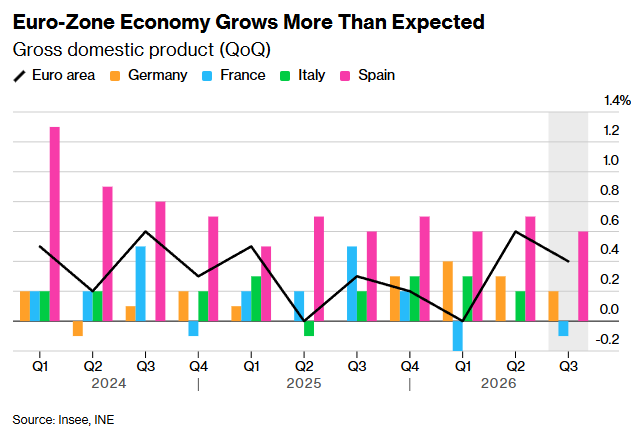
Eurozone growth in the third quarter beat expectations
Specifically, the economic performance of the major member countries was mixed. The German and Spanish economies grew, with GDP growing by 0.2% and 0.6% in the third quarter (economists expected 0.1% and 0.6%, respectively); Italy's GDP remained flat in the third quarter, lower than the 0.1% month-on-month increase expected by economists; and France's GDP fell 0.1% month-on-month in the third quarter, lower than the 0.1% month-on-month increase expected by economists.
The Eurozone's overall economic performance in the third quarter highlighted the broader resilience of the economy. In the face of the inflationary shock brought about by the Middle East War, as well as the heatwaves and arid weather that affected most of this summer, the European economy has shown some resilience. But the ECB has warned that the economy faces downside risks. The ECB kept interest rates unchanged this week, but it is still possible to raise interest rates for the third time in December.
Meanwhile, although inflationary pressure has yet to spread beyond energy, ECB officials remain wary of it. Another set of data released by Italy and France did not reassure them — prices in the two countries rose 5.6% and 3.8% respectively in October, the fastest increase since 2023 and higher than market expectations; although Spain's inflation rate declined slightly as expected, it was still at a high level of 4.9%.
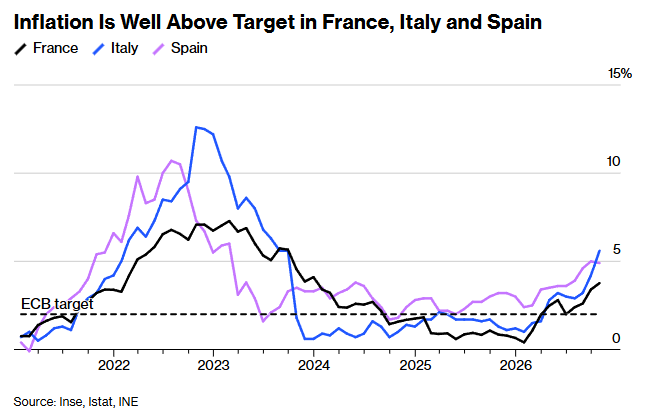
Inflation rates in France, Italy, and Spain are well above ECB targets
The performance of the “two major locomotives” of the European economy is divided. The French economy contracted unexpectedly in the third quarter due to multiple obstacles such as soaring borrowing costs, violent protests, and political and budget uncertainty. Previously, the French economy was already the most underperforming major economy in the Eurozone. In the first half of the year, against the backdrop of weak domestic demand, falling investment, and hot weather impacting agriculture, the French economy only narrowly avoided falling into recession.
The short-term outlook for the French economy is also difficult to reassure. The minority government led by French Prime Minister Sébastien Le Corny is once again mired in a parliamentary confrontation over austerity measures. Meanwhile, France's social and political situation continues to be turbulent. Next year's presidential election is not far away. The far-right faction is currently leading the polls.
French Finance Minister Roland Lescure said in an interview on Friday: “In 2026, the French economy will come to a standstill due to the simultaneous convergence of unprecedented external and internal shocks. The economy must restart. We need to restore confidence, and to do that, budgeting is critical because it will allow us to lower interest rates.”
Economist Jean Dalbard said, “The French economy entered the final quarter without momentum for growth, and the risks faced by the economy were clearly biased downward. The French economy unexpectedly contracted by 0.1% in the third quarter, while the market was expected to grow by 0.1%. Trade fluctuations explain why actual performance fell far short of expectations. What is even more worrisome is that investment has declined sharply again. This is the third consecutive quarter of decline, and the effects of the recent tightening of financing conditions have not even been fully felt.”
By contrast, the German economy has shown resilience. Despite factors such as low water levels in the Rhine River, Germany's GDP grew by 0.2% in the third quarter. The government's massive increase in infrastructure and defense spending has brought optimistic expectations for economic growth. Meanwhile, Europe's imposition of a cap on Chinese hybrid vehicle imports may also benefit German automakers. German Chancellor Mertz also plans to take further steps to try to boost economic growth through social welfare reforms and attracting private capital investment.
Italy's economic performance in the third quarter was also unsatisfactory. The Italian government expects GDP to grow by 1% in 2026. This increase will help fund some of the tax cuts promised by Prime Minister Meloni before next year's general election. Meloni also applied for an additional fiscal space of about 28 billion euros (about 31.3 billion US dollars) from the European Union for energy and defense spending. But if economic growth slows, it will be more difficult to implement the government's other fiscal commitments, including reducing the budget deficit to less than 3% of GDP.
The growth of the Spanish economy was mainly driven by domestic demand and trade, showing remarkable resilience. The Bank of Spain listed private consumption, job creation, and population growth as factors driving economic growth. The Bank of Spain expects the country's economy to grow 2.6% in 2026 and 2.2% in 2027, which is significantly higher than the overall growth rate of the Eurozone. Spain has largely escaped the effects of political instability, including Prime Minister Sanchez's inability to push for the adoption of the budget.