


EN
Missed Saia's Run? What Holders Had To Believe
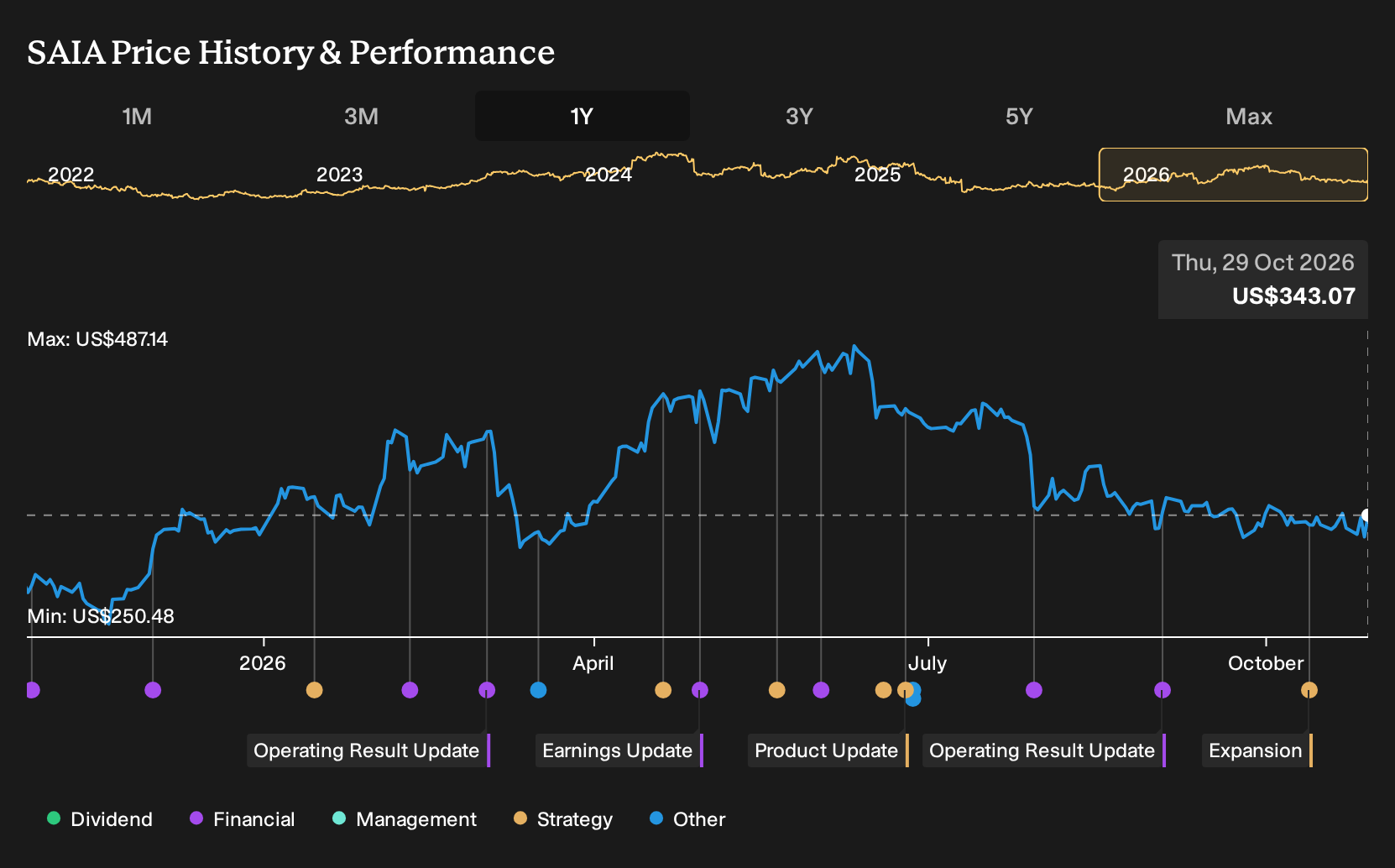
Saia’s latest headline move was a fresh US$250 million share repurchase authorization, coming right after the firm reported record Q3 revenue and strong pricing on its LTL network. Investors who held Saia over the past year are up 21.0%, including dividends. If you were weighing a purchase a year ago, you had to decide whether a capital hungry terminal buildout and mixed margin guidance could really support that kind of outcome, or if optimism was already stretched.
The easy part of this move is behind Saia. Zero in on 30 high quality undervalued stocks for companies trading below our estimates.
The Case For And Against Saia At The Time
The shares cost US$277 at the start of the period, so anyone looking at Saia then had to judge whether that level fairly reflected a capital heavy expansion plan and a choppy freight backdrop.
The bullish story argued that an expanding terminal network and logistics tech could drive meaningful efficiencies, with a Fair Value of US$338 that represented the price those assumptions pointed to. One key plank was the idea that revenue could rise 6.6% a year with profit margins reaching 11.6%.
The bearish view saw more fragility, with e-commerce automation, regulation and capital intensity biting, and a Fair Value of US$250 that reflected those more cautious expectations. That camp worried that expensive fleet upgrades, muted shipment trends and higher wage and benefit costs would keep net margins under pressure.
What The Results Changed For The Saia Thesis
Record Q2 and Q3 revenue at Saia, plus higher Q2 net income and a net margin that moved from 8.7% to 9.9%, supported the optimistic case that a larger terminal network and tech spending could support stronger economics. The lowered full year margin outlook and higher wage and expansion costs pulled the other way, so the evidence cut both ways.
The whole episode turned on whether heavy capital spending would actually lift profitability. For a different freight carrier, you would track net margin alongside capex and new terminal openings to see if extra concrete and trucks are translating into better earnings quality.
What Saia’s Current Price Already Assumes
Saia now trades at US$343, with this Narrative’s Fair Value sitting below that level, so the Narrative views the recent gain as already baking in a confident outcome.
The argument hinges on whether an expanded terminal grid and tech spend can overcome a higher structural cost base. A buyer today must judge that operating ratio gains and free cash flow will comfortably outrun fuel, wage, insurance and purchased transportation pressure.
"Although Saia is reporting record revenue and improving operating ratio from its enlarged network, the sharp 47.3% rise in purchased transportation expense and shift to 15.4% of linehaul miles handled externally risk embedding a higher structural cost base that could restrain future operating margin and earnings progression if volumes soften or rail pricing tightens further."
One Narrative disagrees with today's price. → See where this Narrative says Saia should trade
Saia And A Different Freight Bet
Saia hinges on concrete, docks and trailers. You could also look at who manages the freight information itself.
Instead of owning terminals, one logistics platform connects shippers and carriers through software. It focuses on pricing, booking and running loads through a digital marketplace.
That model aims to turn fragmented trucking capacity into something closer to an on-demand network. The pitch is simple enough for you to grasp quickly.
Where Saia commits capital to its own fleet, this other freight player commits resources to code, data and relationships. The open question is how much long term economics that digital middle layer can keep for itself.
That argument has a Narrative and a number behind it. → See the company one Narrative values 76% above its price
Have feedback on this article? Concerned about the content? Get in touch with us directly. Alternatively, email editorial-team@simplywallst.com