


EN
Capacity Expansion Could Be A Game Changer For Applied Materials Stock
- Applied Materials is expanding its role in AI driven chip production, with strong DRAM equipment revenue, EPIC research collaborations, and heavier capital spending on added manufacturing capacity.
- The company’s push into higher value areas like advanced packaging, process diagnostics, and display materials links near term demand for AI hardware to longer term service and materials revenue streams.
- We will now look at how Applied Materials’ capacity expansion and EPIC partnerships could reshape the investment narrative around AI equipment demand.
Applied Materials Investment Narrative Recap
For a shareholder in Applied Materials, the core belief is that AI driven chip demand, EPIC partnerships and expanded manufacturing capacity keep translating into higher value equipment, services and materials revenue. In the near term, the main hinge point is execution on that capacity buildout while keeping Semiconductor Systems and services running efficiently as customer orders evolve.
The biggest short term catalyst is upcoming earnings and guidance around AI related tools, DRAM equipment and advanced packaging orders. The key risk is that heavier capital spending, flat gross margin guidance and a greater mix of lower margin display revenue keep free cash flow tight, which could make the ramp feel heavier than the headlines suggest.
The recent move to object to tokenized trading of Applied Materials shares on the OKX ICE venue sits on the edge of the main AI equipment story but still matters for you as a shareholder. It keeps trading of the stock anchored in traditional exchanges and regulatory structures at a time when liquidity, price discovery and governance are already juggling higher volatility around AI narratives.
Operationally, the more material update remains the step up in capital spending to expand manufacturing output and support EPIC collaborations. That decision connects directly to the main catalysts around AI led wafer fab equipment demand, advanced packaging growth and Applied Global Services expansion, while reinforcing the existing risk that cash returns to investors could stay secondary to factory buildouts for a while.
Applied Materials Growth Assumptions In Plain Numbers
Analysts are effectively tying Applied Materials’ AI equipment story to a specific revenue and earnings profile by the end of this decade. The forecasts are not just directional. They spell out how much business performance would need to change for the current narrative to hold together.
Applied Materials' narrative projects US$58.5b revenue and US$19.6b earnings by 2029. This rests on analysts assuming 23.8% yearly revenue growth and an earnings increase of about US$10.3b from US$9.3b today.
On the earnings side, the consensus view points to profit margins moving from 30.1% today to 33.5% in three years. If achieved, that margin lift would mean more of each AI related tool sale, service contract and EPIC backed process win drops through to the bottom line, even as capital expenditure and headcount stay elevated.
The jump from US$9.3b of earnings today to US$19.6b by 2029 implies that AI driven orders for wafer fab tools, packaging equipment and process diagnostics need to scale meaningfully from current levels. Analysts are also building in only very slight share count growth of 0.08% per year over the next three years, so most of the projected earnings per share outcome hinges on actual profit expansion rather than financial engineering.
Layered over those income statement targets is a valuation bridge. To line up with the analyst consensus, Applied Materials would need to trade on a P/E of 35.8x in 2029, compared with 46.4x today and against a current US semiconductor industry P/E of 53.1x. That set up assumes investors are willing to pay a lower multiple on higher earnings if the AI equipment thesis and EPIC collaborations keep feeding into the higher margin segments analysts have pencilled in.
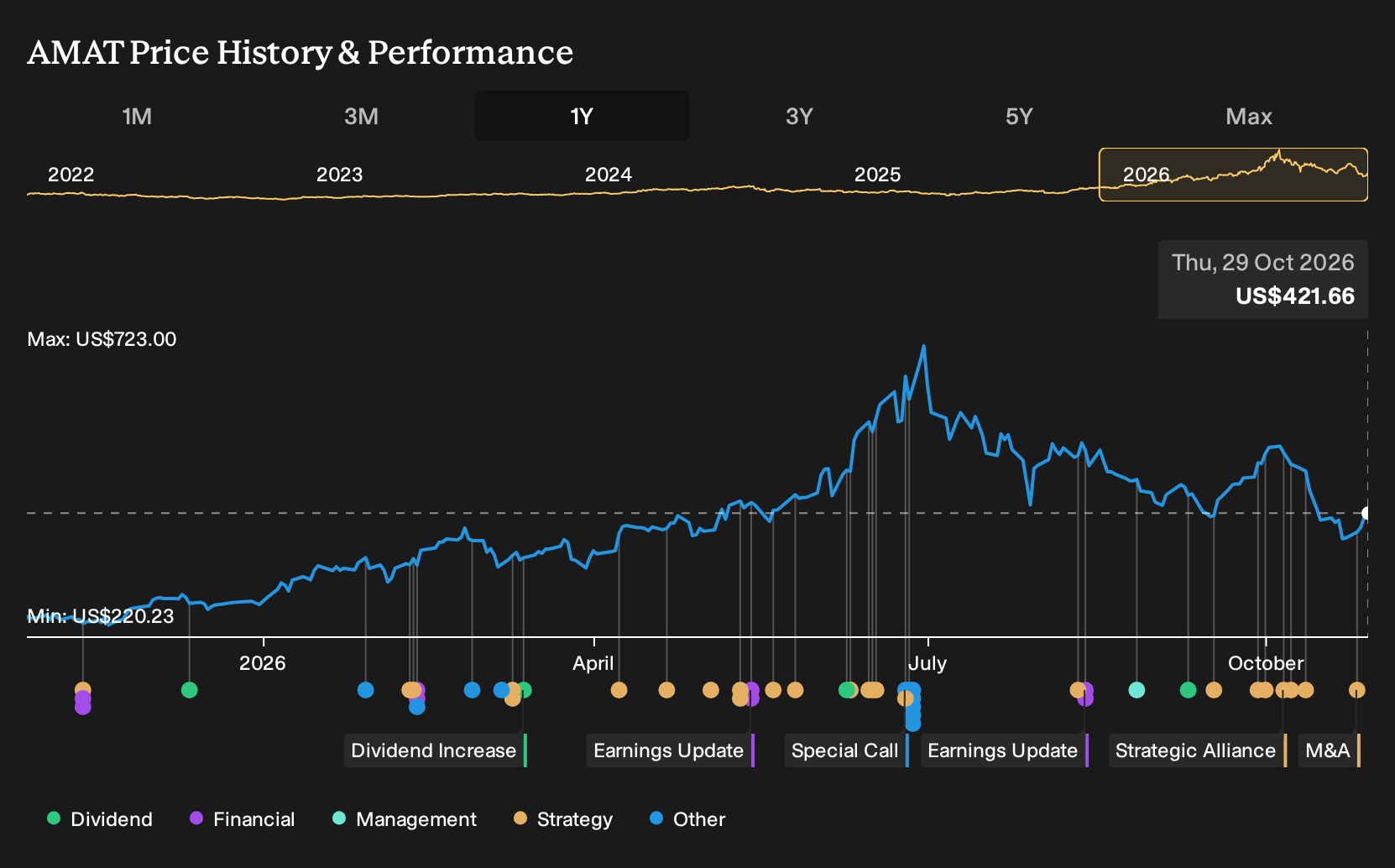
Uncover why Applied Materials' fair value indicates a 52% potential upside to its current price, which could narrow quickly.
Exploring Other Perspectives
One alternate view is that Applied Materials’ heavier capacity buildout is the real swing factor for you, not just AI tool demand. The most cautious analysts were pencilling in revenue of about US$54.0b and earnings of US$18.6b by 2029 before this tokenization objection, which could prompt them to revisit both the growth path and valuation multiples.
Explore 9 other Applied Materials fair value estimates, including one that suggests as much as 34% downside from the current price!
Form Your Own Verdict
Don't just follow the ticker. Dig into the data and build a conviction that's truly your own.
- A great starting point for your Applied Materials research is our analysis highlighting 3 key rewards and 1 important warning sign that could impact your investment decision.
- See our latest analysis for Applied Materials. The report includes a comprehensive fundamental analysis summarized in a single visual, the Snowflake, making it easy to evaluate Applied Materials' overall financial health at a glance.
Looking For More Investment Ideas Beyond Applied Materials?
Applied Materials may be central to your AI thesis, but your portfolio likely needs more than one story. If you want to keep building a watchlist grounded in clear numbers and fundamentals, the Simply Wall St Screener can help you filter for the types of businesses that fit your risk profile and return goals.
- If capital preservation and smoother returns matter most to you, start with a list of companies that score well on stability and risk. Check out 30 resilient stocks with low risk scores.
- If you care about balance sheet strength and the ability to fund growth internally, scan for businesses with cleaner debt profiles and solid fundamentals through the list of solid balance sheet and fundamentals (23 results).
- If you want to uncover less crowded ideas that still have strong underlying metrics, sort through a focused universe of smaller, higher quality opportunities using the 18 high quality undiscovered gems.
Have feedback on this article? Concerned about the content? Get in touch with us directly. Alternatively, email editorial-team@simplywallst.com