


EN
Why PI Industries Bears Were Right Before The Drop
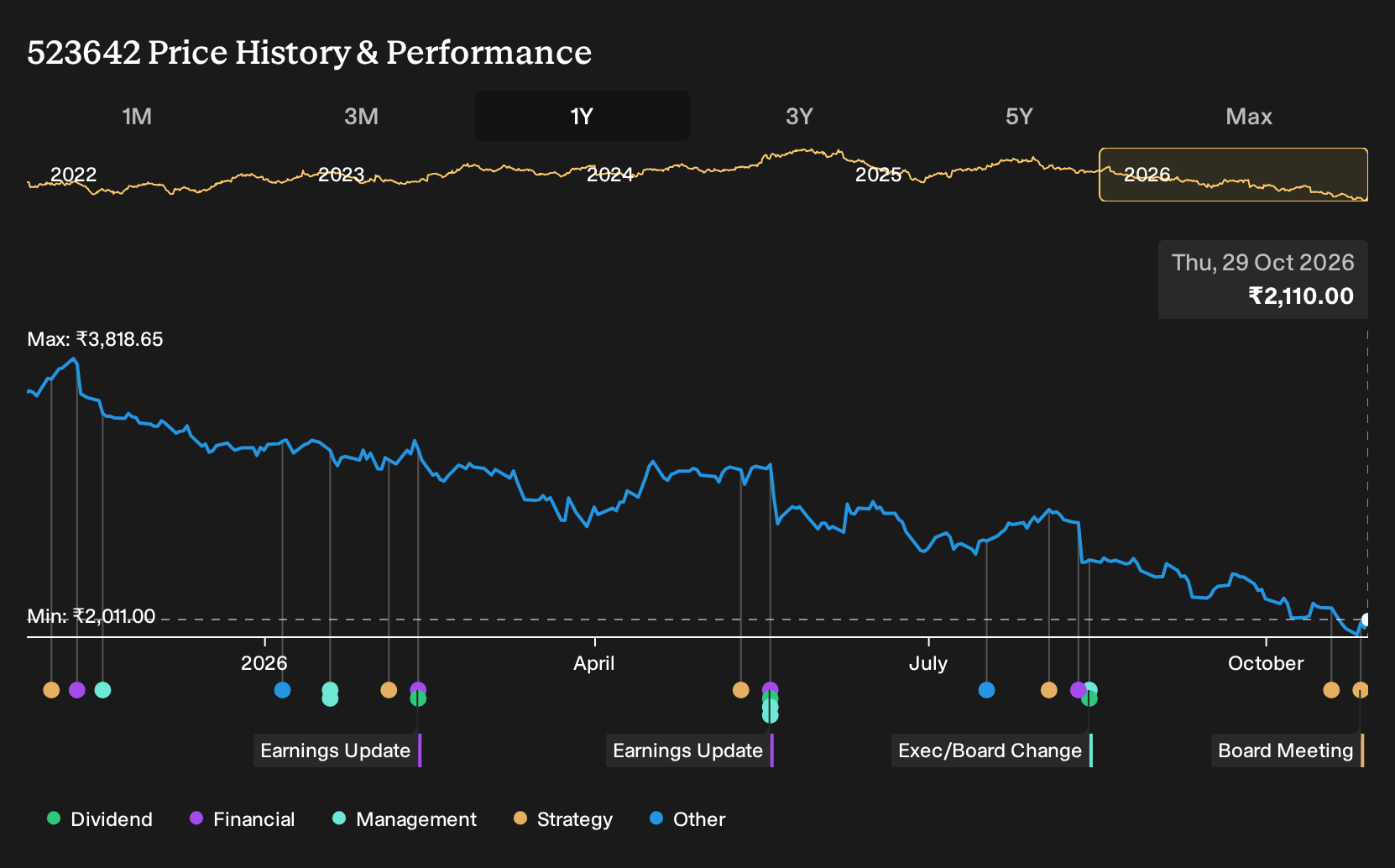
If you had looked at PI Industries in late October 2025 and decided to sit it out while analysts argued over whether life sciences expansion would secure resilience or whether agrochemical demand and regulation would bite, the past year might feel different today. Holding PI Industries over the past year would have meant a 41.0% loss, including dividends. With Q1 2027 revenue and net margin both lower than Q1 2026, which starting assumption deserved more scrutiny?
If the move has made PI Industries harder to judge, start where the gap is still open and scan 191 high quality undervalued stocks.
What You Would Have Been Weighing Up On PI Industries
The shares cost ₹3,607 at the start of the period, and investors in PI Industries were being pulled between two very different but plausible stories.
On the optimistic side, the bull Narrative argued that a broader life sciences push would add resilience. A Fair Value of ₹4,062, the price implied if assumptions held, was built on 12.0% annual revenue growth and profit margins near 19.9%.
The bear Narrative pointed to regulatory pressure and supply issues, with a Fair Value of ₹2,800 and a key concern that tighter rules on traditional agrochemicals could shrink core markets over time.
What The Evidence Did To The PI Industries Argument
The clearest fact was operational. PI Industries reported Q1 2027 revenue of ₹17,023 million and net income of ₹2,442 million, both below Q1 2026, with net margin slipping from 21.0% to 14.3%. That challenged the bull case that life sciences expansion would keep profitability near 19.9%, and it gave more weight to the cautious view on earnings pressure.
The lesson is simple. When a story leans on resilient margins, track net margin alongside top line and earnings each quarter, then test whether it is holding up or sliding away from the original assumption.
What You Would Be Paying For In PI Industries Today
PI Industries now trades at ₹2,110, and the selected Narrative sets a Fair Value above that level based on its own assumptions rather than hard fact. The gap rests on a belief that the newer pharma and biologicals platforms can justify more than the current agrochemical profile.
If you are weighing that Narrative, the key assumption to test is whether upfront losses in pharma and global biologicals can turn into durable, high margin revenue while funding heavy R&D and capacity spend.
"The main thing that has to go right is that PI Industries turns the current upfront investments and EBITDA losses in pharma and global biologicals into profitable, scaled businesses while continuing to fund R&D and capacity. The numbers imply that PI Industries’ debt free balance sheet with about INR 38b of net cash, a solid FY26 EBITDA margin of 25% and guided CapEx in the range of INR 700 to 800 crore support a share price that does not fully reflect these newer growth platforms."
One Narrative has put a figure on that disagreement. → See the Narrative with its higher Fair Value, assumptions and all
Where PI Industries’ Story Echoes
Looking at PI Industries, you are already thinking about chemistry, regulation and supply chains.
Take one step sideways and you hit a different bottleneck. High performance motors and generators depend on powerful permanent magnets.
A separate specialist handles the work of mining rare earths, refining them and turning them into magnet materials for big industrial buyers.
Government contracts, long term offtake deals and customer commitments shape how that business develops and what risks sit on its plate.
If you want a parallel to PI Industries’ long build in life sciences, this rare earth player offers a very different version of the same long game.
The case is on the record, with the assumptions it rests on. → See the Narrative that values this company 72% above its price
Have feedback on this article? Concerned about the content? Get in touch with us directly. Alternatively, email editorial-team@simplywallst.com