


EN
Caterpillar Drops 10% Pre-Market Despite Q3 Beat and AI Build-Out Growth
Caterpillar (CAT), a Dividend Aristocrat with 33 consecutive years of higher payouts, topped third-quarter earnings estimates on Oct. 29 for the fifth straight quarter, as the AI data center build-out pushed Power Generation sales up 30%. But the beat was only about 1%, much thinner than the 31% cushion in Q2, and the stock fell nearly 10% in pre-market trading, leaving it roughly 40% below its 52-week high.
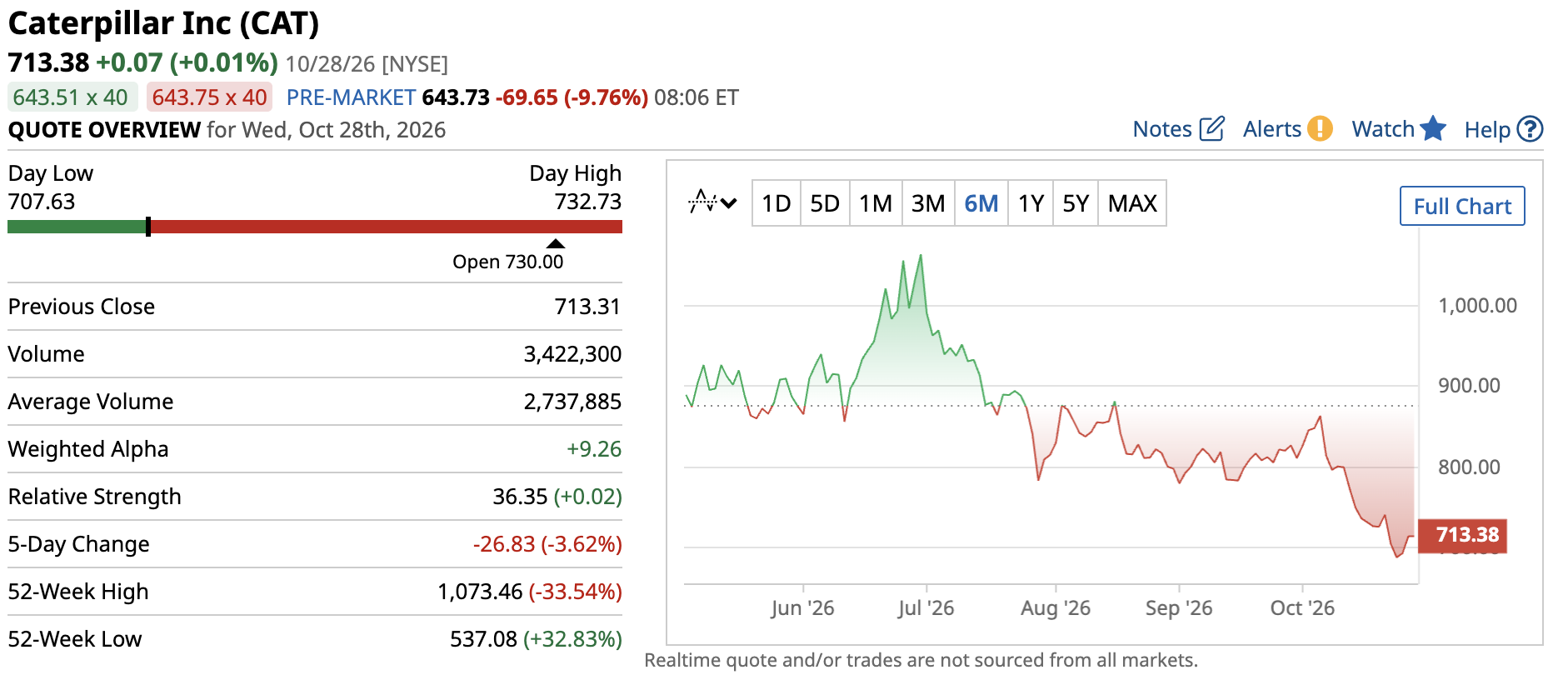
So is the selloff an overreaction, or a warning for the AI infrastructure story?
To answer that, it helps to start with the bigger picture. Money isn’t the only common denominator of businesses. Regardless of the sector, one crucial detail of growth is infrastructure, and AI is no exception. Caterpillar’s engines and generators put it in a less obvious corner of that spending, and this report showed how much of it is reaching the numbers. So what did the results actually show?
How Caterpillar’s Q3 Results Compare With Wall Street Estimates
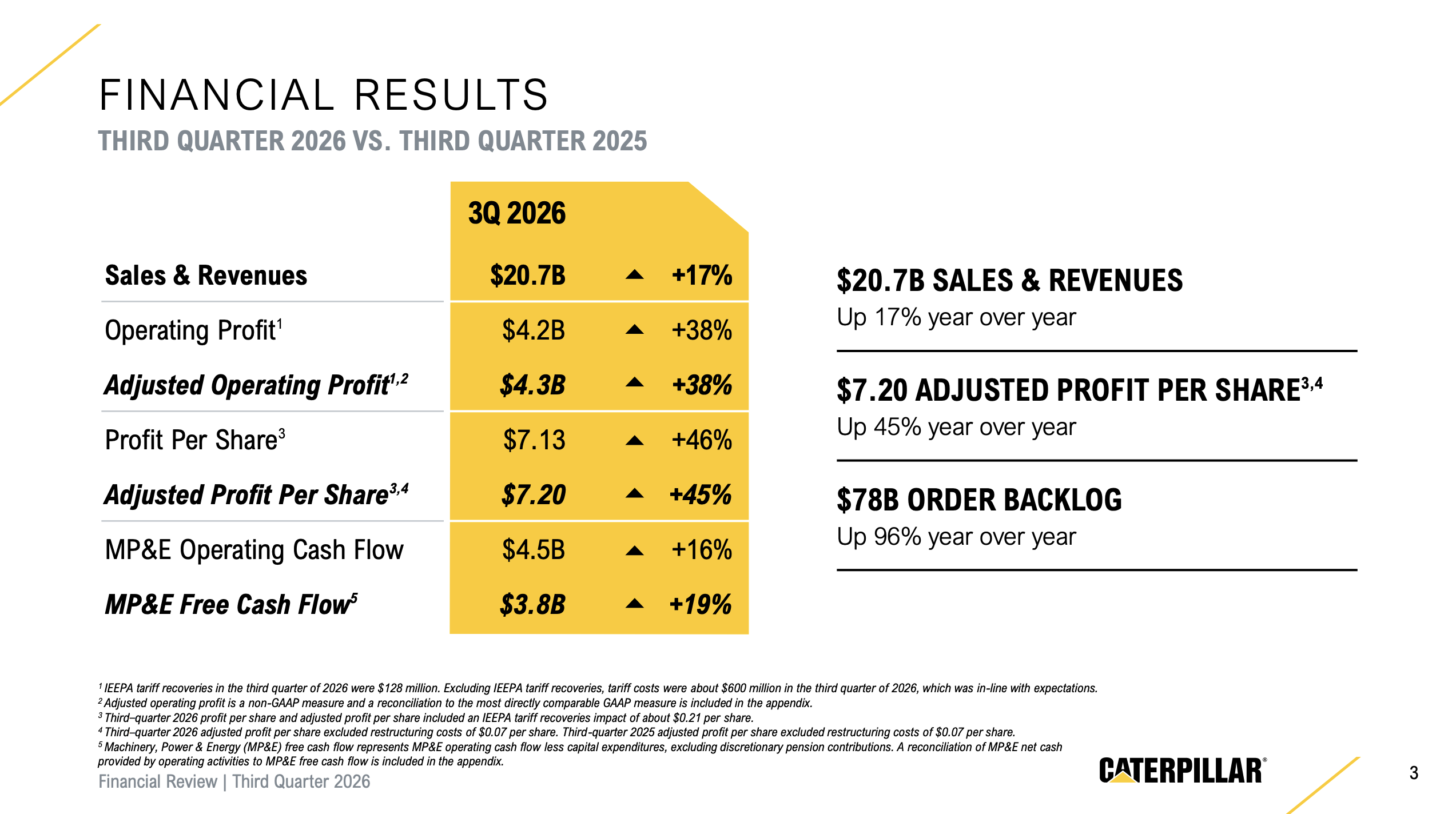
Here’s Caterpillar’s financial summary for the third quarter of 2026:
| Metric | Caterpillar (CAT) |
|---|---|
| Sales | $20.68 billion (+17% YOY) |
| Net Income | $3.29 billion (+42.9% YOY) |
| Adjusted EPS | $7.20 vs. $7.12 expected (+45% YOY) |
| Power Generation Sales | $3.42 billion (+30% YOY) |
| Stock Reaction (Pre-Market) | -9.7% to $644.03 |
| Forward P/E | About 22x (pre-market price) |
The numbers are still strong. Caterpillar’s third-quarter results showed sales up 17% YOY and net income up about 43%. Adjusted earnings of $7.20 per share beat the $7.12 consensus, which marks the fifth straight quarter Caterpillar has topped estimates.
But the size of the beat tells a different story. Caterpillar beat by roughly 31% in Q2 and 22% in Q1. This time, the cushion was about 1%.
Growth also cooled. Sales growth slowed from 24% to 17%, and sales were essentially flat from the record $20.5 billion in Q2. Adjusted EPS slid from $8.17 last quarter, partly because Q2 got a $392 million boost from tariff recoveries, compared with $128 million in Q3.
That helps explain the reaction. Shares fell 9.7% to $644.03 in pre-market trading, from Wednesday’s close of $713.38. In other words, investors wanted more than a 1% beat from a stock that had been sliding since early October.
Still, investors care most about the AI-driven part of the business. So how did Power & Energy do?
Power Generation Sales Jumped 30% on Data Center Demand
Caterpillar’s AI opportunity is clearly showing up in the numbers. Power Generation sales grew 30% to $3.42 billion, slightly faster than Q2's 29% growth. The company said the gains came mainly from turbines and large reciprocating engines used in data center applications. That means Power Generation now makes up roughly one-sixth of Caterpillar’s total sales.
The segment is profitable too. Power & Energy’s profit rose 31% to $2.14 billion, and its margin widened to 24.4% from 21.9% a year ago.
Plus, the pipeline is still being worked. Deliveries under the 2-gigawatt order that American Intelligence & Power placed through its strategic alliance with Caterpillar and Boyd CAT are scheduled to run from September 2026 through August 2027. In other words, much of that deal's revenue is likely still ahead.
But AI isn’t the only driver. Construction Industries sales rose 18% to $7.98 billion, with profit up 33%. Resource Industries sales climbed 15% to $4.62 billion, though profit grew just 14% and its margin slipped to 13.5% as higher material costs, including tariffs, weighed on results.
So how much of that revenue is turning into profit and cash?
Profit Margins Improved From a Year Ago but Slipped From Q2
Operating profit jumped 38% to $4.21 billion. The adjusted operating margin was 20.6%, up from 17.5% a year ago, but down from 21.9% in Q2. Pricing did much of the heavy lifting, adding $663 million to profit and more than offsetting $415 million in higher manufacturing costs.
On the cash side, enterprise operating cash flow was $4.4 billion, and Caterpillar returned $2.0 billion to shareholders through $1.2 billion in buybacks and $0.7 billion in dividends. Over nine months, operating cash flow from its machinery, power and energy business rose 49% to $11.5 billion.
But the cash pile ended the quarter at $7.9 billion, down from $10.0 billion at the end of 2025. Heavy buybacks and a bigger inventory build, with inventories up 22% to $22.2 billion, outpaced cash flow. Meanwhile, customer advances jumped 61% to $5.3 billion, suggesting customers are putting down money for future orders.
Beyond the quarterly numbers, shareholders also want to know what they get paid to wait.
Caterpillar’s 33-Year Dividend Streak Offers a Modest Yield
Caterpillar is a Dividend Aristocrat that has increased its payouts for 33 consecutive years. This month, the board voted to maintain the quarterly dividend at $1.63 per share.
That works out to a forward annual dividend of $6.52, or about a 1% yield at the pre-market price. Its dividend payout ratio is roughly 25% of trailing adjusted earnings, leaving plenty of room for reinvestment or higher payouts. So how does Wall Street see the stock after this report?
What Wall Street Analysts Expect From Caterpillar Stock Next
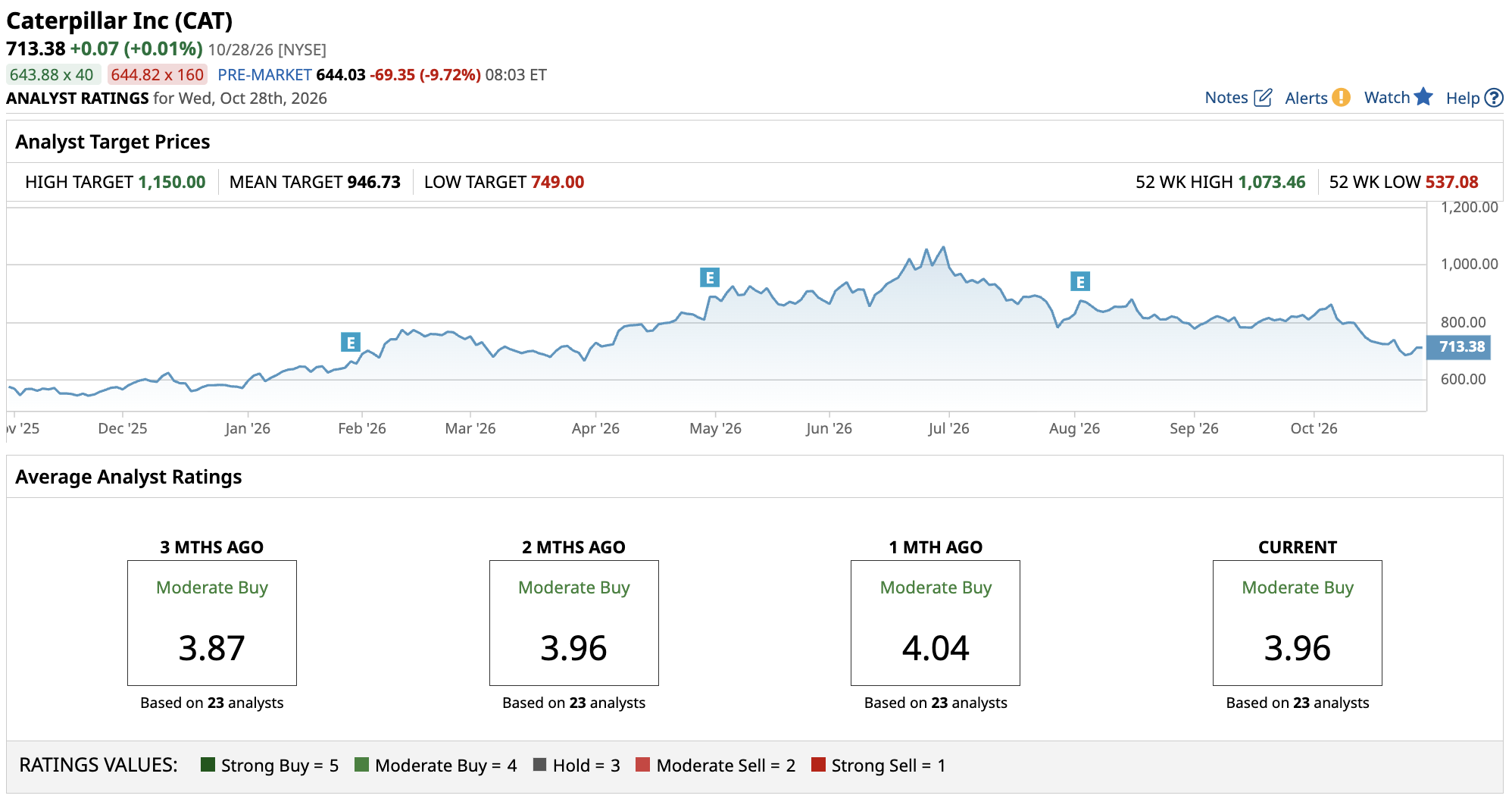
Heading into the report, here’s what Wall Street says:
A consensus of 23 analysts rated the stock a “Moderate Buy,” with a mean price target of $946.73. At the pre-market price of $644.03, that implies about 47% upside. In other words, targets point to roughly 16% to 79% upside, with the low target at $749 and the high at $1,150. Those targets predate the report, so expect updates in the coming days.
The pullback is significant. Shares were up about 12% for the year at the pre-market price, but they sat roughly 40% below their 52-week high of $1,073.46. That puts Caterpillar at roughly 22 times forward earnings, using estimates from before the report, while analysts expect fiscal 2026 earnings of $27.74 per share, up roughly 45.5%.
So where does that leave investors after the report?
Is Caterpillar Worth Watching After Its Q3 Report?
Caterpillar established itself in the construction industry. But behind the scenes, the company is also making a leap in AI infrastructure, and 30% growth in Power Generation sales shows that leap is real.
The report wasn’t perfect. The beat was thin, sales growth cooled, and margins slipped from Q2. But management pointed to strong order rates and a record backlog, which suggests demand remains durable.
The pullback changes the math. At roughly 22 times forward earnings, the stock looks more reasonable than it did a day ago, though it still isn’t a bargain. Add a modest yield of about 1%, and it doesn’t strongly appeal to income-focused investors.
However, I think it’s a pretty interesting stock to watch, especially after a drop like this one. Consistency is already proven. Plus, massive gains could be just around the corner, as long as data center demand keeps converting into profit.
On the date of publication, Rick Orford did not directly have a position in any of the securities mentioned in this article. All information and data in this article is solely for informational purposes. For more information please view the Barchart Disclosure Policy here.