


EN
The Call ON Semiconductor Bulls Got Right
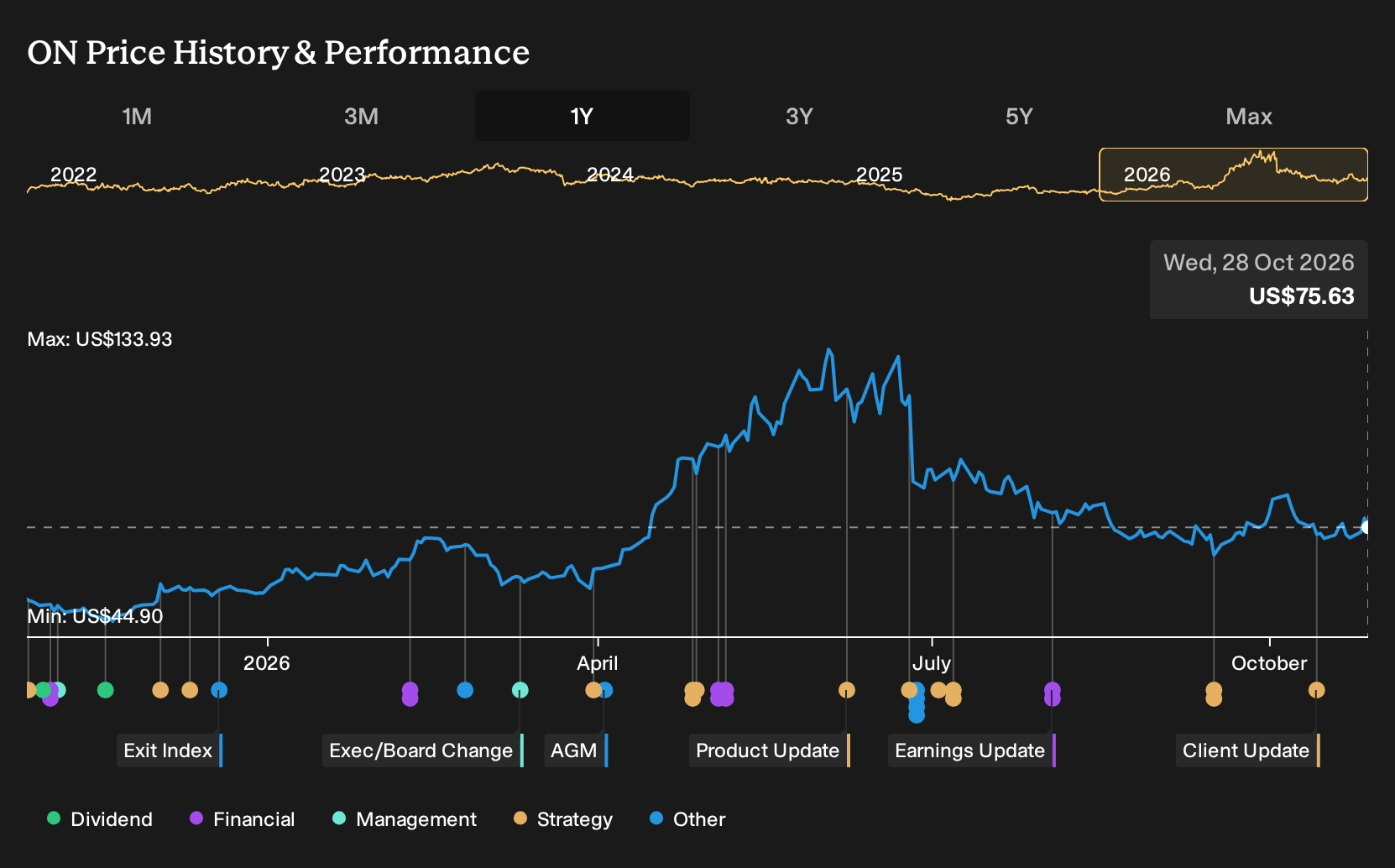
If ON Semiconductor was on your watchlist instead of in your portfolio, this move may feel like it got away. Holding ON Semiconductor over the past year would have returned 48.7%, including dividends. That outcome invites a question. Back in late October 2025, analysts were already split between EV and AI optimism and concerns about tariff pressure and margin compression. If you had focused on how much future profitability depended on automotive and AI power demand actually materialising, would this opportunity have looked different?
On Simply Wall St, a Narrative is an investor's thesis written down: the reasoning, plus the numbers it rests on. Run those numbers and you get an estimated Fair Value.
The move put ON Semiconductor in the middle of this trade. Scan 54 AI infrastructure stocks for other companies exposed to it.
The Two ON Semiconductor Stories Investors Had To Compare
The shares cost US$51.8 at the start of the period, so any view on ON Semiconductor depended on which story investors believed carried more weight.
The bullish narrative put fair value at US$57.73, 11% above the start price. It leaned on expanding EV and AI markets in China, plus investment in silicon carbide and power solutions as a route to higher margins.
The bearish view set fair value at US$38.5, 26% below the start price. It focused on tariff and geopolitical risks potentially raising costs and compressing profitability despite EV demand.
What The Results And Deals Tested For ON Semiconductor
The revised US$5.7b all cash Synaptics acquisition gave ON Semiconductor fresh evidence for the bullish story, because it pursued AI and industrial breadth without share dilution and targeted earnings per share accretion. Q2 2026 also brought higher revenue, higher net income, and a net margin shift to 14.1%, which challenged the bearish focus on lasting margin pressure. Overall, the period supported the optimistic case more than the cautious one.
The lesson is simple. When a thesis hangs on profitability and capital allocation, track net margin and deal structure together. Future checks at other companies should start with whether higher margin and accretive transactions both actually show up in reported numbers rather than just in management slides.
What ON Semiconductor's Current Price Already Bakes In
ON Semiconductor now trades at US$75.63 after a 48.7% gain over the past year. The selected Narrative’s Fair Value sits above that level, based on confidence in AI power, EV content and energy storage demand rather than just silicon carbide exposure.
For that higher figure to be reached, a buyer today would need to judge that ON can actually execute on its high voltage AI data center and automotive content plans while integrating Synaptics without losing focus.
"The planned shift of data centers to high-voltage DC architectures, which ON Semiconductor links to an increase in content per AI rack from about US$15,000 today to over US$115,000 by 2030, creates a path for mix driven margin expansion as higher value power products become a larger share of revenue."
That disagreement has a full argument behind it. → Uncover the higher Fair Value this Narrative argues for
Looking Beyond ON Semiconductor
You have looked at ON Semiconductor for AI power demand. Now consider what moves the information those systems create.
AI servers, cloud software and storage never operate alone. They rely on custom chips, networking gear and security tools that keep data flowing.
Another business concentrates on this digital plumbing. It helps customers process, connect, secure and manage data across private clouds, data centers and mainframes.
As computing and connectivity lean into heavier workloads, that kind of infrastructure role may matter as much as ON’s power chips.
One Narrative has already put a figure on it. → Uncover the company trading 46% below one Narrative's Fair Value
Have feedback on this article? Concerned about the content? Get in touch with us directly. Alternatively, email editorial-team@simplywallst.com