


EN
How Investors May Respond To ABB (SWX:ABBN) Strong Earnings And Partnerships
- ABB reported third quarter 2026 revenue of US$9,701 million and net income of US$1,181 million, alongside continued share repurchases totaling US$851 million under its 2026 buyback.
- Recent agreements with Mitsubishi Electric and Electric Torque Machines point to ABB pushing deeper into power distribution and data center cooling, both tied to long term electrification and digital infrastructure spending.
- Next, the focus will be on how ABB's stronger quarterly metrics and Mitsubishi Electric joint venture reshape its broader investment narrative.
See how ABB's electrification and data center cooling initiatives compare with peers backing similar themes in our hand-picked 43 power grid technology and infrastructure stocks.
ABB Investment Narrative Recap
To own ABB, you need to believe in long term electrification, grid spending, and data center demand feeding a large installed base where services and software matter more over time. The latest quarter shows solid revenue and earnings, but not a step change, so the near term story still hinges on converting backlog into cash without margin slippage.
The biggest near term swing factor remains how resilient orders stay in weaker end markets like machine automation and China exposed industries. A key risk is that pricing pressure and local competitors eat into profitability just as ABB commits capital to new power distribution and data center initiatives, which would blunt the benefit of its current projects.
The Mitsubishi Electric joint venture in power distribution appears most closely tied to the current catalyst mix. It concentrates ABB even more in switchgear, breakers, UPS, and smart metering, where electrification and reliability driven spending has been supporting backlog and visibility across utilities, industrial sites, and data intensive facilities.
Execution risk is material. ABB is taking operational responsibility for global sales and will need to integrate transferred staff, product portfolios, and customer contracts between now and the planned October 2027 closing. If integration or market share trends disappoint, that could feed directly into the main risk already highlighted by consensus: pressure on margins and pricing power.
ABB Forecasts and What They Ask You To Believe
ABB's narrative projects US$48.3b in revenue and US$7.5b in earnings by 2029. That profile lines up with analyst assumptions of 9.9% yearly revenue growth and an earnings increase of US$2.5b from US$5.0b today.
These figures imply a business that is not only growing its top line but also lifting profitability over time. Forecast profit margins rising from 13.7% today to 15.5% in three years point to a model where pricing, mix, and cost control matter as much as headline demand for electrification and data center infrastructure.
For anyone tracking ABB closely, the earnings step up from US$5.0b to US$7.5b sits at the center of the story. That kind of move typically needs both steady project execution in areas such as grid equipment and cooling, and a richer mix of software and services layered onto the installed base.
Analysts building these projections are also assuming modest share count reduction, with shares outstanding shrinking by about 0.54% per year over the next three years. A lower share base, combined with higher forecast earnings, would mechanically lift earnings per share even if the headline profit line tracked near the middle of the current forecast range.
The current P/E level near 31.5x compared with an implied 28.6x on projected 2029 earnings signals an expectation that ABB grows into its multiple as profits expand. That prospective P/E also sits slightly below the cited 29.8x level for the wider US electrical peer group, which frames ABB less as an outlier and more as a stock priced in line with sector assumptions about long term electrification and grid investment.
Disagreement across the analyst community is wide enough to matter. Forecast earnings stretch from US$6.7b on the cautious side to US$9.7b at the high end, which indicates that views differ meaningfully on how ABB converts its backlog and joint ventures into sustainable profitability by the back half of the decade.
Revenue assumptions follow the same pattern. The US$48.3b projection for 2029 effectively becomes a referendum on whether electrification, data center cooling, and automation offset weaker pockets such as machine automation and China linked sectors that have already been flagged as soft spots.
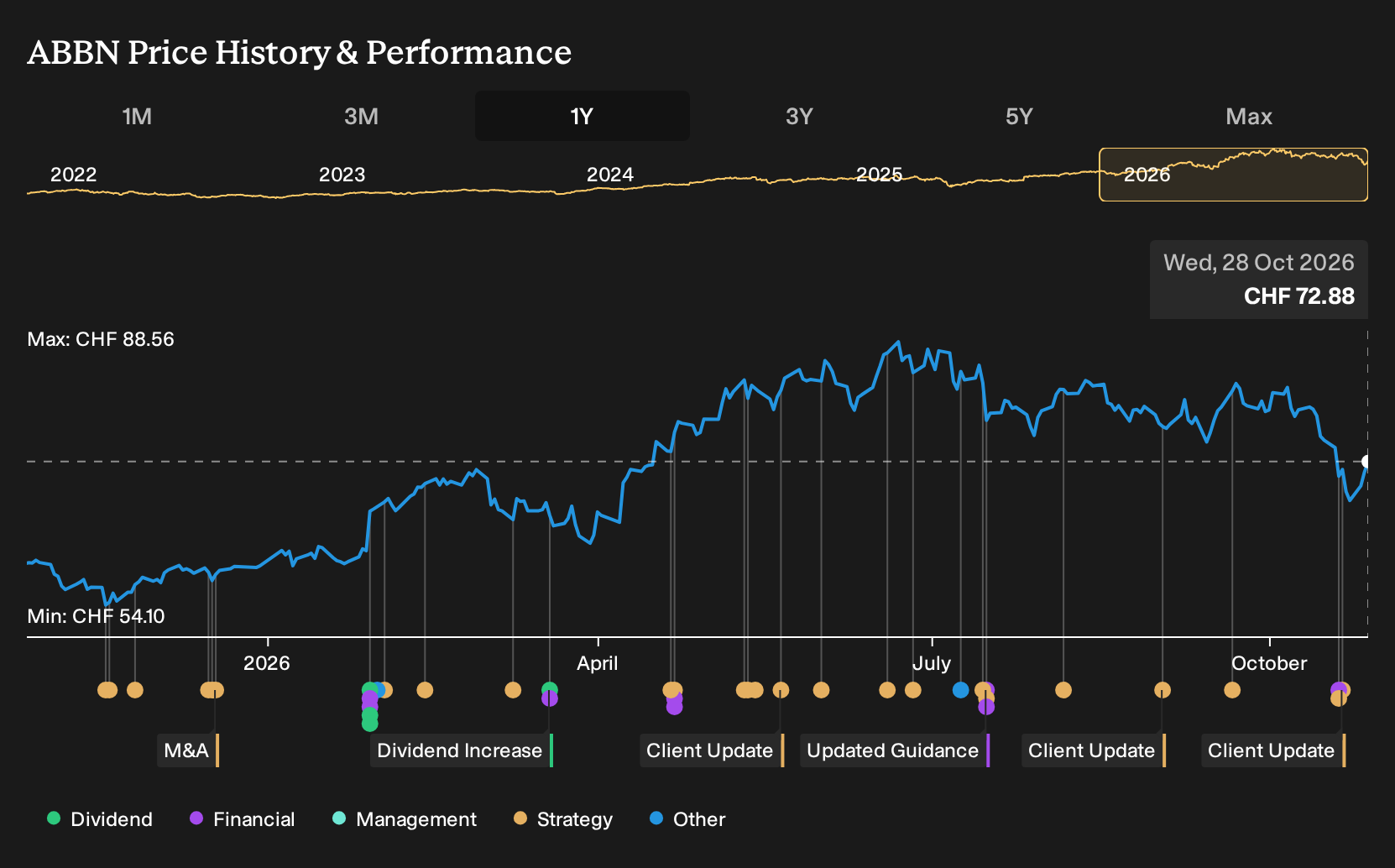
While the consensus price target of CHF82.86 sits 13.3% above the quoted CHF71.84 share price, the more important takeaway for investors is the set of conditions embedded in that gap. These include the revenue climb to US$48.3b, the earnings path to US$7.5b, and a future P/E close to 28.6x, all discounted back at roughly 6%.
The spread between the bullish CHF96.12 target and the bearish CHF66.67 view maps closely to the uncertainty around ABB's order intake quality and margin trajectory. Stronger data center and grid activity would tilt outcomes toward the upper end of the earnings range, while persistent price competition or weaker project execution would point closer to the lower bound.
For readers weighing ABB against peers, the key is not to copy these projections but to stress test them. Ask whether a near 10% annual revenue growth rate and a lift in margins to 15.5% over three years feel consistent with your expectations for global electrification, data center build outs, and ABB's ability to hold pricing in contested markets.
Uncover why ABB's fair value indicates a 14% potential upside to its current price, which could narrow quickly if ABB executes to consensus expectations.
Exploring Other Perspectives
One alternate view leans heavily on data center risk. Bearish analysts worry ABB might not fully turn its AI and DC backlog into profitable work, especially with issues like Gamesa Electric still weighing on returns. They were modelling only US$43.9b of 2029 revenue and US$6.7b of earnings before this latest cooling agreement, so you can treat today’s news as a prompt to compare several different storylines rather than accept a single forecast path.
Explore 5 other ABB fair value estimates, including one that suggests as much as 7% downside from the current price.
The Verdict Is Yours
Don't just follow the ticker. Dig into the data and build a conviction that's truly your own.
- A great starting point for your ABB research is our analysis highlighting 3 key rewards and 1 important warning sign that could impact your investment decision.
- See our latest analysis for ABB. The report includes a comprehensive fundamental analysis summarized in a single visual, the Snowflake, making it easy to evaluate ABB's overall financial health at a glance.
Looking for more ABB-linked investment ideas?
If the ABB story has sharpened your thinking about electrification, balance sheets, and payout profiles, it can help to line it up against other listed businesses targeting different angles of risk and return.
- For investors who care most about resilient finances and conservative risk, start with companies that show stronger balance sheet quality using this list of solid balance sheet and fundamentals (205 results).
- If you want income on top of potential capital gains, focus on companies with robust payout ratios and higher yields highlighted in this curated 226 dividend fortresses.
- Readers hunting for underfollowed opportunities can scan companies with solid fundamentals that receive less attention by working through this tailored 607 high quality undiscovered gems.
Have feedback on this article? Concerned about the content? Get in touch with us directly. Alternatively, email editorial-team@simplywallst.com