


EN
When Meta and Alphabet made the market worried that AI would burn money, Microsoft (MSFT.US) used more than 10 billion dollars in cash flow to “hedge” and commercialize AI from story to profit
The Zhitong Finance App learned that Microsoft (MSFT.US) announced the results for the first fiscal quarter of fiscal year 2027 (ending September 30, 2026) after the US stock market on Wednesday EST. The three core indicators of revenue, earnings per share, and Azure growth rate all exceeded market expectations, and for the first time, it disclosed Azure cloud revenue in dollar terms, providing investors with an observation anchor that had been missing before.
Financial reports show that Microsoft's total revenue for the quarter was US$92.3 billion, up 19% year on year; operating profit was US$45.9 billion, up 21% year on year (fixed exchange rate increase 22%); GAAP net profit was US$36.6 billion, up 32% year on year, corresponding to diluted earnings per share of 4.92 US dollars, up 32% year on year. Excluding the impact of OpenAI investments, non-GAAP net profit was US$36.4 billion (up 18% year over year), and non-GAAP diluted earnings per share were US$4.89 (up 18% year over year).
In contrast, Wall Street analysts expect adjusted earnings per share of $4.73 and revenue of $90.69 billion. Microsoft Chief Financial Officer Amy Hood summed up the quarter as “a strong start that exceeded expectations in terms of revenue, operating profit, and earnings per share” in a statement.
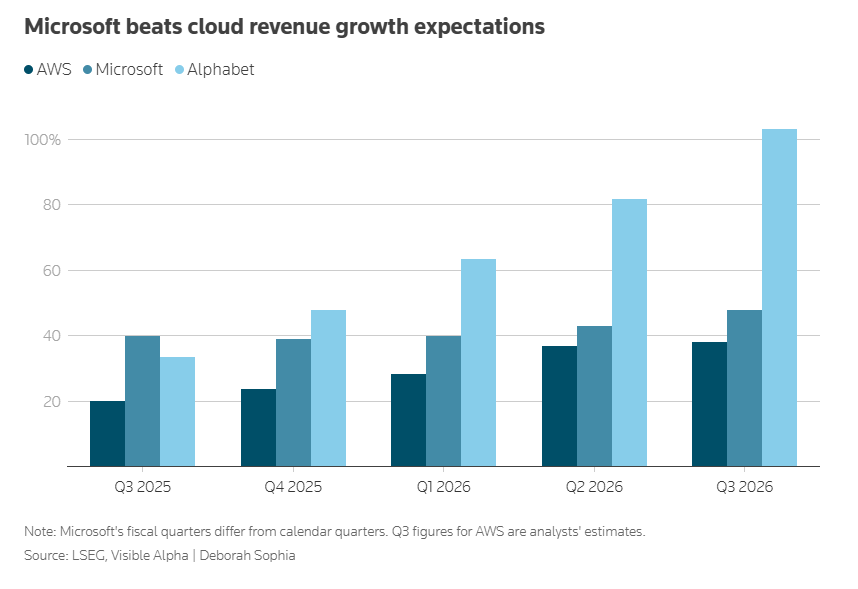
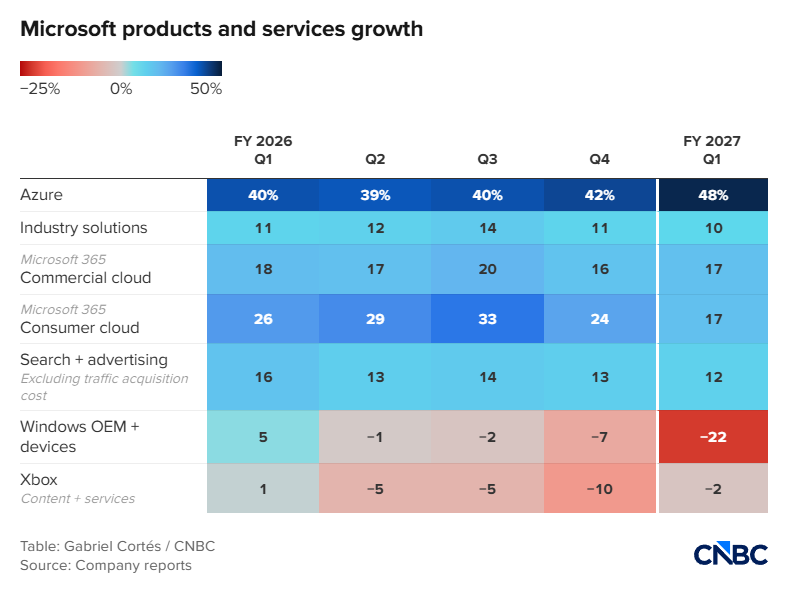
Looking at the breakdown, Azure was first disclosed in US dollars, making it Microsoft's largest single business. Azure's revenue for the quarter was US$33.17 billion, up 48% year on year, further accelerating from 42% in the previous fiscal quarter. It was also higher than the 44%-45% fixed exchange rate guidance given by the company in July and analysts' expectations of about 44%. This is the first time since Microsoft went public that it has separately disclosed Azure's revenue in dollars. Previously, it only disclosed the growth rate. The overall revenue of Microsoft Cloud (Microsoft Cloud) was US$63.9 billion, up 30% year over year (fixed exchange rate increased 31%), and the growth rate increased further from previous quarters.
The most direct endorsement of revenue growth comes from a 73% year-on-year increase in commercial remaining performance obligations (Commercial RPO) to $677 billion — this backlog of orders “signed and not yet confirmed as revenue” provides quantitative support for the “demand still exceeds supply” narrative.
Also, it is worth noting that starting from fiscal year 2027, Microsoft will re-list the three-part structure (productivity and business processes, intelligent cloud, more personal computing) that has been in use for 11 years into two business segments: Agents and Infra (intelligence and infrastructure) and Devices and Consumer (device and consumer business). Historical data has been restated.
According to the data, Agents & Infra's revenue for the quarter was US$76.8 billion, up 25% year over year, higher than the StreetAccount consensus of US$75.63 billion. This section includes Azure and Microsoft 365 cloud products, productivity and server licensing, industry solutions, and cutting-edge and support services, and is the main battleground for Microsoft's AI monetization.
Devices and Consumer's revenue for the quarter was US$15.48 billion, down 3% year on year, but it was better than the $15.05 billion consensus. Among them, Windows OEM and device revenue fell 22% year over year. Microsoft attributed the reason to rising memory and storage costs driving up prices, the high base figure brought about by the end of support for Windows 10 in the same period last year, and weak PC demand.
At the product level, Microsoft 365 commercial cloud revenue this quarter increased 17% year over year (increased 18% after adjustment, and the fixed exchange rate increased 19%, and the 1 percentage point revenue recognition benefit for the same period of the previous year has been normalized); search and advertising revenue (after deducting traffic acquisition costs) increased 12% year over year; and Xbox content and service revenue fell 2% year over year.
Two lines of AI commercialization: OpenAI split and CoPilot adoption
The financial report also provided two pieces of evidence on the progress of AI commercialization, corresponding to the two dimensions of “relationship with OpenAI” and “own Copilot ecosystem,” which partly allayed the market's double concerns about “AI threatening Microsoft's software empire” and “Microsoft's AI fate is excessively tied to unprofitable OpenAI.”
According to financial reports, OpenAI's commercial arrangement revenue reached 10 billion US dollars. According to the disclosure, the total revenue from commercial arrangements (including revenue share) with OpenAI this quarter was $10 billion, accounting for about 11% of Microsoft's total sales, up from about 7% for the full year 2026. The financial report also revealed that as of September 30, accounts receivable for OpenAI were 7.2 billion US dollars (6 billion US dollars on June 30). Microsoft's total investment commitment to OpenAI was 13 billion US dollars, and it has already invested 12 billion US dollars, calculated using the equity method and corresponding to about 24% of OpenAI's converted equity.
One of the caliber risks to be aware of is that of this $10 billion, Microsoft sells Azure computing power to OpenAI, and not all of it is equivalent to net incremental external demand.
Microsoft also revealed an increase in the number of its Copilot users. CEO Nadella said on the conference call that “the number of Microsoft 365 Copilot users increased 50% from the previous quarter,” but at the same time emphasized that “paid seats were not disclosed.” Although in the transcript of the conference call, Hood clearly stated “We haven't disclosed updates to Copilot figures this quarter; we're talking about revenue and usage trends”, there is no contradiction between the two — the former points to a month-on-month increase in total number of users (including trial/free), while the latter points to undisclosed paid seats.
Furthermore, Microsoft's newly released high-end productivity suite, Microsoft 365 E7, has received “millions of seats,” and Nadella's “low cost strategy” — including the Copilot Cowork smart device with multi-model switching and a series of low-cost models — is seen as capturing the needs of enterprises that are increasingly sensitive to the cost of AI deployment. These numbers all indicate that “Microsoft is profiting from corporate AI needs, mitigating fears that the technology threatens its software empire and is too deeply tied to unprofitable OpenAI.”
Differentiation in AI payback delivery: Azure growth+scarcity of positive free cash flow
Against the backdrop of large technology companies such as Alphabet (GOOGL.US) and Meta (META.US) experiencing negative or sharp contraction in free cash flow due to huge investment in AI infrastructure, Microsoft maintained positive free cash flow this season, constituting the clearest division of individual stocks in this round of AI capital expenditure cycle. After the financial report was announced, Microsoft's stock price rose by more than 6% after the market, in stark contrast to Alphabet's sharp drop of more than 9%.
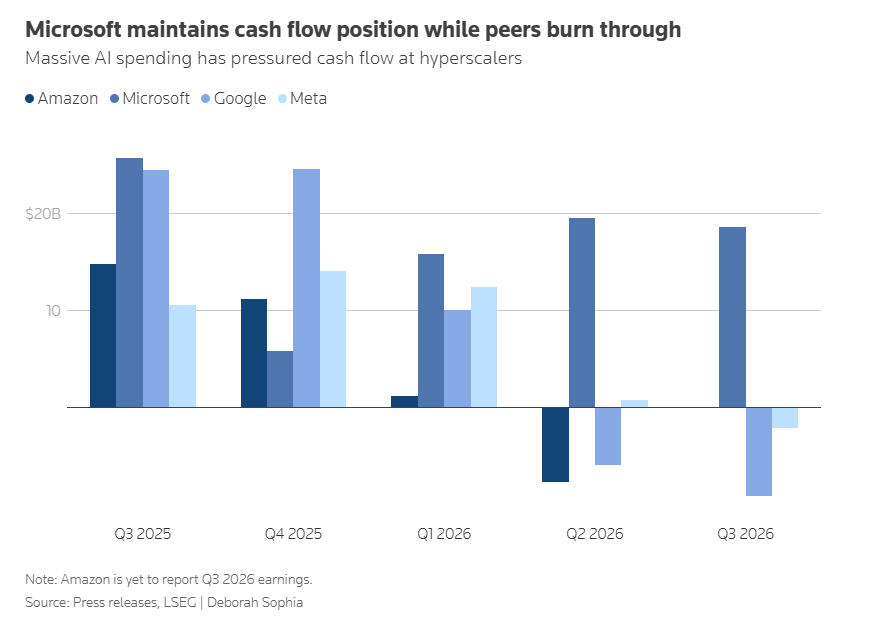
Microsoft's free cash flow for the quarter was 18.6 billion US dollars, down 27% year on year, but it was significantly higher than analysts' previous expectations of about 8 billion US dollars. The key to “exceeding expectations” is that capital expenditure is lower than the company's own guidelines: capital expenditure (including financial leases) for the quarter was US$45.2 billion, up 30% year on year, lower than the “over US$50 billion” guideline given by the company in July, and also lower than the StreetAccount consensus of US$50.67 billion. CFO Hood attributed the gap to a delay in third party capacity (GPU-as-a-Service, GPUaaS) delivery rather than a contraction in expenditure plans: “We expect part of the third party capacity to be delivered in the first fiscal quarter has actually been delayed.”
In contrast, Alphabet's free cash flow for the third fiscal quarter was -9.07 billion US dollars. Meta experienced negative free cash flow for the first time last week, while Oracle (ORCL.US) said on the same day that capital expenditure will peak in this fiscal year and the next fiscal year. Jesse Cohen, senior analyst at Investing.com, commented on this, saying that the Microsoft quarterly report “is almost clean as it gets (about as clean as it gets) for a company of this size” is a “balance weight” after Meta and Alphabet data revived anxiety about AI spending: “Demand still exceeds supply, the commercial backlog is huge, and the return is finally reflected in profits and overall revenue.”
Chad Morganlander, senior portfolio manager at Washington Crossing Advisors, also pointed out that Microsoft is “the only company with annual free cash flow that has not turned negative” among the big four computing giants. “As a company that is still investing but is not in the red, it looks like the adult in the room (the adult in the room)”.
It should be noted, however, that free cash flow is “better than expected”, due in large part to capital expenditure falling short of guidance due to delays in production capacity by third parties — this is essentially a time misalignment rather than a jump in efficiency. If it were to be asserted that “AI has formed its own blood” based on this, it would confuse the pace of accounting with the real return on investment.
Although Goldman Sachs maintained a “buy” rating for Microsoft in an earlier research report, it also suggested that “continued expansion of AI infrastructure investment will still put pressure on Microsoft's free cash flow,” and predicted that Microsoft's free cash flow will drop from about US$67 billion in fiscal 2026 to about 40.1 billion US dollars in fiscal year 2027, and further to about 14.3 billion US dollars in fiscal year 2028. In other words, positive free cash flow is currently a “comparative advantage” rather than “absolutely no pressure.”
Capital expenditure: lower than expected is a delay, not a convergence
The “lower than expected” capital expenditure for this quarter is one of the most easily misinterpreted signs in this financial report. Proper understanding requires distinguishing the pace of accounting/delivery from real investment intentions.
According to official data, capital expenditure (including financial leases) for the quarter was US$45.2 billion, up 30% year on year (US$34.9 billion in the same period last year); of these, cash-caliber “real estate and equipment purchases” was US$39.367 billion, nearly double the same period last year (US$19.394 billion in the same period last year). Hood clearly attributed the gap to delays in third party GPUaaS capacity delivery and emphasized that “demand still exceeds supply”.
Expenses will accelerate in the second half of the year. Hood gave guidance on the conference call: capital expenditure for the second fiscal quarter (including financial leases) will exceed $50 billion, and “capital expenditure for the second half of the fiscal year is expected to accelerate due to the aforementioned third party capacity delays, mainly driven by CPUs (including higher memory and storage costs) and GPUs, and third party capacity delivery postponed to the second half of the year”; 2027 natural year capital expenditure guidance is about 170 billion US dollars.
One detail that is easily overlooked is that approximately 75% of capital expenditure is currently invested in short-term assets (such as Intel (INTC.US) CPUs and Nvidia (NVDA.US) GPUs), up from about 66% in the previous three quarters and about half of the same period last year. This shift shows that Microsoft is prioritizing infrastructure that quickly translates into revenue — “faster revenue recognition with faster weekly conversions,” rather than simply scaling up.
Another more hidden accounting mechanism is also worth noting: Microsoft took the initiative in July to extend the useful life of data center buildings from 15 to 25 years, and reclassified some leases from financial leases to operating leases, reducing the book capital expenditure from $190 billion to $175 billion — but actual construction investment did not decrease as a result. This means that the decline in book capital expenditure is not equal to a slowdown in the actual pace of construction. Observing the intensity of Microsoft's AI infrastructure, we need to look at multiple measures such as cash purchases, financial leases, and operating lease commitments at the same time.
The shift to capital efficiency and the “responsible spending” narrative
Despite this, in addition to the huge investment, Microsoft is using a series of capital efficiency actions to send a signal of “responsible spending” to the market, which forms support its valuation premium relative to its peers.
D.A.Davidson analyst Gil Luria said that Microsoft “still takes the most responsible approach (considering to have the most responsible approach)” when it comes to spending. Supporting this judgment are three parallel clues: First, the aforementioned change in the allocation of about 75% of capital expenditure to short-term assets; second, Microsoft laid off 4,800 employees this season (about 2.1% of the total number of employees) and announced on October 26 that it would provide a voluntary separation (buyout) plan for about 60,000 employees (about a quarter of the total number of employees) to find a balance between expensive AI construction and capital efficiency; third, the launch of Copilot Cowork, which switches between low cost models and multiple models, to capture wider demand.
However, “responsible spending” is essentially a narrative rather than a financial result, and must be presented in parallel with “accelerated capital expenditure in the second half of the year.” In fact, according to the Bank of America's global fund manager survey in September 2026, 42% of respondents viewed “AI infrastructure expenses” as the most likely source of systemic credit incidents (38% in August), and 53% ranked the purchase of semiconductor stocks as the “most crowded transaction” — the market's questions about AI capital expenditure are systemic and not limited to individual companies.
However, at a time when “debt-driven spending” is increasingly triggering market alarm, Microsoft's credit profile is still a key buffer for its “time in exchange for space.”
According to Truist statistics, Microsoft's five-year credit default swap (CDS, an indicator that measures the perceived risk of default) is still the narrowest among large technology companies, even though the average interest spreads for most AI transactions have widened. Hood also confessed during the call: “Given our ratings, we are very lucky to be able to finance in the debt market... I have to say, we haven't used [the debt market] yet.”
Looking ahead, Microsoft gave positive guidance on the conference call: revenue for the second fiscal quarter is expected to be between 96 billion and 97.1 billion US dollars (the midpoint of the range corresponds to a year-on-year growth rate of about 18.8%), higher than LSEG's consensus of 95.6 billion US dollars; Azure for the second fiscal quarter is expected to grow 49% to 50% at a fixed exchange rate, higher than StreetAccount's 45.1% consensus. “Our demand still exceeds supply,” Hood said.
This guideline continues the main line of “demand is stronger than supply,” but it also means that the market's verification window for Microsoft's AI investment will be further lengthened — the real problem is not the growth in this or next quarter, but rather whether free cash flow can remain positive without being “passively lower than the guideline” after capital expenditure of about 170 billion US dollars is gradually implemented in the 2027 natural year and third-party production capacity is delayed in the second half of the year, and whether Azure's high growth rate can continue on a larger basis.