


EN
3 Stocks to Watch as Political Risk Lifts CME Group and Derivatives Trading
Political risk is suddenly front and center again, with the Alaska Senate race, a contested certification process, and direct White House pressure on the DOJ turning election rules into a market story. Short bursts of uncertainty tend to reshuffle winners and laggards fast, especially around derivatives and volatility trading. This piece walks through three stocks that appear closely exposed to this news, and why that link matters for your portfolio decisions.
The stocks covered below are just a starting sample, and the full screen surfaced 31 more U.S. listed derivatives and volatility trading infrastructure companies with equally compelling narratives that are not included in this article.
If you want to identify and analyze potential high conviction ideas quickly, head straight into the U.S. Listed Derivatives and Volatility Trading Infrastructure screener
Virtu Financial (VIRT)
Overview: Virtu Financial is a high-frequency market maker and trading technology firm that provides liquidity and execution services across global markets.
Operations: Virtu generates about US$2.7b from Market Making and US$667 million from Execution Services, primarily across the United States and Ireland.
Market Cap: US$8.68b
Virtu Financial is relevant in this context because it operates at the intersection of derivatives, options, and intraday volatility with the core infrastructure of modern markets, so bursts of political risk can quickly reshape its trading environment.
Expansion into digital assets, new products, and cross-asset services may reduce earnings cyclicality and support Virtu's position in emerging markets for these services.
An important consideration is what could happen to Virtu's margins if one less visible pressure on its funding costs and trading volumes shifts at an unfavorable moment.
If that funding squeeze risk matters to you, read the full narrative for Virtu Financial to see how Virtu Financial’s setup could accelerate or stall under sharper volatility regimes.

StoneX Group (SNEX)
Overview: StoneX Group is a global financial services network that connects commercial, institutional, and retail clients to futures, options, commodities, and payments markets.
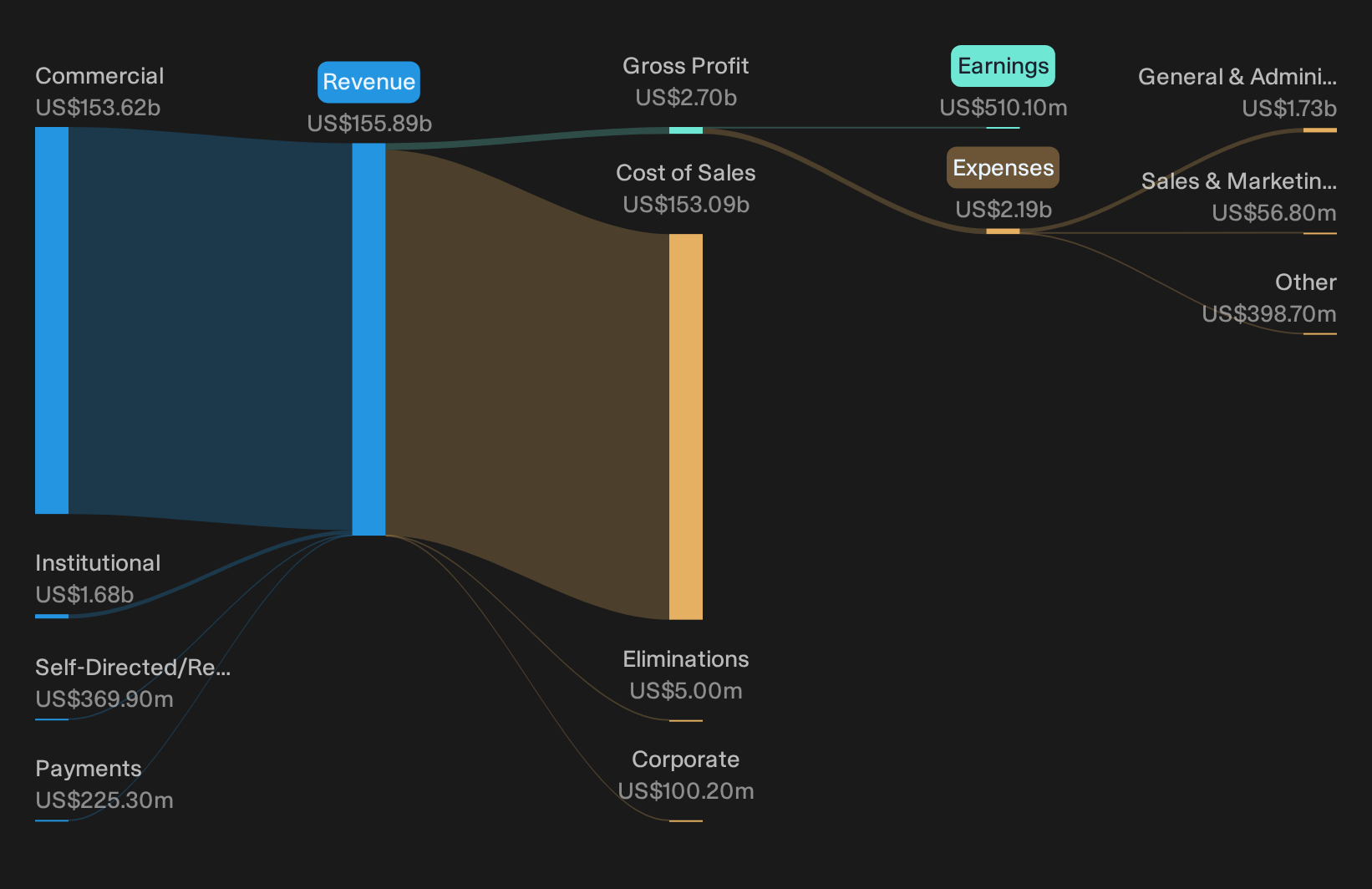
Operations: StoneX generates most of its US$155.6b revenue from Commercial activities, with additional billions from Institutional, Self-Directed/Retail, and Payments segments worldwide.
Market Cap: US$6.7b
StoneX Group matters for this derivatives and volatility screen because it links clients directly into futures and options markets where political headlines quickly turn into hedging demand and trading flow.
The R.J. O’Brien acquisition, completed in July 2025, made StoneX the largest non-bank futures commission merchant in the United States and strengthened its listed derivatives, clearing, and commodity brokerage franchise. The acquisition is expected to affect derivatives scale, client balances, cross-selling, and operating leverage.
The real swing factor for StoneX Group is what happens if one quiet shift in client activity reshapes how those new volumes feed through to profitability.
That quiet shift could be pivotal, and the full narrative for StoneX Group shows how StoneX Group’s derivatives reach, client mix, and risk controls might be accelerating or quietly stalling.
CME Group (CME)
Overview: CME Group runs major futures and options exchanges and a clearing house where institutions and investors manage risk tied to global markets.
Operations: CME Group generates about US$7.0b in revenue from Unclassified Services, largely tied to derivatives trading, clearing, and related services.
Market Cap: US$110.3b
Where Virtu and StoneX plug clients into the plumbing of derivatives, CME Group is the marketplace itself for futures, options, and clearing when political risk suddenly matters more.
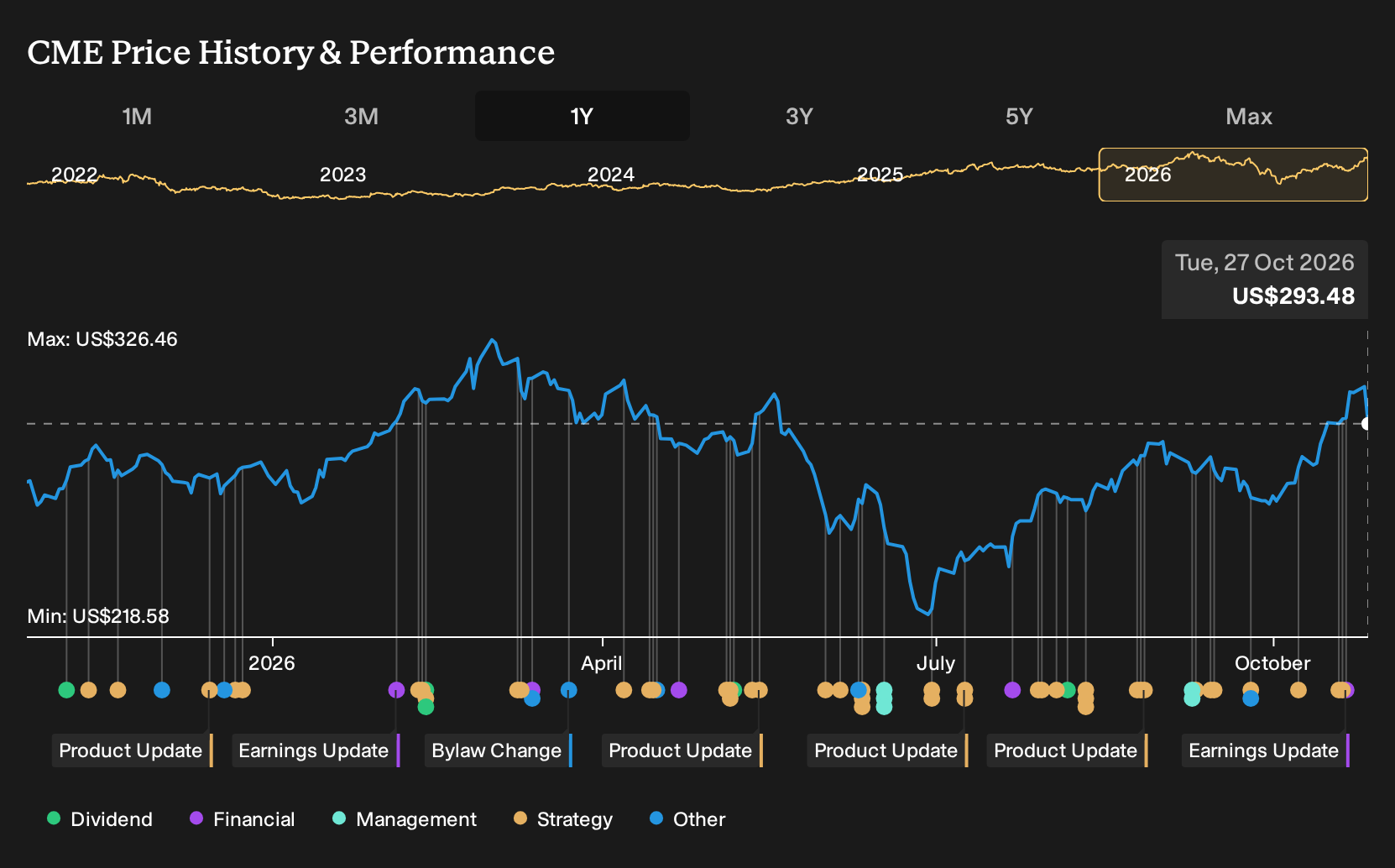
Heightened global macroeconomic uncertainty, record sovereign debt issuance, persistent geopolitical tensions, and ongoing trade disputes are fueling sustained demand for risk management and hedging solutions, evidenced by record contract volumes and open interest. This supports CME Group transaction fee revenue and helps keep margins and earnings strong.
For you as a shareholder or prospective investor, a single shift in how regulators treat newer contract types could reshape that earnings mix quickly.
That kind of rule change risk is exactly why reading the full narrative for CME Group can help you see where CME Group’s earnings mix might quietly be accelerating or stalling in the future.
Seeking Alternatives Before Momentum Flies
Markets move fast, and fresh opportunities can shift from under the radar to fully priced while you wait. Spot potential ideas before the crowd moves in and act based on your own analysis.
- Target income-focused ideas by scanning 5 dividend fortresses that aim to keep cash flowing even when prices are swinging and yields elsewhere are changing.
- Explore early AI-related opportunities with 39 profitable AI stocks that aren't just burning cash that already have earnings behind them instead of relying on companies that are still burning cash while the story is under the radar.
- Consider positioning for a potential power shift using 42 power grid technology and infrastructure stocks that could benefit if grid upgrades accelerate and more capital is directed toward critical infrastructure.
Have feedback on this article? Concerned about the content? Get in touch with us directly. Alternatively, email editorial-team@simplywallst.com