


EN
IDEX (NYSE:IEX) beats Q3 2026 sales expectations

Manufacturing company IDEX (NYSE:IEX) reported Q3 2026 results exceeding the market’s revenue expectations, with revenue up 8.3% year on year to $951.7 million. Its non-GAAP profit of $2.33 per share was 4% above analysts’ consensus estimates.
For more on IDEX, read our free full research report.
IDEX (IEX) Q3 2026 highlights:
- Revenue $951.7 million vs S&P analysts’ consensus estimates of $934.5 million (8.3% year-on-year growth, 1.8% beat)
- Adjusted EPS $2.33 vs S&P analysts’ consensus estimates of $2.24 (4% beat)
- Adjusted EBITDA $264.8 million vs analysts’ consensus estimates of $256.6 million (27.8% margin, 3.2% beat)
- Adjusted EPS guidance Management raised its full-year adjusted EPS guidance to $8.94 at the midpoint, a 1.8% increase
- Operating margin 21.9%, in line with the same quarter last year
- Free cash flow margin 22.5%, up from 21.5% in the same quarter last year
- Market capitalization $17.19 billion
“We are pleased to report another strong quarter, with results ahead of our expectations. This quarter, we delivered both record sales and adjusted EPS while expanding margins and booked nearly $1 billion in orders. Advantaged markets and larger acquired businesses are driving this performance, and momentum is broadening across the rest of the portfolio,” said Eric D. Ashleman, IDEX Corporation Chief Executive Officer and President.
Revenue growth
A company’s long-term revenue performance can indicate its overall quality. Any business can deliver a good quarter or two, but many enduring ones grow for years. Over the last five years, IDEX grew its revenue at a mediocre 6.5% compounded annual growth rate, falling short of the industrials sector standard.
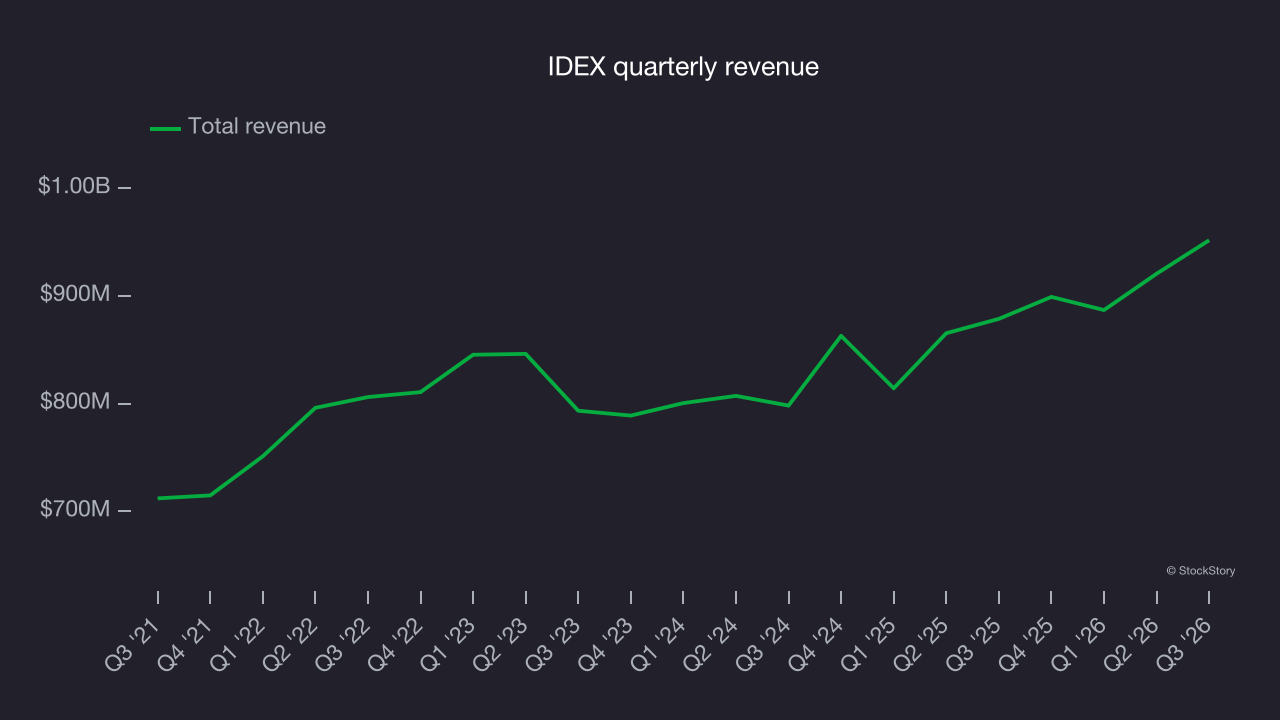
Long-term growth matters most, but within industrials, a half-decade historical view may miss cycles, industry trends or a company capitalizing on catalysts such as a new contract win or a successful product line. IDEX’s annualized revenue growth of 7% over the last two years aligns with its five-year trend, suggesting its demand was consistently weak. 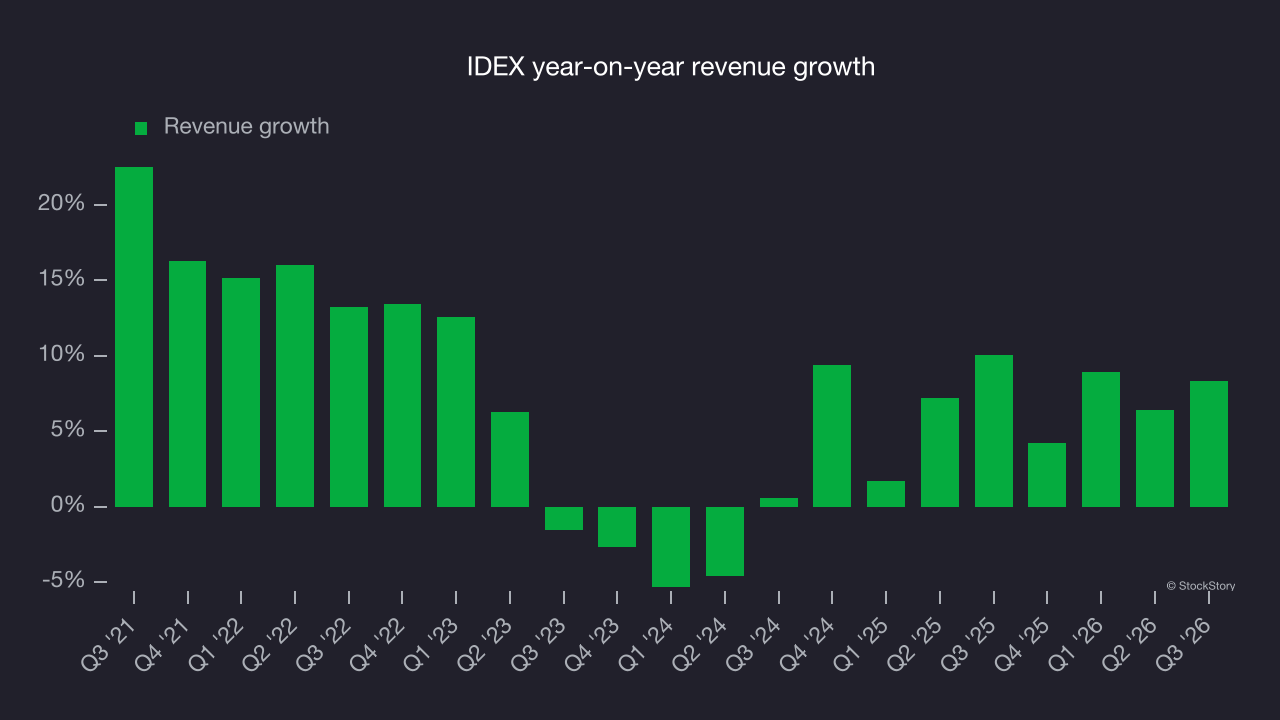
This quarter, IDEX reported year-on-year revenue growth of 8.3%, and its $951.7 million of revenue exceeded Wall Street’s consensus estimates by 1.8%.
Looking ahead, sell-side analysts expect revenue to grow 5.4% over the next 12 months, according to S&P, a slight deceleration versus the last two years. This underwhelming projection indicates its products and services will face some demand headwinds.
Operating margin
IDEX has performed well over the last five years. It demonstrated high profitability for an industrials business, with an average operating margin of 21.7%. This result is unsurprising given its high gross margin, which provides a favorable starting point.
Analyzing the trend in its profitability, IDEX’s operating margin decreased by 3.2 percentage points over the last five years. This raises questions about the company’s expense base because its revenue growth should have given it leverage on its fixed costs, resulting in better economies of scale and profitability.
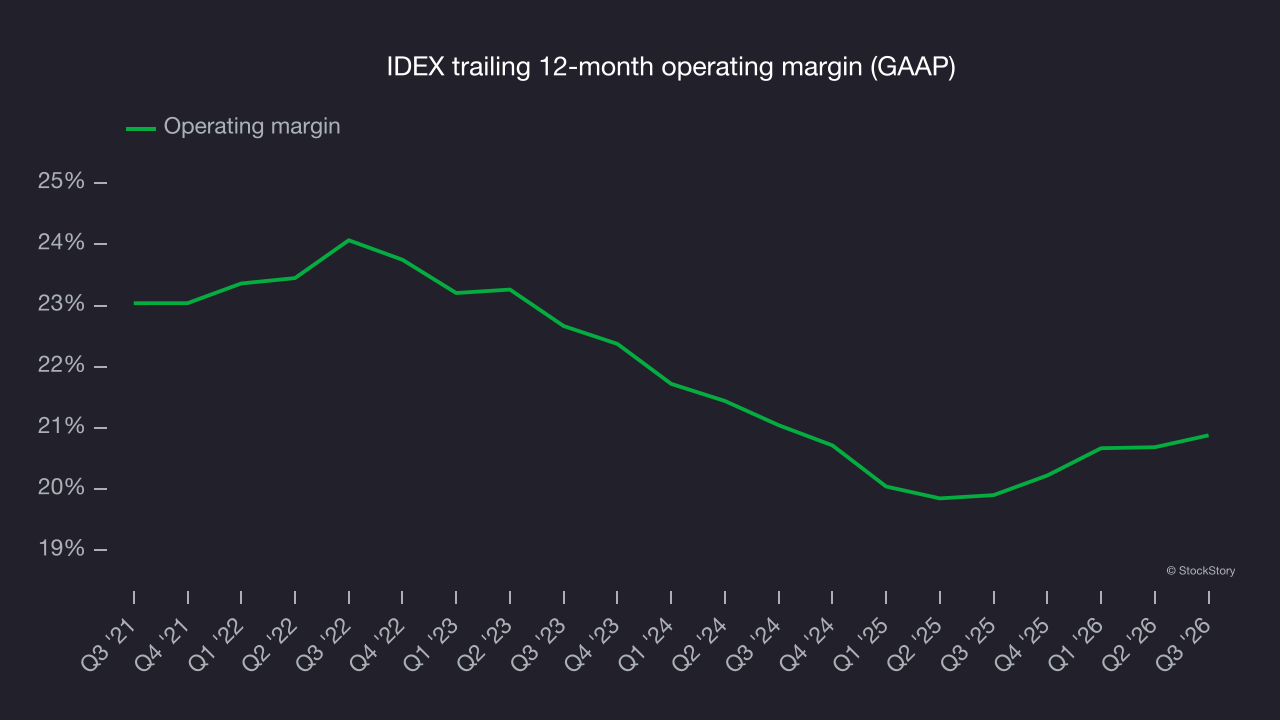
In Q3, IDEX generated an operating margin of 21.9%, in line with the same quarter last year. This indicates the company’s cost structure has recently been stable.
Earnings per share
Revenue trends explain a company’s historical growth, but the long-term change in earnings per share (EPS) points to the profitability of that growth. For example, a company could inflate its revenue through excessive spending on advertising and promotions.
IDEX’s unimpressive 7.4% annual EPS growth over the last five years aligns with its revenue performance. This tells us it maintained its per-share profitability as it expanded.
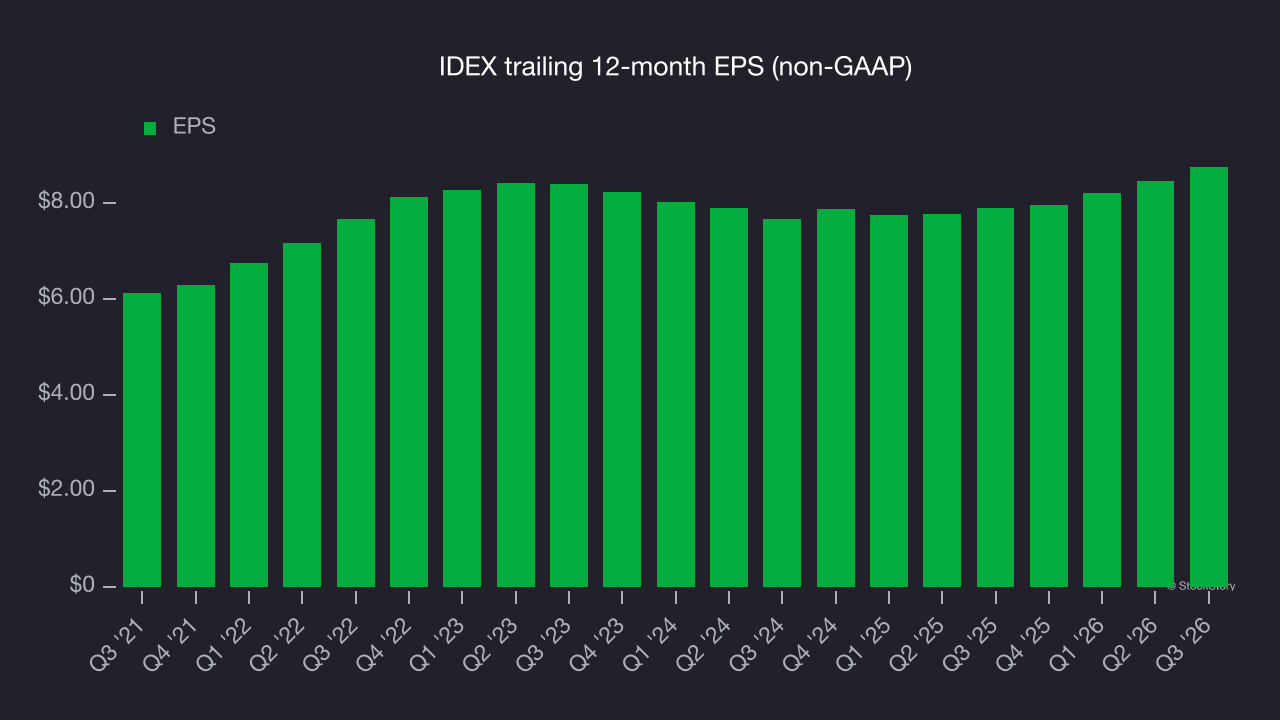
As with revenue, examining EPS over a shorter period can reveal changes in the business.
For IDEX, its two-year annual EPS growth of 6.8% is similar to its five-year trend, implying stable earnings.
In Q3, IDEX reported adjusted EPS of $2.33, up from $2.03 in the same quarter last year. This result beat analysts’ consensus estimates by 4%. Over the next 12 months, Wall Street expects IDEX’s full-year EPS to grow 8.1% from $8.75 to $9.46, according to S&P.
Key takeaways from IDEX’s Q3 results
IDEX delivered a decent quarter, with both revenue and EBITDA topping analysts’ consensus estimates. Those beats were the key positives in the report. Shares remained flat at $233.06 immediately after the results.
When deciding whether IDEX is a buy, the latest quarter matters, but not nearly as much as longer-term fundamentals and valuation. Read the full research report for more on these factors (it’s free).