


EN
Does Earnings Beat Change The Bull Case For Teradyne Stock (TER)
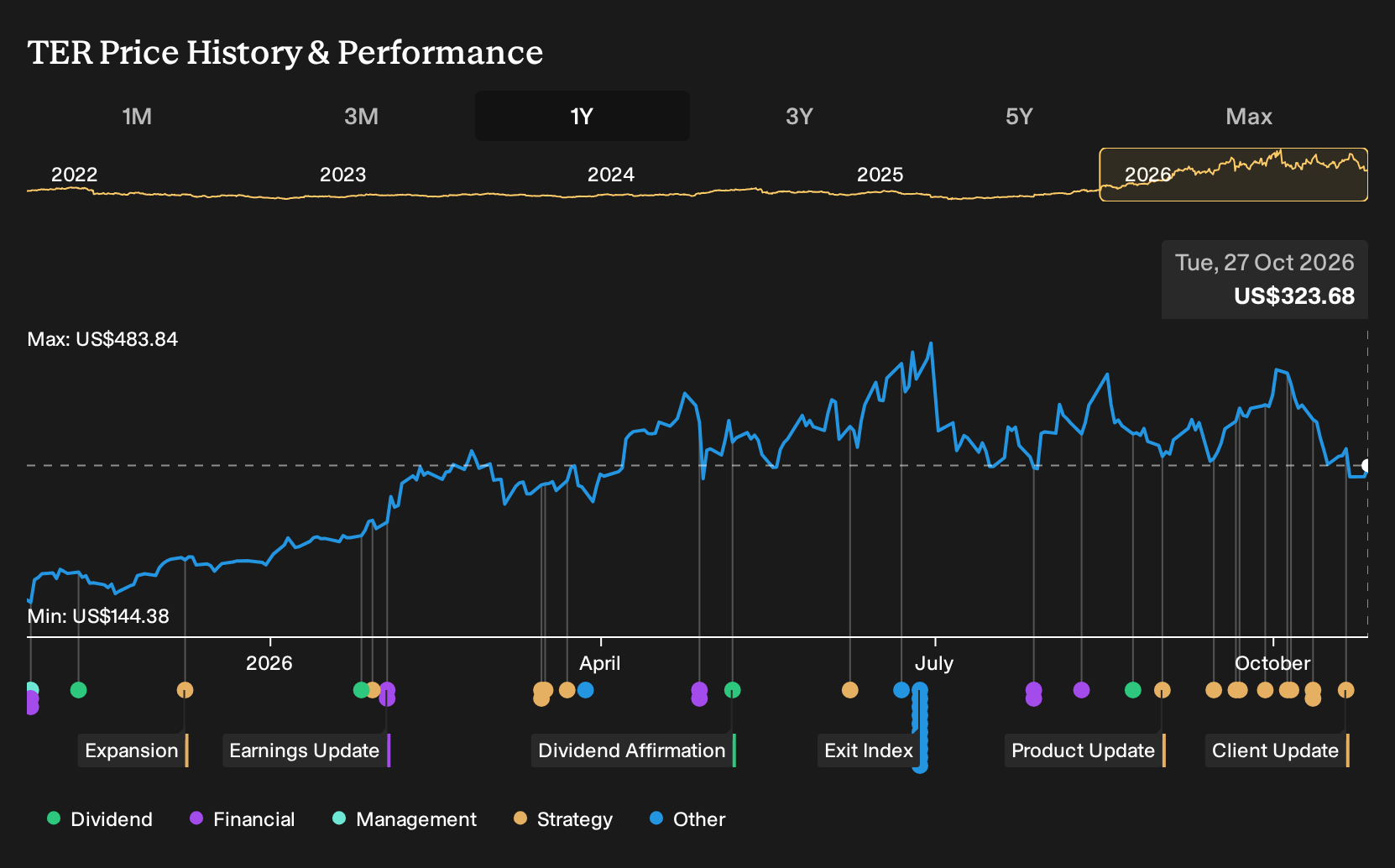
- Teradyne reported third quarter 2026 sales of US$1,305.95 million and net income of US$342.41 million, with earnings per share from continuing operations of US$2.17 on a diluted basis.
- The company’s nine month 2026 results, with US$3,917.43 million in sales and US$1,115.85 million in net income, show how current demand conditions are influencing both scale and profitability across the test and robotics portfolio.
- This article examines how Teradyne's investment narrative is affected by this significant increase in quarterly earnings power.
Scan beyond Teradyne and explore other robotics and automation plays linked to this earnings momentum using our hand-picked 94 robotics and automation stocks.
Teradyne Investment Narrative Recap
To own Teradyne, you need to believe that AI driven semiconductor test, memory programs and robotics can support a larger, more resilient earnings base over time. The latest quarter, with US$1,305.95 million in sales and US$342.41 million in net income, reinforces that the firm is currently executing against that AI and automation demand.
The key short term swing factor remains how orders tied to AI data centers and complex chip packaging hold up, given prior concerns about capital spending timing. The biggest risk is still margin pressure from mix, pricing and higher R&D, so the recent profitability strength only partly eases that concern.
The Sereact partnership inside Teradyne Robotics is the announcement that most clearly complements this earnings story. Hundreds of Universal Robots systems are already running Cortex software in European logistics sites, and returns handling at Zalando fulfillment centers in Germany and Poland is now automated using UR12e based cells.
For you, this ties directly into the catalyst of robotics and physical AI becoming a more material contributor beside Semiconductor Test. It also highlights execution risk. Scaling from hundreds of robots at early adopters to broader use across returns handling, store replenishment and piece picking will test how repeatable the Teradyne robotics model really is.
Teradyne Consensus Assumptions and What They Imply
Teradyne's current quarter tells you what the business is earning today. The analyst playbook outlines what has to happen next. Consensus models are built around AI heavy test demand and growing robotics adoption, but the key numbers are straightforward enough for you to pressure test yourself.
Forecasters are assuming Teradyne's revenue grows at about 22.7% a year over the next few years. That pace underpins their view that AI centric test systems, memory programs and robotics can support a larger earnings pool. If actual order patterns or pricing differ from those expectations, the compounding effect on future sales could be very different from the simple headline growth rate.
On profits, analysts frame today's earnings at about US$1.2b and are targeting US$2.6b of net income by 2029 as their central case. That implies earnings a little more than doubling, roughly 2.2x current levels, with profit margins moving from 25.8% to 31.4%. The gap between the most bullish estimate at US$3.5b and the most cautious at US$1.9b highlights how uncertain that journey is, even before you add in cycle risk or competitive responses.
Valuation assumptions are doing just as much work as the operational forecasts. To hit the consensus price target, Teradyne would need to be trading on a P/E of 37x those projected 2029 earnings, compared with 54.5x today and against a current US Semiconductor industry P/E of about 46.9x. For you as an investor, that means the story is not only about higher robotics and test profits but also about a lower valuation multiple than the stock currently carries and a discount to the wider peer group multiple cited in the report.
Analysts also build in a small reduction in share count, with forecasts assuming outstanding shares shrink by roughly 0.17% a year for the next three years. Even if that change feels minor in any single year, over time it can modestly boost earnings per share relative to net income growth, assuming the buyback or share reduction actually occurs on those terms.
In addition, the analysis uses discount rates around 11.25% to bring those future earnings back to today. That choice plays a major role in the fair value range you see, because even strong cash generation can look very different when discounted at a higher required return. Your own required rate of return may differ, which is one reason to treat the consensus fair value as a scenario rather than a conclusion.
Teradyne's narrative projects US$8.2b revenue and US$2.6b earnings by 2029. This rests on analysts assuming 22.7% yearly revenue growth and implies earnings of about US$1.2b today rising to US$2.6b by that year, which is roughly a 2.2x earnings increase off the current base.
Uncover why Teradyne's fair value signals a 38% potential upside to its current price, a gap that could narrow quickly if expectations continue to hold.
Exploring Other Perspectives
The most cautious analysts focus on the risk that Teradyne’s AI heavy test and robotics pipeline hits a revenue air pocket. Before these Q3 numbers, they were pencilling in about US$6.8b of 2029 sales and US$1.9b of earnings, which is well below consensus. Treat this earnings surprise as a reason to compare those different narratives and evaluate which assumptions you find more realistic.
Explore 4 other Teradyne fair value estimates, including one that suggests as much as 26% downside from the current price!
The Verdict Is Yours
Disagree with existing narratives? Extraordinary investment returns rarely come from following the herd, so go with your instincts.
- A great starting point for your Teradyne research is our analysis highlighting 3 key rewards and 1 important warning sign that could impact your investment decision.
- See our latest analysis for Teradyne. The report includes a comprehensive fundamental analysis summarized in a single visual, the Snowflake, making it easy to evaluate Teradyne's overall financial health at a glance.
Looking for more Teradyne style investment ideas?
If the Teradyne story has sharpened your focus on quality, use the Simply Wall St Screener to identify other stocks that fit your own risk and return preferences.
- If capital protection comes first for you, start with a basket of companies that score well on balance sheet strength and fundamentals through our list of solid balance sheet and fundamentals (24 results).
- If value for money is your filter, look for shares that combine quality metrics with pricing that screens as attractive using the 29 high quality undervalued stocks.
- If you want to search for lesser known opportunities, cast a wider net across financially sound businesses that receive less attention using the 21 high quality undiscovered gems.
Have feedback on this article? Concerned about the content? Get in touch with us directly. Alternatively, email editorial-team@simplywallst.com