


EN
Ford Motor (F) Could Be 25% Undervalued After Fuel Pump Class Action Ruling
Ford Motor (F) is back in focus after a federal judge certified state classes in a long-running lawsuit over CP4 high-pressure fuel pumps in certain 6.7L diesel trucks.
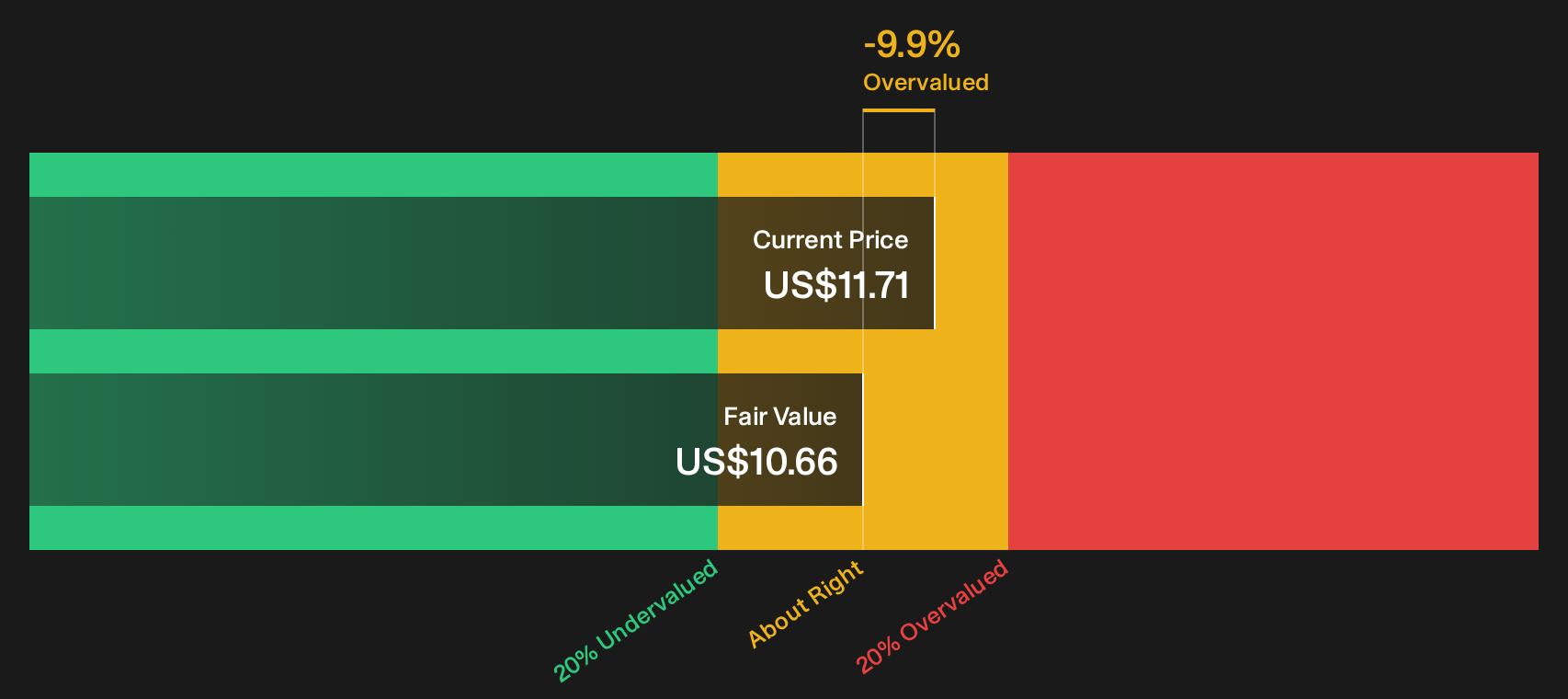
Ford Motor shares trade at US$11.71 after a mixed year, with the 1 year total shareholder return down 6.66% even though the 3 year total shareholder return is up 42.81%. Recent 90 day share price weakness of 23.36% suggests momentum has been fading as investors reassess legal and operational risks.
Scan beyond Ford Motor and compare how other manufacturers with heavy recall or legal exposure are priced today by running a focused screen of 30 resilient stocks with low risk scores.
For Ford Motor, the recent slide could reflect deeper concern about legal and diesel exposure, or simply a shift in sentiment away from cyclical autos. The valuation now needs to be tested against those pressures.
Most Popular Narrative: 25% Undervalued
Ford Motor closed at $11.71 while the most followed valuation storyline puts fair value closer to $15.70. That gap rests on a view that software, commercial fleets, and cost discipline can outweigh current legal and diesel headlines.
Ford Motor is building a larger base of high margin software subscriptions, with about 1.6 million paid subscriptions across the group, blended ARPU of around US$14 per month and contribution margins above 50%, which can increase recurring revenue and support earnings resilience if subscriber numbers and ARPU continue to grow.
See why 203 investors see Ford Motor as 25% undervalued.
Result: Fair Value of $15.70 (UNDERVALUED)
Still, the narrative around Ford Motor could unravel if recall costs flare up again, or if trade and regulatory pressures materially erode margins and cash generation.
Find out about the key risks to this Ford Motor narrative.
Another View: Cash Flows Tell A Different Story
There is a catch. While the prevailing Ford Motor narrative leans on a fair value of about $15.70, the Simply Wall St DCF model puts the future cash flow value nearer to $10.66, which implies the shares trade above that estimate and could be pricing in more execution success than that model supports.
That gap does not make either approach right or wrong on its own, but it does leave you with a simple question: Which yardstick do you trust more when software, recalls, and EV spending all pull the forecast in different directions?
Look into how the SWS DCF model arrives at its fair value.
Simply Wall St performs a discounted cash flow (DCF) on every stock in the world every day (check out Ford Motor for example). We show the entire calculation in full. You can track the result in your watchlist or portfolio and be alerted when this changes, or use our stock screener to discover 29 high quality undervalued stocks. If you save a screener we even alert you when new companies match - so you never miss a potential opportunity.
Next Steps
Mixed messages around Ford Motor can pull you in opposite directions, so move quickly, review the full data set, and weigh the 3 key rewards and 2 important warning signs.
Looking for more investment ideas beyond Ford Motor?
Do not stop with Ford Motor. Use the Simply Wall Street screener to spot other opportunities that fit your style before the crowd moves on.
- Target potential upside by reviewing companies that currently look mispriced using the 29 high quality undervalued stocks.
- Focus on stability by scanning a list of solid balance sheet and fundamentals (24 results) that could better handle shocks and funding needs.
- Hunt for lesser-known opportunities by checking a 21 high quality undiscovered gems before attention and liquidity catch up.
Have feedback on this article? Concerned about the content? Get in touch with us directly. Alternatively, email editorial-team@simplywallst.com