


EN
DocuSign Stock And AI Governance Demand In Focus
AI headlines are moving from hype to hard questions as Anthropic’s potential $2 trillion IPO puts both opportunity and risk governance in the spotlight. Capital is still pouring into anything tied to algorithms and data, while regulators, politicians and infrastructure bottlenecks turn up the heat on how those systems are controlled. This article examines three stocks connected to that news flow and explains how their approach to cyber risk and governance could be relevant for a diversified portfolio.
The stocks highlighted below are a small sample of what this theme can cover. The full screen surfaced 34 more companies with equally compelling AI risk and cybersecurity narratives that are not included here. To see the wider opportunity set, identify patterns and analyze which profiles fit your own risk tolerance, head straight into the AI Risk Governance and Cybersecurity Leaders screener.
GMO internet group (TSE:9449)
Overview: GMO internet group runs core internet infrastructure, security and financial platforms, supplying domains, hosting, payments and cyber protection services.
Operations: The group generates most revenue from Internet Infrastructure at ¥186.8b, with Japan contributing ¥285.9b of the reported total.
Market Cap: ¥296.3b
GMO internet group matters for this AI risk and cybersecurity screen because its infrastructure and security tools sit where sensitive data and transactions actually move.
"The launch and growth of the net security GMO project, including high unit price penetration testing and cryptographic services, aim to capture rising cybersecurity demand and support higher margin recurring revenue."
What happens to those higher margin ambitions if one unresolved pressure on trust and resilience starts to reshape customer security budgets?
If that pressure point has your attention, the full narrative for GMO internet group examines how GMO internet group’s security push, capital allocation and risk controls may be decoupling from headline narratives.

DocuSign (DOCU)
Overview: DocuSign provides AI powered electronic signature and agreement management software that helps organizations securely create, automate, sign and manage digital contracts.
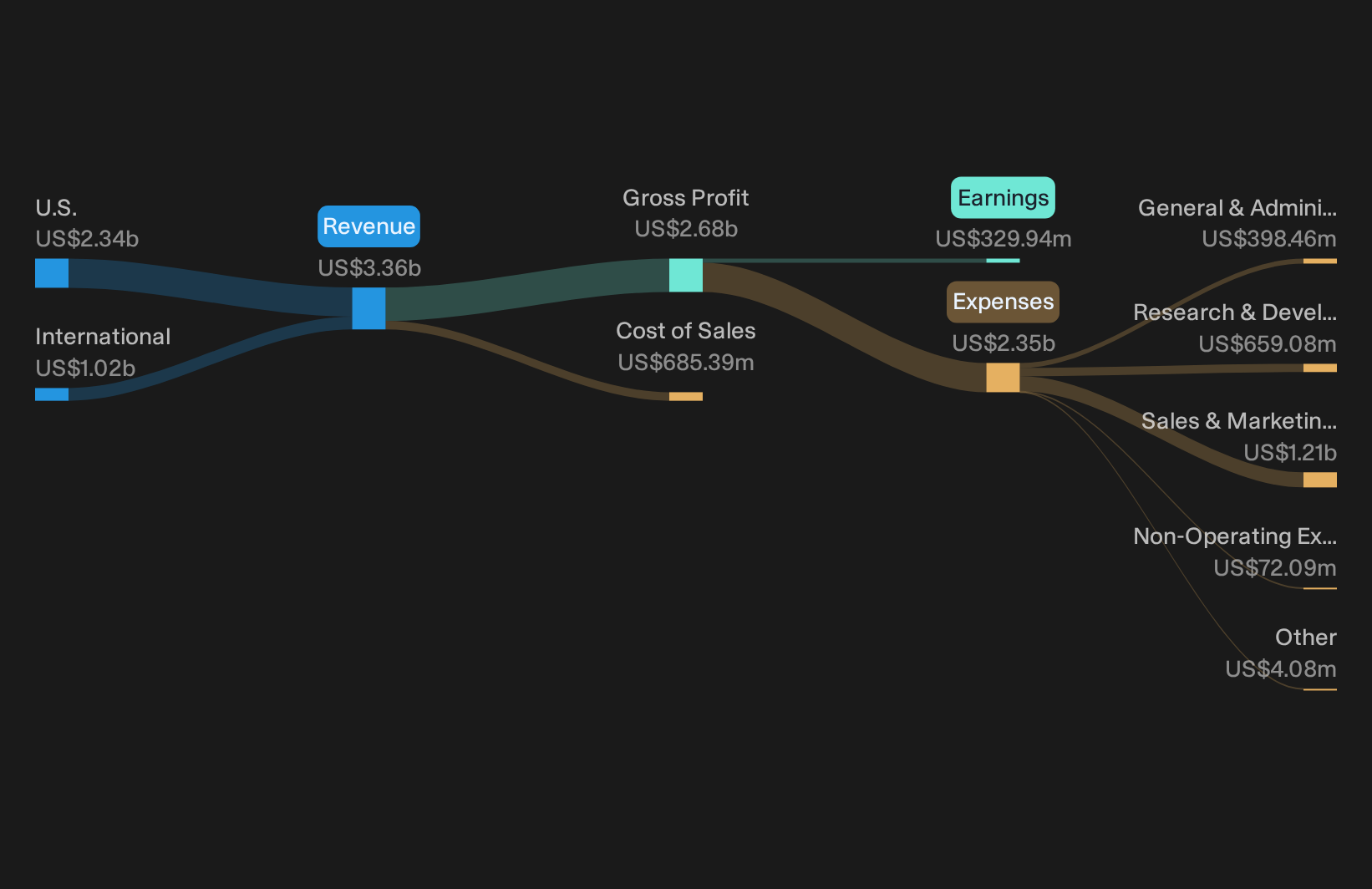
Operations: DocuSign generates about US$3.4b from software, with roughly US$2.3b from the U.S. and US$1.0b from international customers.
Market Cap: US$15.9b
DocuSign fits this AI risk governance and cybersecurity screen through its focus on securing identity, signatures and contract workflows, which becomes increasingly important as more critical agreements shift into automated, AI assisted channels.
"Sustained adoption of digital workflows and remote or hybrid work practices continues to support demand for DocuSign eSignature, contract lifecycle tools, and AI powered Intelligent Agreement Management, which can feed into subscription revenue and billings growth."
What happens if one unseen pressure on how enterprises manage and govern those high value agreements starts to reshape DocuSign’s margin profile?
That margin question is exactly what the full narrative for DocuSign tackles, spelling out how DocuSign’s AI agreements engine could turn governance friction into accelerating contract economics.
Afry (OM:AFRY)
Overview: Afry provides engineering, design and advisory services for infrastructure, industry and energy projects, including digital and risk related consulting.
Operations: Afry generates about SEK 11.4b from Industry, SEK 8.9b from Transportation & Places and SEK 5.7b from Energy, after adjustments.
Market Cap: SEK 14.4b
Afry matters for this AI risk governance screen because it helps critical infrastructure clients design, monitor and upgrade complex systems where digital controls and compliance obligations are tightly linked.
"The accelerating global push for clean energy and decarbonization is sustaining strong demand within AFRY's Energy division, with a larger order backlog supported by long duration hydro, nuclear, grid and LNG projects. This can support revenue visibility and earnings quality as these projects are delivered and invoiced."
The key question is how one shift in project mix and efficiency efforts ultimately feeds through to the profitability investors focus on most.
If you want to see how that shift in project mix could reshape Afry’s earnings power, read the full narrative for Afry and see which assumptions might be getting overlooked.

Seeking Fresh Alternatives Before They Fly
New themes can break out while older stories lose momentum and become crowded. Scan fresh ideas that are still under the radar and consider them while they remain less followed.
- Look for potential turnarounds early and sift through 72 high quality undiscovered gems that pair resilient balance sheets with business models that remain less widely covered.
- Focus on durable income and review the 29 dividend fortresses that highlights higher yielding payers some investors may not be fully appreciating.
- Explore structural demand shifts and filter the 42 power grid technology and infrastructure stocks with companies linked to aging networks, grid upgrades and long term infrastructure spending.
Have feedback on this article? Concerned about the content? Get in touch with us directly. Alternatively, email editorial-team@simplywallst.com