


EN
Is Narrowed EBIT Guidance Altering The Investment Case For DSV Shares?
- DSV reported third quarter 2026 sales of DKK 80,702 million and net income of DKK 3,006 million, and narrowed full year EBIT guidance to DKK 24,000 to 25,000 million based on year to date performance.
- The new share buyback program running to 2030, capped at 24,044,452 shares and aligned with incentive plans, illustrates how DSV links capital returns to operational delivery.
- This article examines how DSV's narrowed 2026 EBIT guidance reshapes the broader investment narrative around efficiency, cash generation and capital returns.
DSV Investment Narrative Recap
For DSV to make sense in a portfolio, you need to be comfortable with a freight and logistics group that is still absorbing Schenker, fixing Road service issues and pushing a big tech and productivity program. The narrowed 2026 EBIT range of DKK 24,000 to 25,000 million keeps that earnings story intact, so the headline catalyst remains execution on integration and systems rollouts.
The bigger worry near term is operational. Road delivery metrics, extra terminal costs and timing effects on free cash flow are still live pressure points. The new guidance range does not remove those risks. It indicates that management still sees current EBIT conversion as achievable if service levels and working capital behave.
Out of the recent announcements, the new share repurchase program running to March 2030 ties most directly into the EBIT guidance narrative. Management now has room to buy back up to 24,044,452 shares, as long as treasury stock stays below 10% of issued capital and prices remain within 10% of the latest market quote.
For investors, that buyback sits in the background of the real trigger, which is cash generation from operations and property disposals. If EBIT before special items tracks inside the DKK 24,000 to 25,000 million range and working capital unwinds as planned, there is more capacity to keep that capital return program moving without stretching the balance sheet.
What the DSV Consensus Assumes
Analysts effectively ask you to underwrite a slow and steady DSV rather than a high octane growth story. The current consensus pegs revenue at DKK 324.1b and earnings at DKK 23.3b in 2029, which feeds directly into the narrowed EBIT guidance and the longer dated buyback plan.
Under those projections, the top line is modeled to rise at 2.7% a year, while earnings today of DKK 8.0b are expected to climb to DKK 23.3b by 2029, roughly a near 3x step up. That assumes margins widen from 2.7% to 7.2% over the same period as Schenker synergies, property disposals and the data platform program work through the income statement.
Put differently, the roadmap behind the new DSV capital return framework leans heavily on efficiency gains rather than aggressive volume growth. Revenue guidance assumptions stay modest, while the bigger swing factor is whether the business can reach and hold those higher profit margins without repeating the current Road disruption inside other divisions.
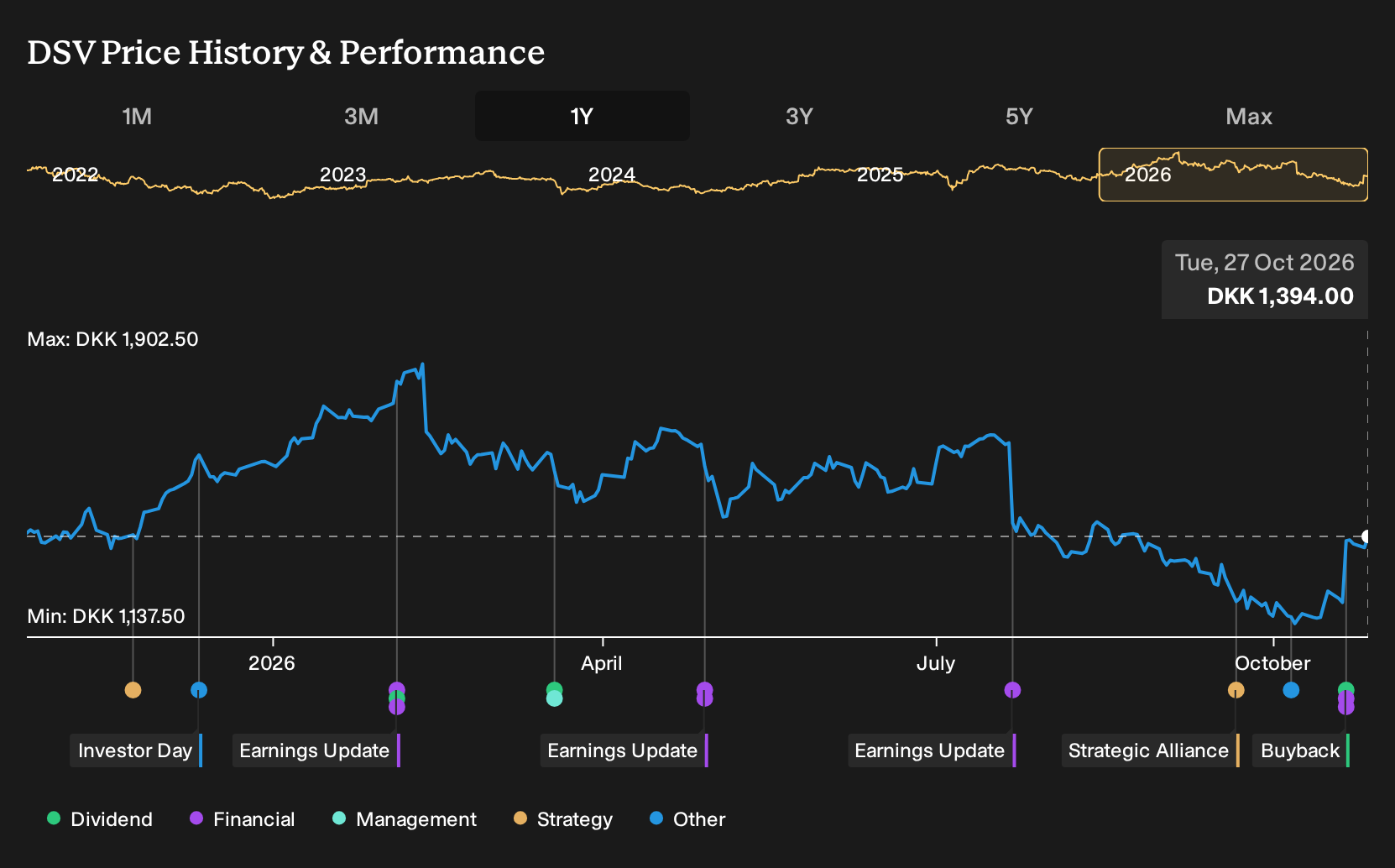
On valuation, the same analyst set sketches a reset from a P/E of 40.9x earnings today to 23.2x by 2029 on that DKK 23.3b profit line. That future multiple is below the 41.1x quoted for the wider GB logistics peer group and is the key input that allows the consensus price target of DKK 1,812.95 to sit above the present share price of DKK 1,374.5.
For context, the target is about 24.2% higher than where DSV trades at the moment, with individual analyst views spread between DKK 1,250.0 and DKK 2,300.0. That range signals that investors are not aligned on how much weight to put on the Schenker integration, the AI productivity plan and the timing of cash release from property sales.
DSV's narrative projects DKK 324.1b revenue and DKK 23.3b earnings by 2029. This requires 2.7% yearly revenue growth and an earnings increase of roughly DKK 15.3b from DKK 8.0b today.
Uncover why DSV's fair value indicates a 30% potential upside to its current price, which could narrow quickly.
Exploring Other Perspectives
One alternate read on DSV focuses less on guidance risk and more on the buyback as a potential catalyst. The most optimistic analysts were already pencilling in about DKK 328.6b of revenue and DKK 29.9b of earnings by 2029. That is far above consensus and reflects a much stronger earnings narrative that the new repurchase plan may now test. You see sharply different views here, so it can help to compare these assumptions with your own and explore how both stories might shift after this guidance and buyback news is fully reflected in the market.
Explore 3 other DSV fair value estimates, including one that suggests up to 121% upside from the current price!
Form Your Own Verdict
Don't just follow the ticker. Dig into the data and build a conviction that's truly your own.
- A great starting point for your DSV research is our analysis highlighting 3 key rewards and 3 important warning signs that could impact your investment decision.
- See our latest analysis for DSV. The report includes a comprehensive fundamental analysis summarized in a single visual, the Snowflake, making it easy to evaluate DSV's overall financial health at a glance.
Looking for more investment ideas beyond DSV?
Once you have a handle on DSV, it can help to widen your watchlist with other companies that match your risk profile and income goals. The Simply Wall St Screener lets you move from this single story to a broader set of opportunities in just a few focused filters.
- If you want potential upside without abandoning quality, start with a set of companies that combine robust balance sheets and attractive pricing through our 195 high quality undervalued stocks.
- For investors who care most about durability and capital preservation, filter for businesses with stronger financial footing and lower risk scores using the 223 resilient stocks with low risk scores.
- If reliable income is the priority, focus on companies that pair sizeable yields with resilient payouts by screening through our 224 dividend fortresses.
Have feedback on this article? Concerned about the content? Get in touch with us directly. Alternatively, email editorial-team@simplywallst.com