


EN
How Investors May Respond To Bank of Hawaii Stock After Earnings Miss
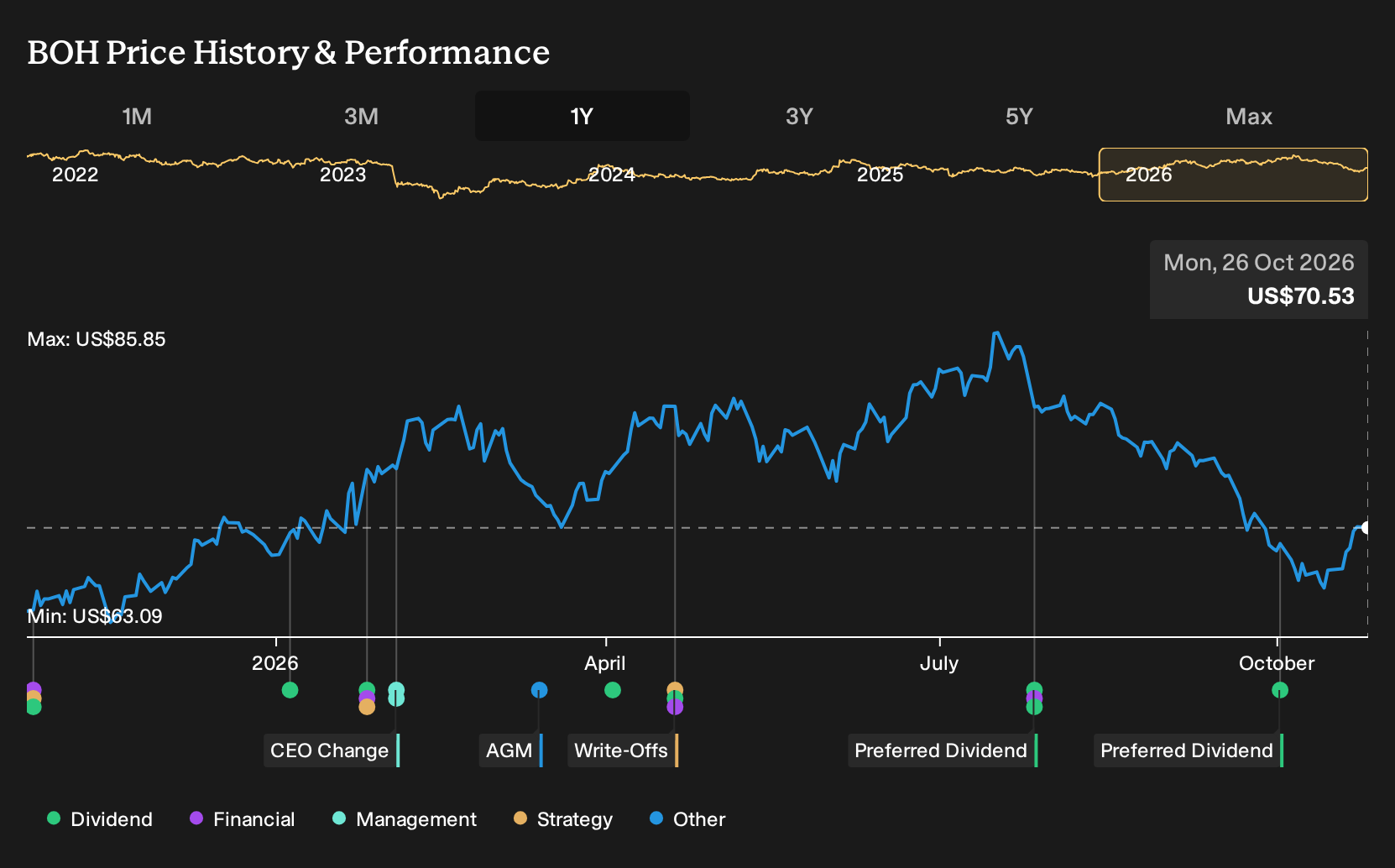
- Bank of Hawaii reported third quarter 2026 net income of US$64.26 million with basic EPS from continuing operations of US$1.50, while the board kept the quarterly dividend at US$0.70 per share and disclosed recent share repurchases.
- The combination of earnings that landed slightly below analyst expectations and an expanded US$200 million buyback authorization highlights management’s capital return focus alongside ongoing operating execution.
- We will look at how Bank of Hawaii's investment narrative is tested by the slight quarterly earnings miss against market expectations.
Bank of Hawaii Investment Narrative Recap
To own Bank of Hawaii, you need to be comfortable with a Hawaii centric loan book and a model that leans on net interest margin management, disciplined costs, and fee income rather than rapid expansion. The Q3 2026 print, with year to date earnings of US$185.49 million and basic EPS of US$4.30, keeps that steady execution story intact.
The key near term catalyst is whether margin support from repricing and funding mix work shows through cleanly while loan growth in the low to mid single digits materializes. The biggest risk remains concentration in the local economy. The slight EPS miss versus expectations and share price drop do not materially change that risk reward equation.
The most relevant fresh data point is the expanded US$1.025b buyback authorization following the extra US$200 million and the Q3 tranche of 256,000 shares repurchased for US$20.2 million. For an investor, that sits alongside the US$0.70 quarterly dividend, signalling that Bank of Hawaii is actively managing capital returns while it works its operating plan.
This matters for the current catalysts because any progress on net interest margin, fee income from wealth and advisory, and modest loan growth will flow through a gradually shrinking share count if repurchases continue. The flip side is that if Hawaii specific conditions weaken or margin trends disappoint, capital return alone will not offset pressure on earnings and valuation.
What The Current Forecasts Assume For Bank of Hawaii
Analysts sketch a fairly specific path for Bank of Hawaii. Their models point to revenue rising by 8.2% per year over the next few years, profit margins stepping up from 28.5% today to 31.6%, and earnings growing from US$214.4 million now to US$300.8 million, with earnings per share of US$7.14 by 2029. The same forecasts build in a gradual 0.84% annual reduction in the share count, which lines up with the recent buyback activity investors have just watched unfold.
Those earnings projections sit inside a valuation framework that expects Bank of Hawaii to trade on a P/E of 12.8x in 2029, compared with 12.7x today and 11.5x for the wider US banks group. That gap to the sector implies investors would be paying a modest premium for what analysts see as improved profitability and a more efficient balance sheet. It also means any shortfall in margins, loan growth, or credit quality could have an outsized impact because the current share price already reflects some of that expected progress.
Bank of Hawaii's narrative projects US$950.8 million revenue and US$300.8 million earnings by 2029. This implies 8.2% yearly revenue growth and an earnings increase of about US$86 million from current earnings of US$214.4 million.
Uncover why Bank of Hawaii's fair value indicates a 15% potential upside to its current price, which could narrow quickly as sentiment shifts around Bank of Hawaii.
Exploring Other Perspectives
Fair value estimates for Bank of Hawaii from just 2 members of the Simply Wall St Community range from about US$81 to over US$106,000 per share, which shows how far opinions can stretch when private investors model their own forecasts. Set that against the bank’s single state concentration risk and the current focus on dividends and buybacks, and you get a reminder that views can diverge sharply. Use that spread as a prompt to test several community perspectives before deciding how this story fits your own expectations.
Explore another Bank of Hawaii fair value estimate, including one that suggests as much as 150235% upside from the current price!
Decide For Yourself
Disagree with existing narratives? Extraordinary investment outcomes rarely come from following the herd, so consider relying on your own judgment.
- A great starting point for your Bank of Hawaii research is our analysis highlighting 4 key rewards and 1 important warning sign that could impact your investment decision.
- See our latest analysis for Bank of Hawaii. The report includes a comprehensive fundamental analysis summarized in a single visual: the Snowflake, which makes it easier to evaluate Bank of Hawaii's overall financial health at a glance.
Looking For More Investment Ideas Beyond Bank of Hawaii?
If the Bank of Hawaii story has sharpened your thinking around risk, income, and capital returns, you can use that framework to scan a wider field of opportunities with the Simply Wall St Screener.
- For investors who care most about balance sheet resilience and solid fundamentals, start with this curated list of solid balance sheet and fundamentals (24 results) that fits a quality first approach.
- If you want potential value on your side, widen the search to a focused 29 high quality undervalued stocks that applies consistent metrics across the market.
- Income focused readers can zero in on reliable cash payouts by reviewing a dedicated 5 dividend fortresses built around higher yield opportunities.
Have feedback on this article? Concerned about the content? Get in touch with us directly. Alternatively, email editorial-team@simplywallst.com