


EN
Is Higher Thrive Savings Altering The Investment Case For Marsh McLennan Stock?
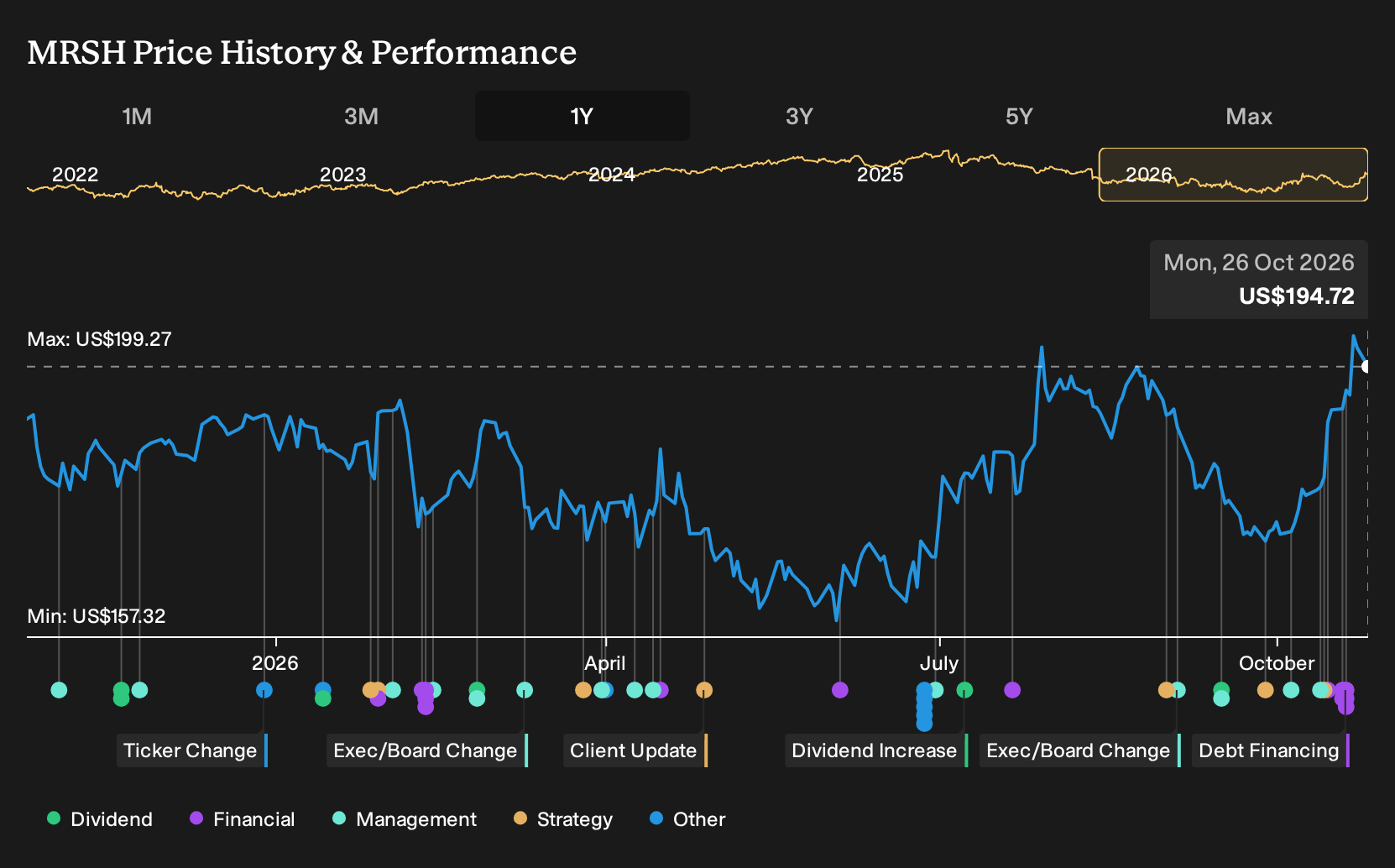
- Marsh & McLennan Companies has issued €600 million of 4.250% senior notes due 2032 and €600 million of 4.625% senior notes due 2036, with the proceeds earmarked for general corporate purposes and the bonds structured as senior, unsecured, fixed rate eurobonds.
- The enlarged fixed income funding, together with the Thrive program’s higher US$600 million savings target and higher expected costs, reflects management’s focus on reshaping Marsh & McLennan’s cost base and capital structure to support productivity and margin goals.
- We will now look at how Marsh & McLennan's higher Thrive savings target could reshape its longer term investment narrative.
Marsh & McLennan Companies Investment Narrative Recap
To own Marsh & McLennan Companies, you need to believe the firm can keep turning rising risk complexity into steady fee income while protecting margins through technology and cost discipline. The higher US$600 million Thrive savings target and the new eurobond funding both point to management leaning hard into that margin story rather than chasing aggressive top line swings.
The key near term catalyst is execution on productivity, especially as insurance and reinsurance pricing pressure hangs over brokerage commissions. The biggest risk remains that softer pricing and any renewed legal costs outpace efficiency gains. The latest funding move looks incremental to that thesis, not a material shift.
The Thrive program update is the announcement that really ties this together. Management lifted the annualized savings target to US$600 million and also raised expected costs to US$750 million, signalling a larger and more complex change program. Execution quality on that rollout will shape how investors read the recent debt raise.
If Thrive delivers the planned process automation and back office reengineering, it could help offset reinsurance softness, where recent pricing pressure has already weighed on revenue. If delivery slips or savings leak away into higher ongoing expenses, then the enlarged debt stack and higher restructuring charges would leave less room to absorb industry or litigation shocks.
What The Current Marsh & McLennan Assumptions Really Ask You To Believe
Analyst forecasts sketch out a clear hurdle for Marsh & McLennan Companies. The broker consensus assumes revenue can compound at 4.1% a year over the next three years while profit margins rise from 14.2% today to 17.1% by 2029. That is a story about higher efficiency doing more of the heavy lifting than aggressive top line expansion.
Earnings expectations tell the same story in bolder numbers. Forecast net income sits at US$5.4b by around 2029 compared with US$4.0b today. That is an earnings increase of roughly US$1.4b from current levels, with the most optimistic analysts pencilling in as much as US$6.1b. For you, the question is whether the Thrive savings, AI tools and broader cost work are enough to support that jump while insurance pricing stays under pressure.
Marsh & McLennan Companies' narrative projects US$31.5b revenue and US$5.4b earnings by 2029. This requires 4.1% yearly revenue growth and an earnings increase of about US$1.4b from US$4.0b today.
Valuation assumptions layer one more condition on top. To align with the consensus price target, the business would need to trade on a P/E of 20.5x those 2029 earnings, compared with 21.2x today and a reported 10.8x for the wider GB insurance peer group. That implies investors would still be paying a premium multiple for Marsh & McLennan, even after some compression, because they see the fee and consulting mix as structurally different from a pure insurer.
Share count also features in the story. Analysts factor in a 2.59% yearly reduction in shares outstanding over the next three years, tied to the US$5.5b capital deployment plan that includes buybacks. Shrinking equity alongside higher profit can lift earnings per share even if headline revenue only grows in the low single digits.
Discount rate choices round out the framework. The Simply Wall St model referenced in the consensus uses around 7.2% to 7.24% as the rate to bring those future cash flows back to today. A higher rate would make the same 2029 earnings stream look less valuable, while a lower one would do the opposite. That means your own view on risk and required return can shift what you consider a reasonable entry price for Marsh & McLennan Companies, even if you accept the same operating forecasts.
Discover why Marsh & McLennan Companies' fair value indicates a 4% potential upside to its current price before the market closes that gap.
Exploring Other Perspectives
Four fair value views from the Simply Wall St Community cluster between about US$203 and US$289, so some retail investors see Marsh & McLennan as materially cheaper than others. When you layer that against the fresh €1.2b in senior notes and ongoing Thrive execution risk, you get a wide opinion spread that is worth exploring.
Explore 3 other Marsh & McLennan Companies fair value estimates, including one that suggests it could be worth just $202.90.
Decide For Yourself
Don't just follow the ticker. Dig into the data and build a conviction that's truly your own.
- A great starting point for your Marsh & McLennan Companies research is our analysis highlighting 3 key rewards and 2 important warning signs that could impact your investment decision.
- See our latest analysis for Marsh & McLennan Companies. The report includes a comprehensive fundamental analysis summarized in a single visual, the Snowflake, making it easy to evaluate Marsh & McLennan Companies' overall financial health at a glance.
Looking For More Investment Ideas Beyond Marsh & McLennan Companies?
If you want to stress test your thesis on Marsh & McLennan Companies against other opportunities, the Simply Wall St Screener can help you quickly sort through businesses with very different risk and balance sheet profiles.
- If capital preservation ranks high for you, focus on companies with steadier fundamentals using our 30 resilient stocks with low risk scores to see which stocks have comparatively resilient profiles.
- If value is your main filter, scan for companies that combine quality fundamentals with potentially mispriced valuations using our 29 high quality undervalued stocks and see what else deserves a place on your watchlist.
- If reliable income matters most, aim your search at companies with higher yields and solid payout support by using our 5 dividend fortresses as a jumping off point for further research.
Have feedback on this article? Concerned about the content? Get in touch with us directly. Alternatively, email editorial-team@simplywallst.com