


EN
These 2 Stocks Are Beating the S&P 500 Over the Past 5 Years -- And Neither Has Anything to Do With AI
Fitness chain Life Time Group Holdings (LTH) and multi-banner retailer Urban Outfitters (URBN) had standard deviations of 2.99 and 2.81, respectively, in Monday trading. That put the two consumer discretionary stocks in yesterday’s top 20 bullish price surprises.
LTH stock is up 65% in 2026, while URBN has gained a more pedestrian 20% year-to-date. The Barchart Technical Opinion for the former is a 72% Strong Buy, while the latter is a 100% Strong Buy.
Wall Street is much more enthusiastic about Life Time. Of the 16 analysts covering LTH, 15 rate it a Buy (4.75 out of 5), while of the 16 covering URBN, 8 rate it a Buy (3.94 out of 5).
Life Time reports its Q3 2026 results on Thursday before the markets open; Urban Outfitters reports its Q3 2027 results on Nov. 24 after the markets close.
Over the past five days, LTH stock is up 8% as investors pile in ahead of the results, hoping for a big positive earnings surprise that could drive a nice pop in the share price. Despite URBN reporting in a month, it’s gained nearly 6% over the same period.
While they’re both on a roll, LTH is clearly the momentum stock of the two.
Is it the better buy? I consider that question.
They’re Both Good Long-Term Performers
URBN's five-year return is 155%, 29 percentage points higher than LTH. The S&P 500 return over the same period is 63%. Anytime you can outperform the index, you ought to be happy.
Life Time went public in October 2021, selling 39 million shares at $18 a share, valuing its equity at $3.5 billion. Five years later, it’s closing in on a $10 billion market cap. Its IPO investors, if still holding, have done very well.
The most positive aspect of Life Time’s five-year public-company history is its recovery after losing 30.5% in 2022. It’s up 264% since the beginning of 2023. Over the same period, Urban Outfitters stock gained 277%.
If LTH can do it, URBN can do better.
The Argument for Owning Life Time
As I already mentioned, analysts like the stock. Yesterday, Barclays analyst Brandt Montour initiated coverage of LTH stock with an Overweight rating and a $51 price target, 17% above its current share price.
Montour likes the stock because its members have a household income about twice the national median. Venture capitalist Howard Lindzon believes that the luxury market is evolving. In a recent post, Lindzon stated, “Spending has evolved and the 10 percent are the new 1 percent.” That evolution plays into Life Time’s business model.
Two other factors account for Montour’s rating: First, its enterprise value is a reasonable 11.5 times its 2027 EBITDA (earnings before interest, taxes, depreciation, and amortization). Second, it has almost no AI-related risk.
Those are compelling arguments.
Before agreeing with the analysts, I want to consider Life Time’s previous incarnation as a public company between June 2004 and June 2015.
Life Time Fitness Inc. went public on June 30, 2004, selling 9.9 million shares at $18.50 per share and valuing the company at a market cap of $614.4 million. Its revenue in the year ended Dec. 31, 2003, was $256.9 million, with $54.0 million in operating income.
Fast forward to 2015.
Private equity firms TPG (TPG) and Leonard Green & Partners, along with CEO Bahram Akradi, LNK Partners and others, took the company private for more than $4 billion ($72.10 a share). As part of the deal, Akradi rolled over $125 million in equity. In 2014, it reported $1.23 billion in revenue and $229.4 million in operating income.
So, its operating margin at the end of 2003 was 21.0%, and 11 years later it was 18.6%, down 240 basis points. In 2020, the last year before it went public for the second time, revenue was $948.4 million, and the company posted a $359.1 million operating loss due to Covid. In the 12 months ended June 30, 2026, revenue was $3.18 billion; operating profit was $531.8 million, with an operating margin of 16.7%.
Over 23 years, its operating margin has fallen by 430 basis points, while its revenue has grown 1,139%. It’s making less from more. As companies scale, you’d like to see both move higher together.
One reason to think twice about Life Time is its total debt. In 2003, it was $233 million, 4.3 times EBIT (earnings before interest and taxes). In the trailing 12 months ended June 30, it was $4.28 billion, 8.0 times EBIT.
With interest rates likely to remain elevated for the foreseeable future, LTH could face a reckoning if the American economy enters a recession.
While it may have a wealthier demographic, it isn't recession-proof.
The Argument for Owning Urban Outfitters
I write about retail stocks fairly often. My wife worked in retail management for over 20 years. So, I tend to follow the industry more than some.
I’ve always liked the company.
In fiscal 2027 (January year-end), it’s delivering nothing but record results. Investors aren’t giving its stock the love it deserves. I suspect it’s because of low consumer confidence and higher pump prices. It’s hard to fathom consumers keeping up this spending if inflation remains persistent.
However, the flip side is that consumers are spending selectively. With big market gains, the 10% Lindzon mentions have plenty of disposable cash for clothing. You might not want to buy a $100,000 vehicle in this economic environment, but you won't hesitate over a couple of pairs of jeans.
In Q2 2027, the company’s sales were a record $1.66 billion, 10.4% higher than a year earlier, with growth across all four of its brands: Anthropologie (38% of sales), Free People (29%), Urban Outfitters (22%), Nuuly (10%), and Other (1%).
The most interesting business for me is Nuuly, the retailer’s apparel rental subscription business it launched in May 2019. It offers a monthly subscription service that rents its own brands, third-party labels, and one-of-a-kind vintage pieces through the Nuuly digital platform.
Nuuly’s first-year revenue was $8 million. It’s grown every year since, finishing fiscal 2026 with $568 million in sales, a CAGR (compound annual growth rate) of 103.5%.
This business makes so much sense. It's sustainable retail that lets women try something without committing to a place in their closet. No wonder its revenue has grown so quickly since launch.
Most importantly, Nuuly’s revenue in the first six months of 2027 was $346 million, more than double the same period two years ago. Even a 25% growth rate over the next 2-3 years would likely see the subscription business overtake the legacy Urban Outfitters brand. That’s impressive.
On profitability, its second-quarter adjusted gross profit margin rose one basis point to 37.7%, excluding $95.7 million in tariff refunds. The retailer last posted margins this high in 2014.
As a result, its operating cash flow in the 12 months ended July 31 was $716 million, the highest in its history. Despite opening 54 new stores year-to-date and spending about $475 million on the business, it has generated nearly $300 million in free cash flow.
I don’t see its business turning negative over the final two quarters of 2027. While I don’t have a crystal ball, I like its chances.
The Better Buy: LTH or URBN?
Almost every time, when faced with a choice between two stocks, I will almost always go with the asset-light option.
Urban Outfitters' total debt in the 12 months ended July 31 was $1.21 billion, about 1.9 times its EBIT of $631 million. Life Time’s is 8.0x, fourfold higher. While Life Time has chipped away at its interest expense, it still paid nearly $69 million over the 12 months ended June 30, about 16x Urban Outfitters’ interest expense.
Lease liabilities, rather than long-term debt, make up the lion’s share of total debt for both stocks. At the end of the day, it's cash out the door.
The chart below shows that Life Time's current TEV/EBIT multiple is about double Urban Outfitters'. The average for the former over the past three years is 26.2x compared to 11.2x for the latter.
Life Time’s demographics, combined with its massive fitness facilities, give it a bit of a moat. But not enough to make it the better buy. If you can only buy one, I’d go with URBN.
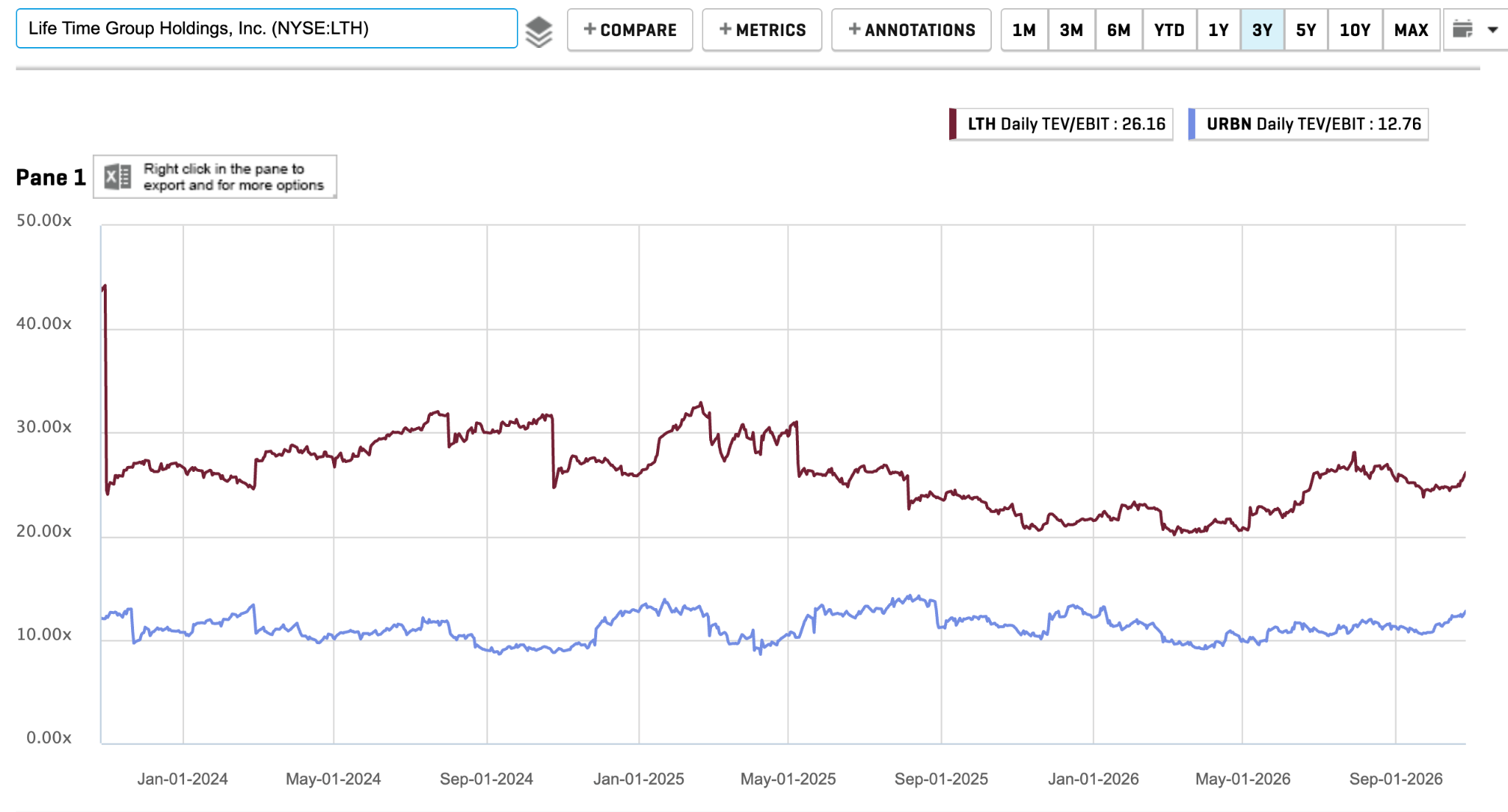
Source: S&P Global Market Intelligence
On the date of publication, Will Ashworth did not have (either directly or indirectly) positions in any of the securities mentioned in this article. All information and data in this article is solely for informational purposes. For more information please view the Barchart Disclosure Policy here.