


EN
Soaring Diesel Prices Could Spark a Scarcity Crisis No One is Talking About. Here’s How to Invest.
There’s been a lot of chatter around the rise of diesel prices, but relatively little about a potential second-order consequence – the potential for soaring diesel to create a food scarcity problem.
Diesel is a critical fuel source for heavy equipment and harvesting on farms, and the skyrocketing cost of this critical input has further pinched margins in agriculture, which are already feeling the stress of wartime fertilizer pricing.
But diesel isn't just a harvesting input; it also directly drives the cost of field preparation, irrigation pumping, logistics, and fertilizer application. In that regard, high diesel prices act as a regressive tax on yield margins, forcing high-cost producers to cut back acreage.
That’s where the potential for a crop crunch enters the picture.
We’ve already seen a similar dynamic in the corn market when ethanol emerged as a viable biofuel years ago. The competitive demand for corn as a crop with value beyond food sent the price of futures ramping higher.
Soybeans (ZSF27) are stabilizing today after a drubbing to start the week as traders reacted to an election shock in Brazil. However, beyond geopolitics, the black swan to watch in this market is the strongest El Niño on record.
Extreme weather patterns in Brazil could translate into a wet spring field, and excess moisture during planting windows in South America, particularly Brazil's southern grain belt, could delay sowing. Concurrently, severe drought could hit Southeast Asia, impacting palm oil and rice, or Australia.
Weaving these factors together creates a picture of agriculture as a late-cycle asset class with inelastic demand, and builds a compelling case for going long ags through bioprocessors. Because supply cannot instantly adjust to weather shocks or energy spikes, companies that control the physical midstream, i.e., crushing, logistics, and biofuel conversion, maintain pricing power that insulates them from broader market pullbacks.
I'm investing in the narrative by going long Archer Daniels Midland (ADM), the world's largest soybean processor and biodiesel producer.
Agribusiness giants like ADM act as a structural hedge by capturing both sides of the demand cycle. When high input costs squeeze primary farmers, integrated processors leverage their global origination, storage, and processing infrastructure to capture wide crush margins, profiting from supply dislocation regardless of whether raw crop prices swing wildly.
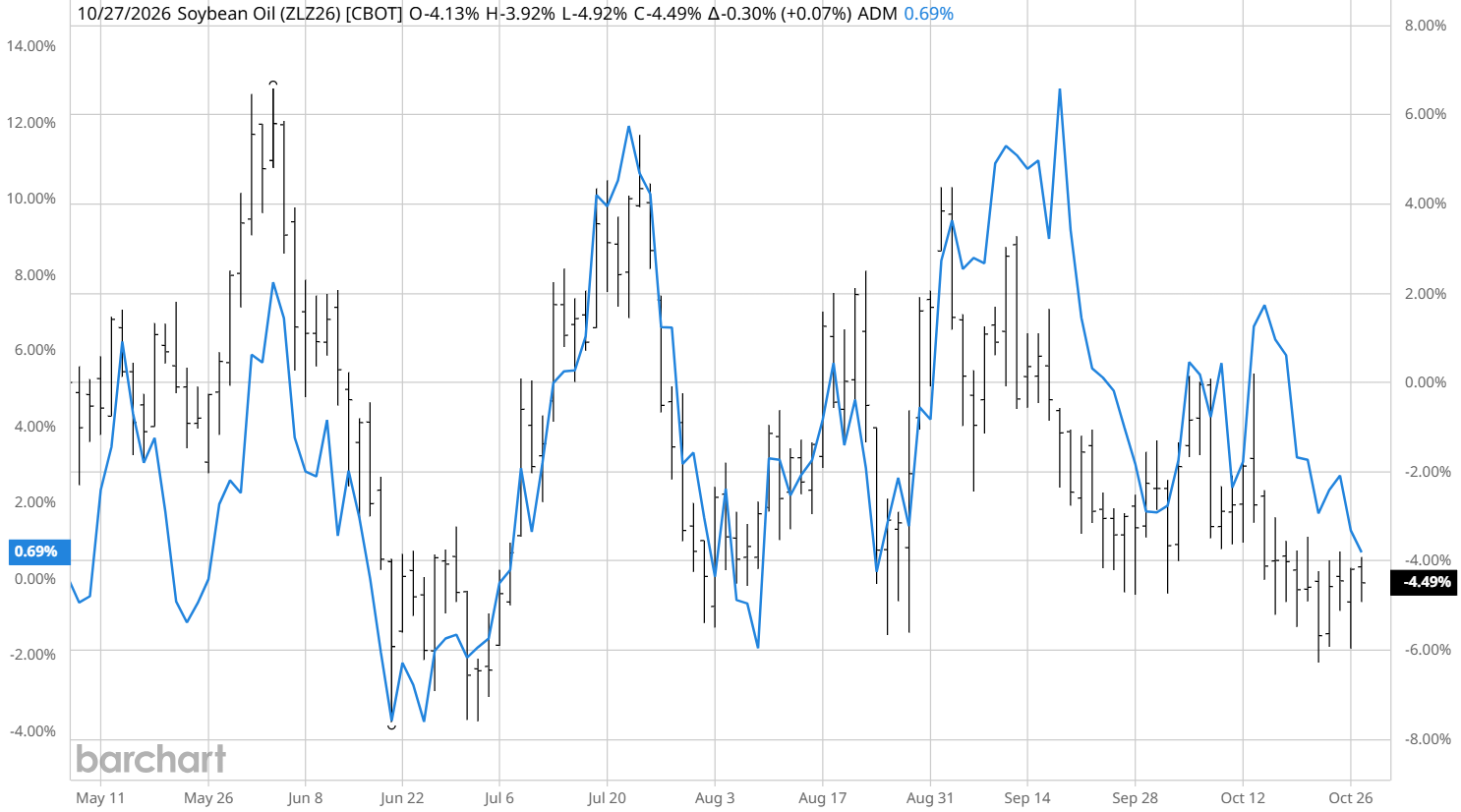
This chart shows the correlation between soybean oil (ZLZ26) and ADM.
For more on stocks that trade like crops, check out this clip from Market on Close:
– John Rowland, CMT, is Barchart’s Senior Market Strategist and the host of Market on Close.
On the date of publication, Barchart Insights did not have (either directly or indirectly) positions in any of the securities mentioned in this article. All information and data in this article is solely for informational purposes. For more information please view the Barchart Disclosure Policy here.