


EN
What Did Brazil's Presidential Election Really Mean for the Global Soybean Market?
Markets went haywire following the Brazilian presidential election this past weekend, again shining a brighter spotlight on ‘betting markets’.
Fundamentally not much changed with the election result, with Brazil still in alliance with China and the US on the outside looking in.
Looking ahead, weather has improved for the US harvest and Brazil's planting of its 2027 crop.
We watched Monday as a number of markets overreacted to this past weekend’s presidential election in Brazil. Depending on who you talk to, the incumbent Luiz Inacio Lula da Silva beating Senator Flavio Bolsonaro was either a surprise or expected. In other words, like nearly everything else in the world these days, there is no clear opinion. (I miss the days of a triumphant Harry S. Truman holding up a newspaper with the big, bold headline reading, “Dewey Defeats Truman”.) That being said, there are a couple things we think we know about the Brazilian election:
- Bolsonaro, favored by the US president, was supported by rural Brazil while Lula was backed more by urbanites.
- At last report, Bolsonaro was refusing to concede the election and was calling for its annulment.
- Again, does all this sound familiar to those in the United States? With the ‘fun’ of next Tuesday’s mid-term election fast approaching.
As Monday played out, a message came in from an investment fund manager, “Can you dumb down the connection between Lula and the meltdown in soybeans. I don’t understand the link.” (You likely concluded this manager’s fund is ag market based. You are correct.) I’ll share with you my response, and look forward to responses, comments, and corrections from others with boots on the ground knowledge of the situation.
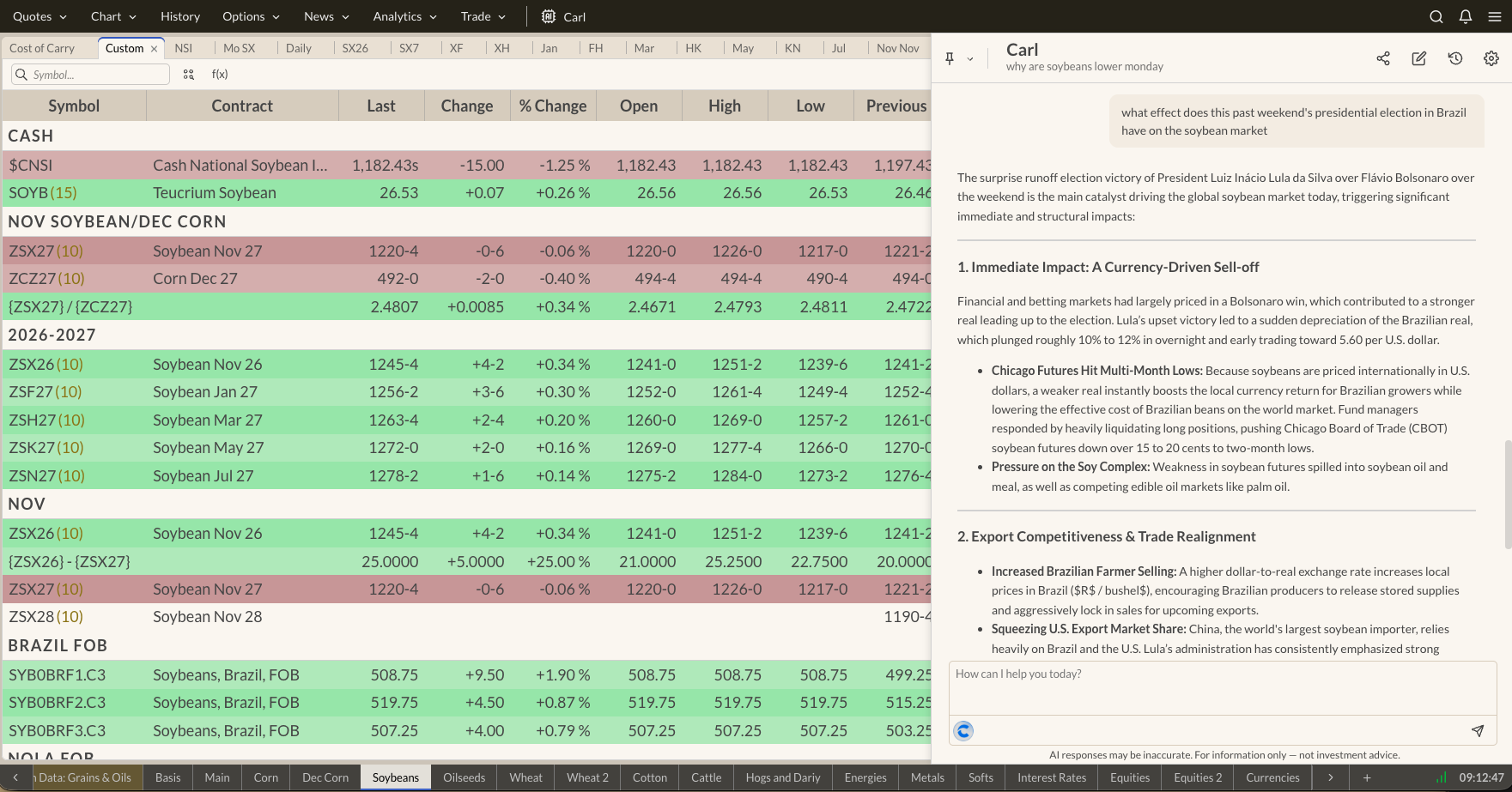
If you ask any AI service what the connection was – though I have my own opinions, out of curiosity I did ask Barchart’s Carl – the first response will likely have something to do with the value of global currencies. This is what Carl had for me:
- 1. Immediate Impact: A Currency Driven Sell-off
- Financial and betting markets (it is key to remember that phrase, ‘betting markets’, DN) had largely priced in a Bolsonaro win, which contributed to a stronger real leading up to the election. Lula’s upset victory led to a sudden depreciation of the Brazilian real (BRLUSD), which “plunged roughly 10% to 12% in overnight and early trading toward 5.60 per U.S. dollar”.
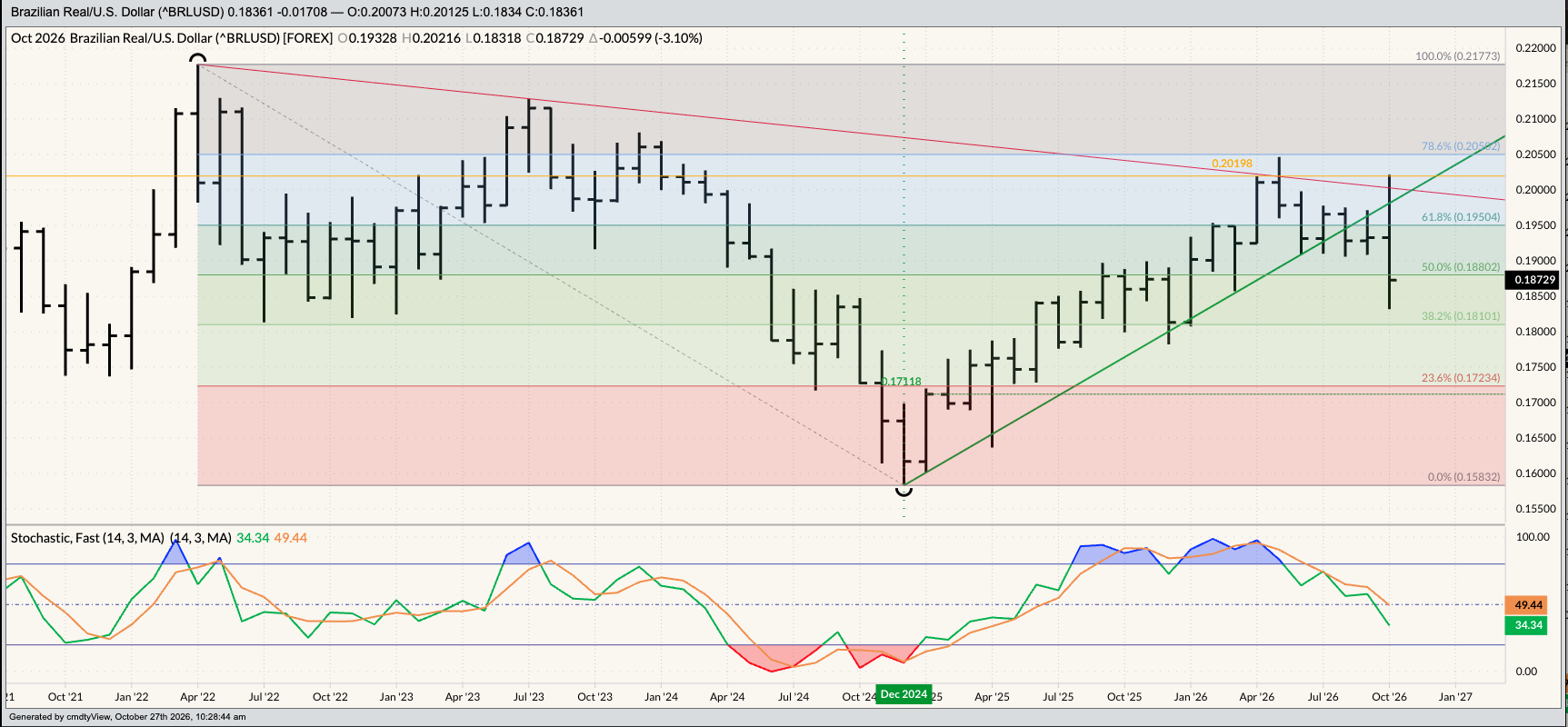
My Blink reaction to this was algorithms had it wrong. If markets were concerned about the economic ripple effects of President Lula’s fourth term, and those ripple effects included Brazil’s central bank making rate hikes to battle annual inflation of 4.6%, running “above the central bank’s tolerance range of 1.5% to 4.5%”[i], then that should actually provide fundamental support to the real. However, upon further research, much of Brazil’s economic problem is tied to “mandatory spending” by the government. It’s also interesting to note Brazil’s central bank “delivered its fifth straight rate cut last month on signs of an economic slowdown”[ii]. We can see this on the long-term monthly chart of the real showing a lower close this past May followed by four months of consolidation. However, earlier this month the real posted a spike rally, likely on the bettors lining up for a Bolsonaro victory.
Next on Carl’s list:
- 2. Export Competitiveness & Trade Realignment
- Increased Brazilian Farmer Selling: A higher dollar-to-real exchange rate increases local prices in Brazil, encouraging Brazilian producers to release stored supplies and aggressively lock in sales for upcoming exports.
- Squeezing U.S. Export Market Share: China, the world’s largest soybean importer, relies heavily on Brazil ‘and the U.S. (emphasis mine, DN) Lula’s administration has consistently emphasized strong pragmatic and diplomatic ties with Beijing. A cheaper real coupled with favorable trade relations strengthens Brazil’s advantage in fulfilling Chinese import demand, placing further pressure on U.S. export sales during what is traditionally the peak U.S. export window.
I disagree with this in theory. As I said in Tuesday’s Morning Commentary, “What I continue to find fascinating is algorithms are supposed to remove human emotions from the equation, but common sense has been erased instead while markets are more reactive than before.” Let’s take this point by point:
- According to CONAB (Brazil’s equivalent to USDA), the 2026 harvest is estimated at roughly 181.6 million metric tons (mmt). Additionally, Brazil reportedly exported over 85 mmt of soybeans between January and August. Using oversimplified math, exports could be near 106 mmt leaving roughly 75 mmt of 2026 production to be sold.
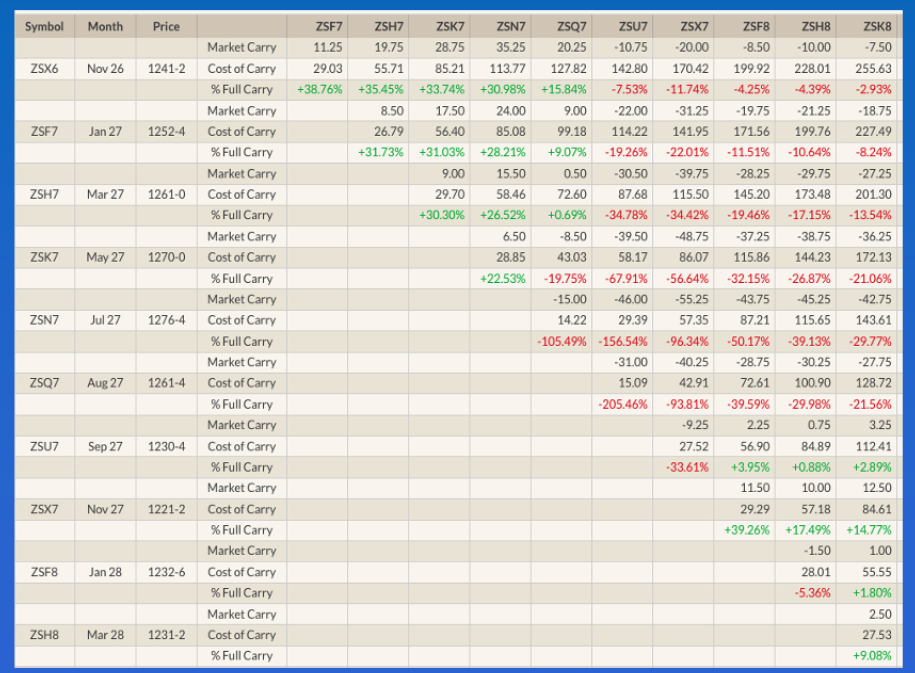
- Did we see heavy commercial pressure during Monday’s selloff? The January-March futures spread saw its carry firm by 1.0 cent, closing at 8.5 cents and covering a still bullish leaning 32% calculated full commercial carry (slide 4). In other words, if commercial interests were swamped by producer selling in Brazil, the market wasn’t showing it.
- U.S. soybean exports were squeezed back in January 2018 when the US president thought it would be a good idea to get in a trade war with the world’s largest buyer of soybeans, meaning the US soy industry, in his view, was expendable One doesn’t have to be as brilliant as the man behind making plans to nuke a hurricane to see that US soybeans were not made great again, but in fact turned into a secondary player on the global market. A look at a chart created using USDA WASDE date shows the difference in US-Brazil soybean exports was 0.5 mmt at the end of the 2014-2015 marketing year, then 1.5 mmt as 2015-16 came to an end. By September 2017 the gap had grown to 4.2 mmt, then after the trade war was announced on social media, the gap widened to 18.1 mmt by the end of August 2018. When the 2025-26 marketing year came to an end this past August, the gap had turned into a chasm 73.2 mmt. This meant the US exports were running 36% behind Brazil’s. This percentage difference increased to 39% in USDA’s October WASDE Keno game.
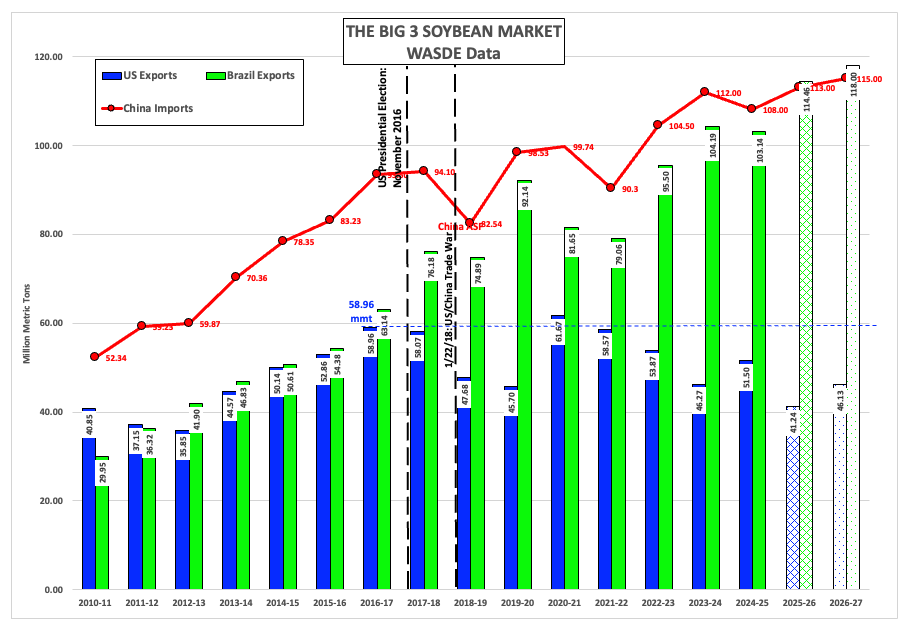
The bottom line is the global soybean market is not an economic game but a political one. The US dollar and Brazilian real have weakened and strengthened many times over the past decade, but the trend of soybean exports has not changed: Brazil’s is growing while the US falls further behind. All while Chinese import demand continues to grow, with USDA’s latest guess coming in at 115.0 mmt. (For the record, USDA has estimated Brazilian exports are 118.0 mmt meaning it has enough soybeans to take care of China and others. US exports were pegged at 46.1 mmt.)
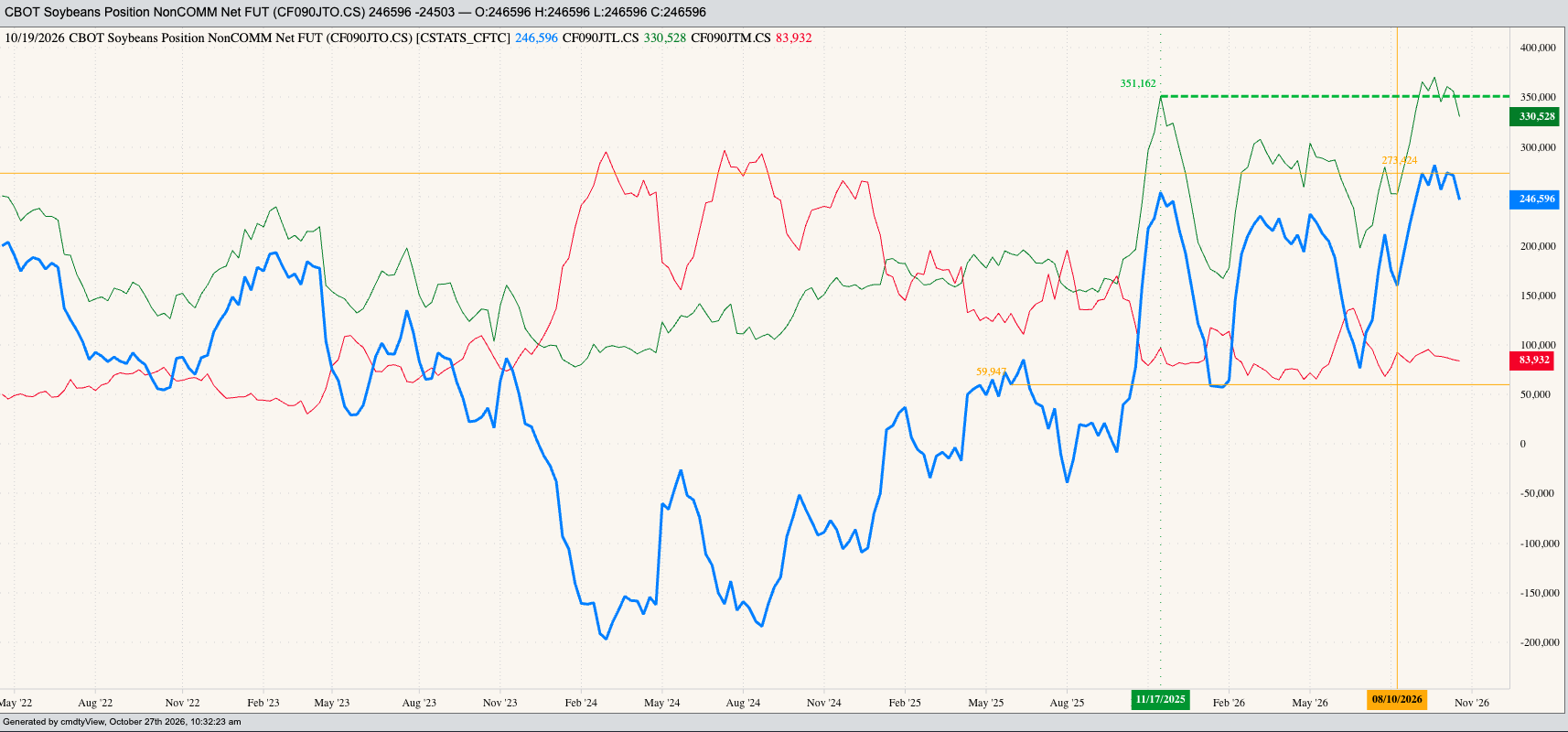
Therefore, if Monday’s soybean selloff wasn’t driven by an actual change in global fundamentals, who was in the driver’s seat? The answer is obvious: Watson. Recall one of Carl’s responses had to do with ‘betting markets’, a sign of the times for where we are these days. I’ve talked before about the unregulated casinos that are predictive market websites, so when Brazil’s election numbers didn’t come in as expected by bettors, folks who have no idea what a soybean looks like started bailing out of their bets. This action was enhanced by trading algorithms also being triggered after being fed the key word “surprise” in most headlines. What are some of the noncommercial numbers of interest?
- The latest CFTC Commitments of Traders report (legacy, futures only) put the noncommercial net-long futures position at 246,596 contracts as of Tuesday, October 20, a decrease of 24,503 contracts from the previous week.
- However, the net-long position was still relatively close to its recent record large number of 281,581 contracts as of Tuesday, September 22, meaning there is still plenty of liquidation possible over the weeks ahead.
- With funds in the January futures contract (ZSF27) at this time, a look at that contract’s daily close only chart shows a loss of 11.0 cents from last Tuesday’s settlement through this past Monday’s close indicating continued noncommercial long liquidation.
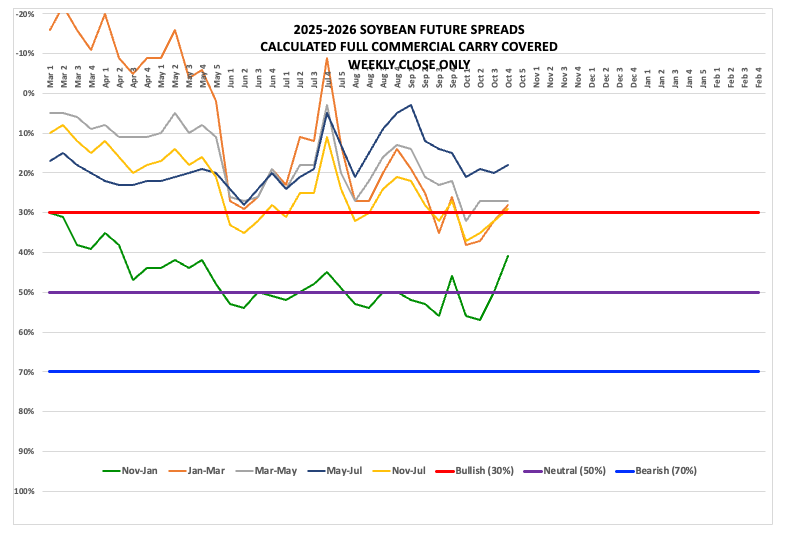
Are there actual fundamental factors that could drive this liquidation? Yes.
- The US harvest has gained momentum the past couple weeks due to improved weather across the Midwest and Plains. Given US producers prefer to store corn on farm and sell soybeans, this means more newly harvested supplies have become available.
- According to – again – reliable news sources, spring weather conditions across key growing areas of Brazil, lowering market concern a little for 2027 production. The March-May futures spread covered a bullish 14% the first week of September (the equivalent of the first week of March in the Northern Hemisphere), then 22% at the end of last month. At Monday’s close this key read on Brazil’s next crop was covering 30%.
[i] From this Reuters piece: (LINK)
[ii] From the same Reuters piece.
On the date of publication, Darin Newsom did not have (either directly or indirectly) positions in any of the securities mentioned in this article. All information and data in this article is solely for informational purposes. For more information please view the Barchart Disclosure Policy here.