


EN
Camden National Corporation (NASDAQ:CAC) posts better-than-expected sales in Q3 2026

Maine-based regional bank Camden National (NASDAQ:CAC) announced better-than-expected revenue in Q3 2026, with revenue rising 4.4% year on year to $68.67 million. Its non-GAAP profit of $1.34 per share was in line with analysts’ consensus estimates.
For more on Camden National Corporation, read the full research report for free.
Camden National Corporation (CAC) Q3 2026 highlights:
- Net interest income $55.42 million vs analysts’ consensus estimates of $54.35 million (8.1% year-on-year growth, 2% beat)
- Net interest margin 3.4% vs analysts’ consensus estimates of 3.3% (9 basis point beat)
- Revenue $68.67 million vs S&P analysts’ consensus estimates of $67.98 million (4.4% year-on-year growth, 1% beat)
- Efficiency ratio 54.6% vs analysts’ consensus estimates of 55% (39.4 basis point beat)
- Adjusted EPS $1.34 vs S&P analysts’ consensus estimates of $1.34 (in line)
- Tangible book value per share $31.40 vs analysts’ consensus estimates of $32.29 (10.5% year-on-year growth, 2.7% miss)
- Market capitalization $987.8 million
"Our third-quarter results demonstrate continued momentum across the franchise, with year-over-year earnings growth, meaningful deposit growth, and strong credit performance," said Simon Griffiths, President and Chief Executive Officer of Camden National Corporation. "Strong deposit growth and continued customer acquisition improved our funding mix, reduced reliance on higher-cost borrowings, and expanded net interest margin by 15 basis points from the second quarter to 3.41%. At the same time, we maintained disciplined expense management while investing in our lending teams and future growth. With record earnings through the first nine months of the year and a stronger balance sheet, we are confident that we are well positioned to deliver sustained earnings growth and long-term shareholder value."
Revenue growth
Net interest income and fee-based revenue are the two pillars supporting bank earnings. The former captures profit from the gap between lending rates and deposit costs, while the latter encompasses charges for banking services, credit products, wealth management and trading activities. Camden National Corporation’s revenue grew at a tepid 7.3% compounded annual growth rate over the last five years, falling short of the banking sector benchmark.
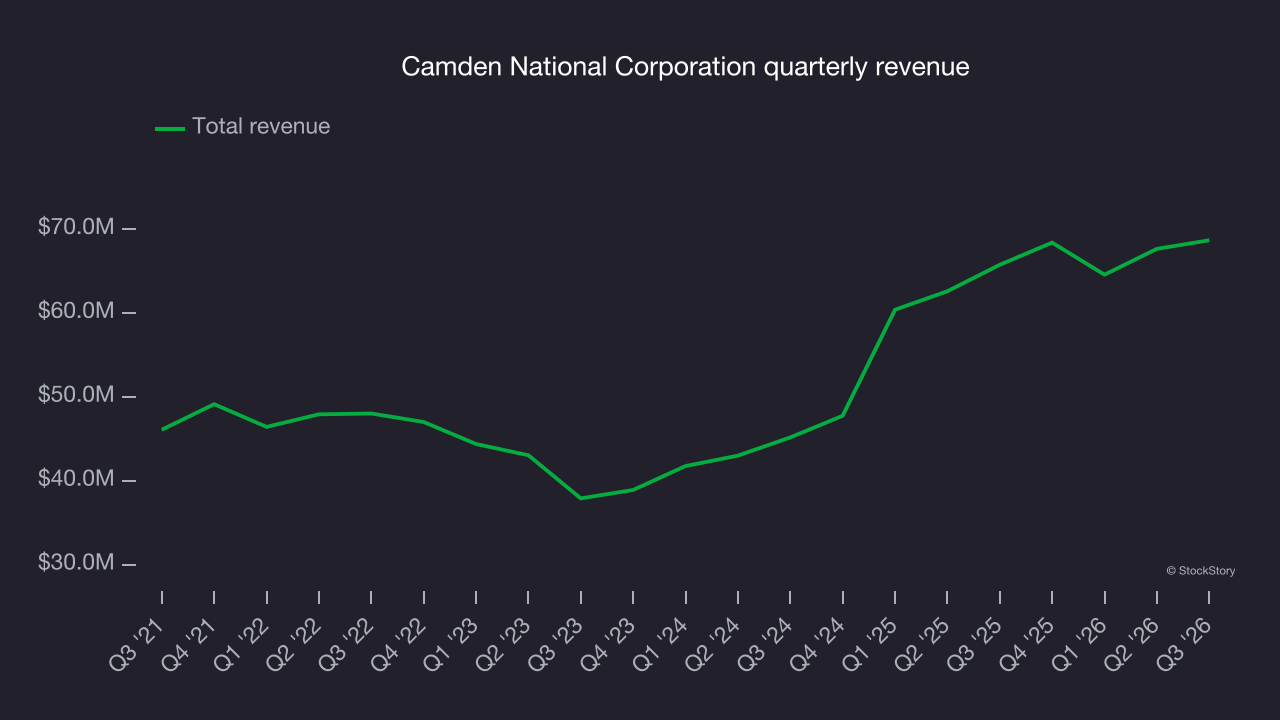
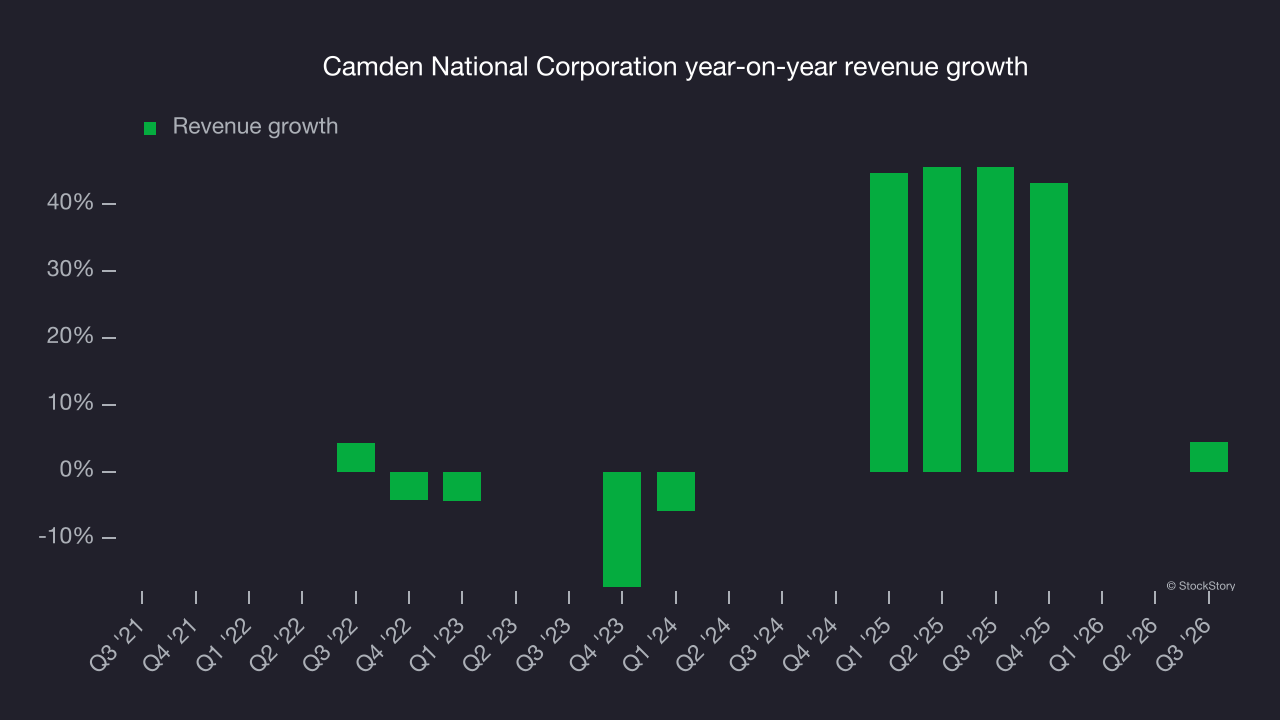
This quarter, Camden National Corporation reported modest year-on-year revenue growth of 4.4% but beat Wall Street’s consensus estimates by 1%.
Net interest income made up 78.3% of the company’s total revenue during the last five years, meaning lending operations are Camden National Corporation’s largest source of revenue.
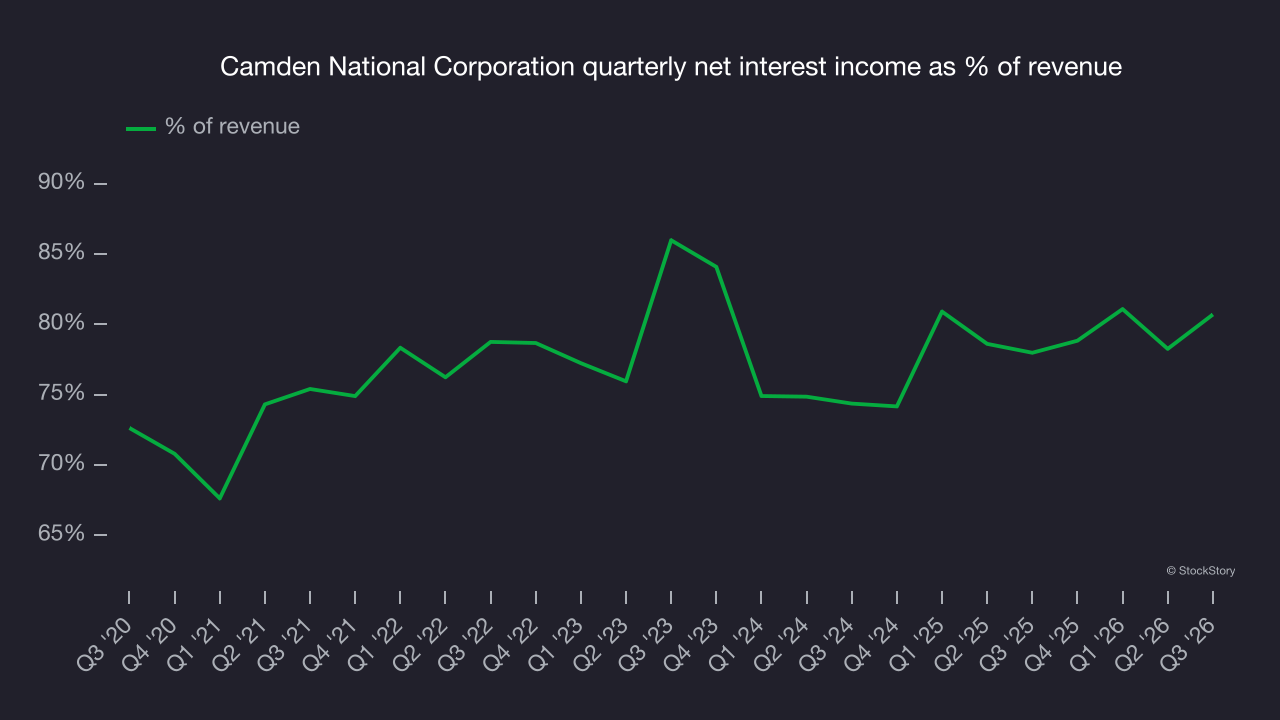
The market focuses primarily on a bank’s net interest income growth as non-interest income is considered a lower-quality and non-recurring revenue source.
Tangible book value per share (TBVPS)
Banks profit by intermediating between depositors and borrowers, making them fundamentally balance sheet-driven enterprises. Market participants emphasize balance sheet quality and sustained book value growth when evaluating these institutions.
That makes tangible book value per share (TBVPS) the most important metric to track for banks. TBVPS represents the real, liquid net worth per share of a bank, excluding intangible assets that have debatable value upon liquidation. EPS can become murky due to acquisition impacts or accounting flexibility around loan provisions, and TBVPS resists financial engineering manipulation.
Camden National Corporation’s TBVPS was flat over the last five years. However, growth has accelerated recently, with TBVPS rising by 2.6% annually over the last two years from $29.82 to $31.40 per share.
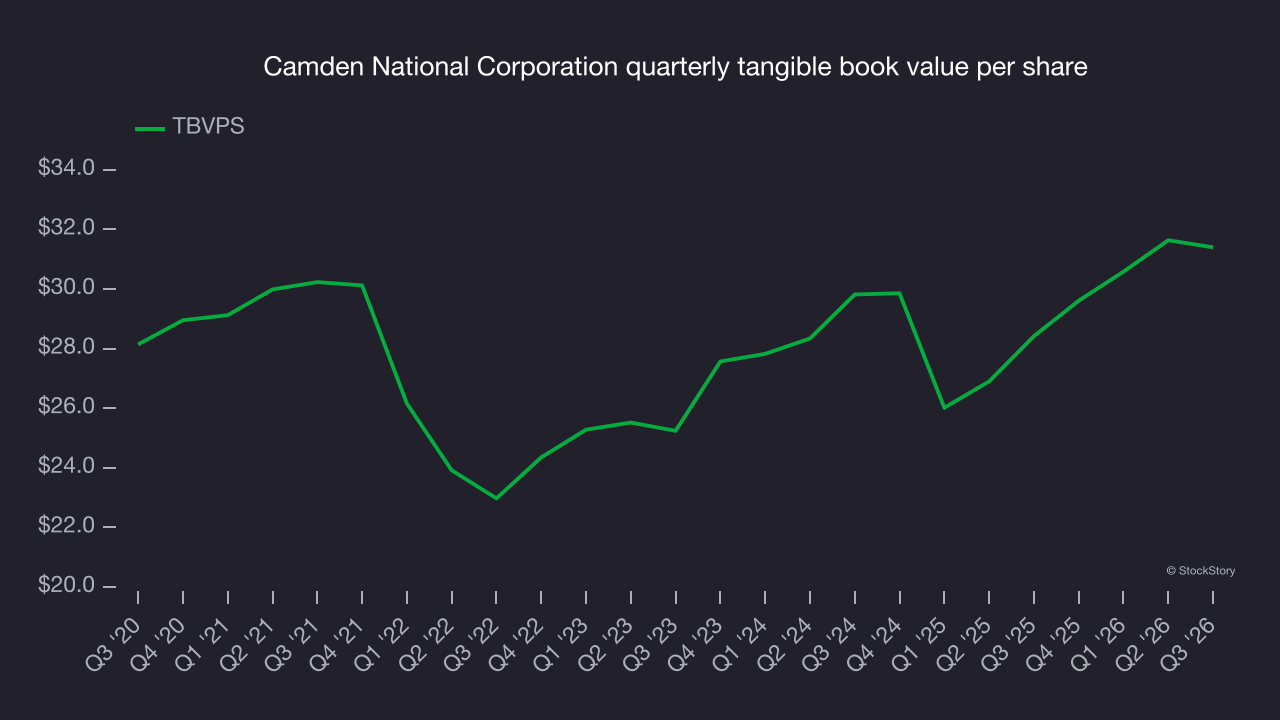
Over the next 12 months, consensus estimates call for Camden National Corporation’s TBVPS to grow by 17.1% to $36.77, a solid growth rate.
Key takeaways from Camden National Corporation’s Q3 results
Camden National Corporation’s quarter was mixed overall. The Company beat on net interest income and narrowly on revenue, but tangible book value per share missed expectations. Shares remained flat at $58.46 immediately after the results.
Camden National Corporation’s latest quarter is only one piece of the longer-term business quality puzzle. Quality, when combined with valuation, can help determine if the stock is a buy. For more on Camden National Corporation, read the full research report here (it’s free).