


EN
Missed Apple's Run? What Holders Had To Believe
If you only glanced at Apple headlines this year, the story was about memory shortages, lawsuits, a CEO handover and a $1,999 foldable iPhone launch. Holding Apple over the past year would have returned 28.3%, including dividends. If you had been deciding on 26 October 2025 whether to put fresh money into the stock, how much of that outcome was really visible in the mix of AI optimism and supply chain risk already on the table?
On Simply Wall St, a Narrative is an investor's thesis written down: the reasoning, plus the numbers it rests on. Run those numbers and you get an estimated Fair Value.
Apple has already moved. See which of 29 high quality undervalued stocks still trade below our estimates.
The Argument You Would Have Been Weighing Up On Apple
The shares cost US$263 at the start of the period, so every Apple investor had to decide which story felt closer to reality.
On the bullish side, the Narrative put Fair Value at US$300, or 14% above the start price. This view hinged on tighter AI and hardware integration and a privacy-first approach that could support higher margins over time.
The more cautious Narrative pointed to a Fair Value of US$241, or 8% below the start price. It focused on regulatory pressure around the App Store as a key threat to high-margin Services income.
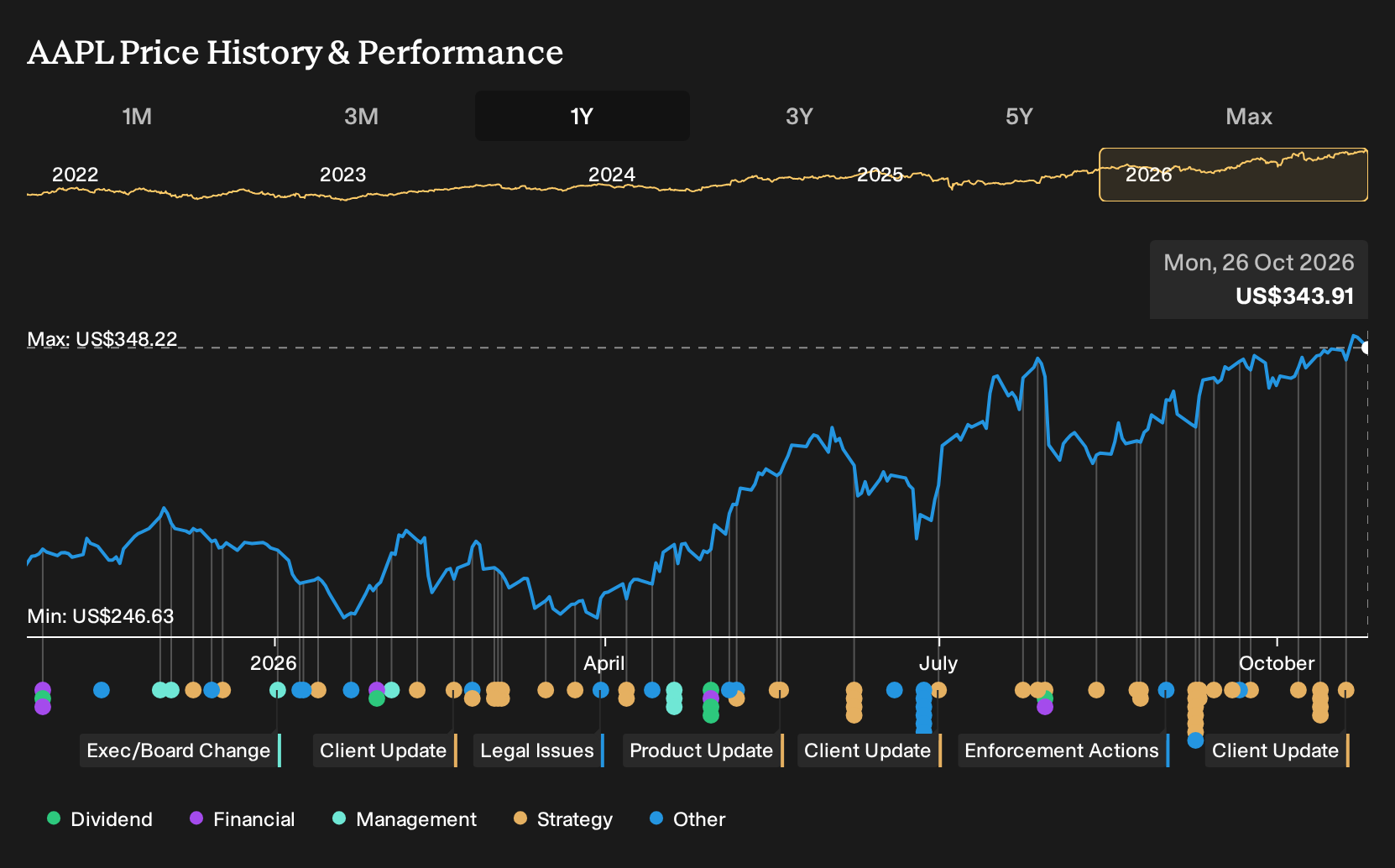
What The Evidence Did To The Apple Argument
Apple’s Q3 2026 update showed revenue at US$109,417m and net income at US$29,789m, with net margin at 27.2% versus 24.9% a year earlier. That margin shift leaned toward the view that tighter AI and hardware integration could support richer profitability, even as memory shortages and price hikes on devices kept the cautious view on demand risk alive. Overall, the evidence cut both ways.
For another stock, focus on which assumption the story really rests on. If the argument is about pricing power and AI driven upsell, track net margin and product pricing changes in the results rather than only watching top line commentary.
What Apple's 28% Run Already Bakes In
Apple trades at US$344 after a 28.3% gain over the past year, while the selected Narrative's Fair Value sits below that price based on its own framework.
That Narrative presents Apple as a services-heavy ecosystem rather than a hardware story, so a buyer today is effectively assuming services and AI execution outweigh the risk that product differentiation has stalled.
"This narrative is primarily based on Ben Thompson's (Stratechery) view that Apple has transitioned from being a product-driven company to a services-oriented one. While the iPhone remains central to Apple's business, hardware differentiation has plateaued."
One Narrative disagrees with today's price. → See where this Narrative says Apple should trade
Where Apple’s Demand Echoes Elsewhere
When you think about Apple, attention goes straight to devices and services. Just beyond that, a quieter layer of hardware keeps everything running.
Phones, laptops and data centers all rely on increasingly dense flash storage. Without it, faster chips and richer apps quickly hit roadblocks.
Another business concentrates on that storage layer for consumer gadgets and large computing hubs. Its work focuses on packing in more data while cutting energy use.
As AI features spread through everyday tech, that kind of storage specialist could see its role shift. That change could also reshape how you judge its potential.
The case is on the record, with the assumptions it rests on. → See the Narrative that values this company 73% above its price
Have feedback on this article? Concerned about the content? Get in touch with us directly. Alternatively, email editorial-team@simplywallst.com