


EN
KKR (KKR) Looks 8% Overvalued As Board Refresh Tests Its Valuation Story
KKR (KKR) has brought former Goldman Sachs chief risk officer Brian J. Lee onto its board, adding him to both the Audit Committee and Risk Committee at a time when investors are watching governance decisions closely.
KKR’s recent governance move comes after a mixed run in the market, with the 7 day share price return up 5.31% while the 30 day share price return is down 5.22% and the year to date share price return has fallen 28.92%.
That short term bounce sits against a 1 year total shareholder return that is down 24.52%. Investors who have held through cycles still see a 69.78% total shareholder return over three years, alongside a 10.75% decline in the 90 day share price return.
New board oversight, the launch of Akrapoint Commercial Capital with a US$350 million asset based finance commitment, an expanded 2.1 GW US renewables joint venture with TotalEnergies, and fresh EU scrutiny of a recent acquisition all help explain why the US$91.62 share price reflects investors constantly reassessing both potential and risk around KKR’s deal making model.
Scan beyond KKR and evaluate other asset focused financiers responding to governance and risk trends with the curated list of list of solid balance sheet and fundamentals (24 results).
KKR keeps adding deals, capital and boardroom firepower. The real tension for investors is whether a US$91.62 price still leaves enough value on the table or already reflects the strength of this platform.
Most Popular Narrative: 8% Overvalued
The most followed KKR narrative pegs fair value at $84.45, slightly below the recent $91.62 close. This frames current pricing as a modest premium rather than a deep discount story.
KKR está evolucionando de un gestor de private equity a una plataforma de capital permanente con múltiples motores de crecimiento.
En términos simples:
Antes: gestor de fondos
Hoy: gestor + asegurador + inversor estructural
Mañana: posible conglomerado de capital global
See why 13 investors see KKR as 8% overvalued.
Result: Fair Value of $84.45 (OVERVALUED)
Still, the KKR story could be knocked off course if private credit losses erode fee pools faster than expected, or if fundraising appetite cools after recent volatility.
Find out about the key risks to this KKR narrative.
Another View On KKR’s Valuation
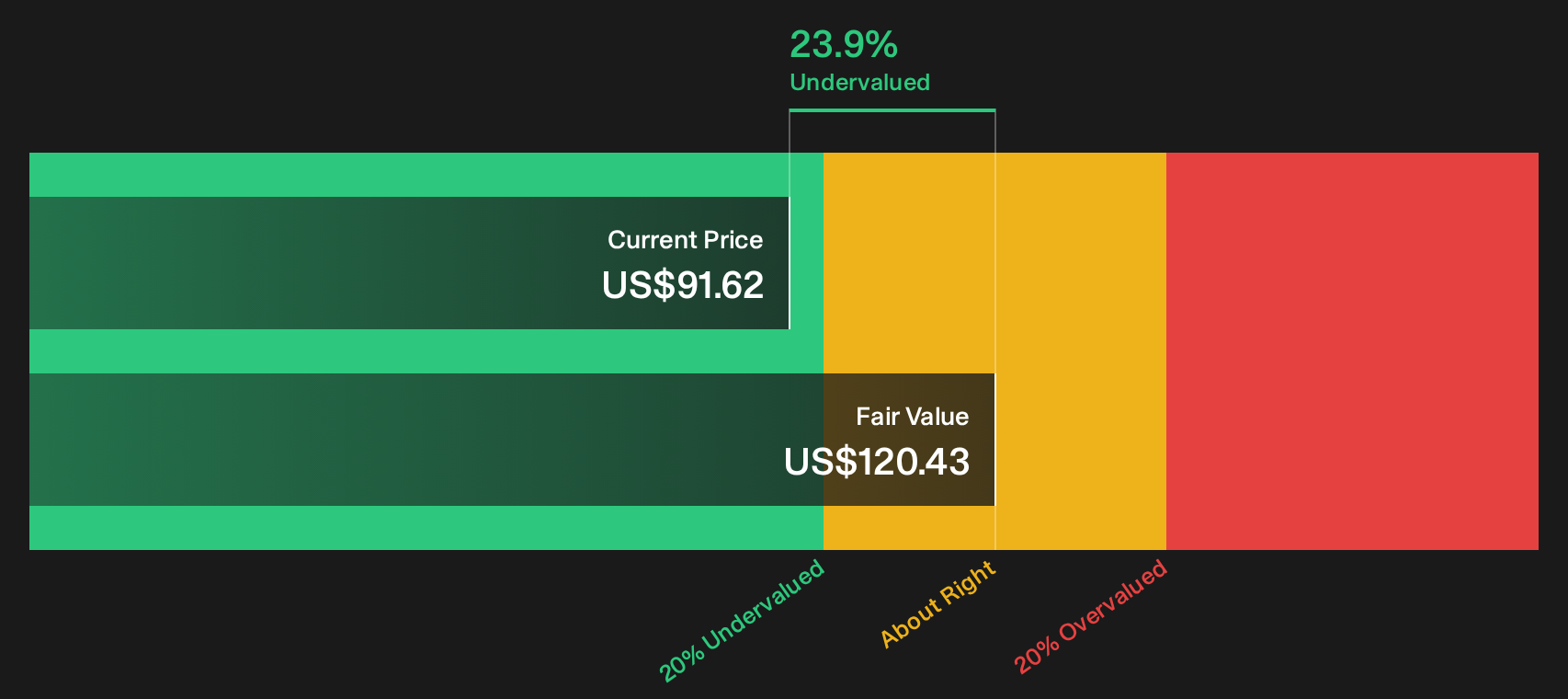
The earlier user narrative framed KKR as about 8% overvalued at $84.45 per share, using an owner earnings style approach. The Simply Wall St DCF model points in the opposite direction, with an estimated future cash flow value of $120.43 that leaves the current $91.62 price looking discounted rather than stretched.
This split view matters for anyone watching KKR closely. Either the DCF is too optimistic on long term cash generation, or the earnings based memo is too strict on what counts as “safe” cash flow. The key question is which set of assumptions lines up better with your own risk appetite and time horizon.
Use that question as a filter, then test your thinking against the detail in our DCF workup with Look into how the SWS DCF model arrives at its fair value..
Next Steps
Seen enough conflicting takes on KKR to feel torn? Act while the details are fresh and weigh the optimism baked into its outlook by checking the 4 key rewards.
Looking For More Investment Ideas Beyond KKR?
If KKR has sharpened your thinking on price, risk and quality, use that same lens to hunt for fresh opportunities before the market moves first.
- Target resilient balance sheets and robust fundamentals by scanning our curated list of solid balance sheet and fundamentals (24 results) that filters for financial strength up front.
- Hunt for quality at a discount and pressure test your value thesis against a focused set of 29 high quality undervalued stocks primed for deeper research.
- Stack potential income on top of capital return by reviewing a shortlist of 5 dividend fortresses built around higher yields and staying power.
Have feedback on this article? Concerned about the content? Get in touch with us directly. Alternatively, email editorial-team@simplywallst.com