


EN
Should Labor Deal And Q3 Results Require Action From Waste Management (WM) Investors?
- Waste Management workers represented by Teamsters Local 396 in Los Angeles and Orange counties have already ratified a new collective bargaining agreement covering about 700 employees.
- The freshly settled union contract clarifies labor costs and operating continuity in Southern California just as Waste Management prepares to release its Q3 earnings results.
- This development may influence how investors evaluate Waste Management’s overall investment narrative in light of the newly ratified Teamsters labor deal.
Waste Management Investment Narrative Recap
To own Waste Management, you need to be comfortable with a slow but steady utility-like profile that leans on long-term contracts, regulated assets and heavy capital spending in areas such as renewable natural gas, recycling and healthcare waste. The newly ratified Teamsters deal in Southern California brings clarity on labor costs in an important region and reduces the risk of service disruption at a time when Q3 results are about to reset expectations.
The biggest near-term swing factor remains how efficiently the business converts its large project spend into cash generation, especially as volume softness in some segments and high leverage from Stericycle integration remain in the background. This union agreement appears operationally manageable relative to those broader execution risks, so it is unlikely to be the main driver of the Q3 share price reaction.
With no fresh company announcements tied directly to this contract, the most relevant backdrop is still Waste Management’s multiyear investment push into technology, recycling upgrades and renewable natural gas facilities. These projects already require substantial capital and now need smooth day-to-day operations, so avoiding labor disruption in a dense Southern California market helps keep that machinery running.
For catalysts, the key question is how well these platforms offset pressures from items such as potential changes to alternative fuel tax credits, softer volumes in some industrial and commercial segments and the need to meet Stericycle synergy and margin targets. A settled union contract does not eliminate those issues, but it supports service reliability and cost visibility, which matters when investors are watching Q3 and 2027 free cash flow targets closely.
What Analysts Are Building Into the Waste Management Story
For anyone tracking Waste Management after the Southern California labor deal, the consensus modeling gives a useful sense of what is already baked into expectations. Analysts are penciling in revenue growth of 5.5% a year over the next three years, paired with profit margins that are modeled to rise from 11.1% today to 13.6%. Those inputs sit behind forecasts that earnings could reach US$4.1b by 2029, compared with earnings today of US$2.9b, which implies roughly a 41% increase in profit dollars. The shared view is that this path would support earnings per share of US$10.63 and a P/E of 29.9x in 2029, slightly lower than the current 30.2x multiple and above the 18.8x level flagged for the broader US Commercial Services group.
These same estimates assume the share count trends a bit lower, with analysts expecting outstanding shares to fall by about 0.78% annually over the next three years. That shrinkage in the equity base, combined with higher margins, underpins the jump from current earnings to the US$4.1b figure linked to the 2029 scenario. At the same time, the models reference a discount rate of 7.31%, taken from the Simply Wall St report, which acts as the hurdle rate for turning that longer term forecast into a present value framework investors can compare to Waste Management's current share price.
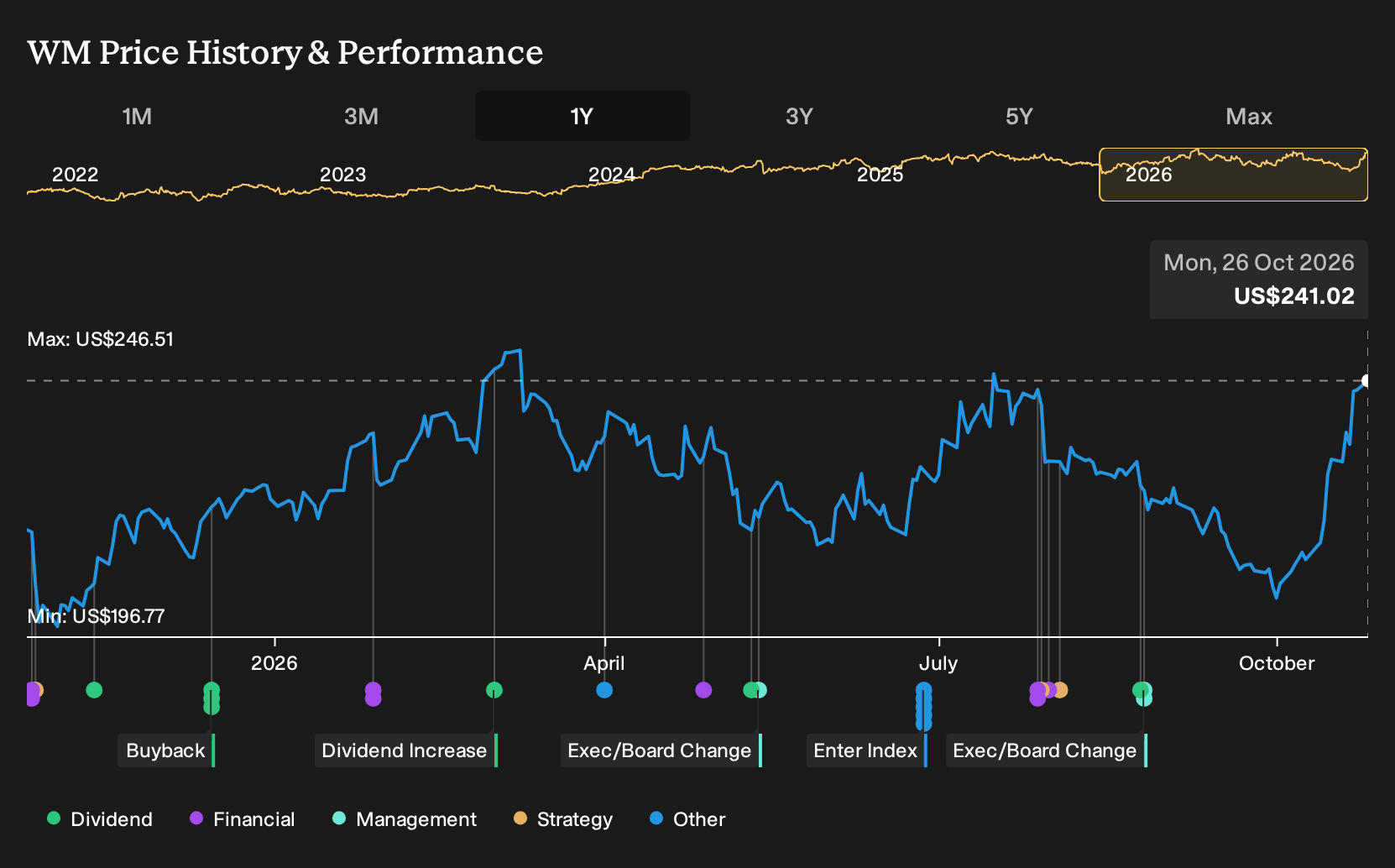
On the valuation side, the consensus target of US$253.84 rests on those same assumptions about revenue, profitability and capital allocation. There is still a healthy spread of opinion, with the most optimistic analyst at US$277 and the most cautious at US$220. This gives readers a sense of how different views on project execution, volume trends or tax policy could affect the outcome. With the stock trading around US$215.75, that central target is 15% higher, but the wide range of views reinforces the need to treat the price objective as a scenario built on specific inputs rather than a fixed destination.
Waste Management's narrative projects US$30.1b revenue and US$4.1b earnings by 2029. This rests on 5.5% yearly revenue growth and roughly US$1.2b earnings increase from US$2.9b today.
Discover why Waste Management's fair value indicates a 5% potential upside to its current price that may not last much longer.
Exploring Other Perspectives
Three fair value views from the Simply Wall St Community cluster tightly between US$248.24 and the US$253.84 analyst target, so retail expectations lean concentrated rather than scattered. When you set that against risks around alternative fuel tax credits, volume softness and Stericycle execution, you can see why opinions on Waste Management can differ widely. Explore those contrasting viewpoints before deciding how this labor stability story fits into your own thesis.
Explore 2 other Waste Management fair value estimates, including one that suggests as much as 5% upside from the current price.
The Verdict Is Yours
Don't just follow the ticker. Dig into the data and build a conviction that's truly your own.
- A great starting point for your Waste Management research is our analysis highlighting 4 key rewards and 1 important warning sign that could impact your investment decision.
- See our latest analysis for Waste Management. The report includes a comprehensive fundamental analysis summarized in a single visual, the Snowflake, making it easy to evaluate Waste Management's overall financial health at a glance.
Looking for more investment ideas beyond Waste Management?
Once you have a handle on Waste Management, it can help to compare it with other businesses that share traits like resilient cash generation, consistent dividends or robust balance sheets. The Simply Wall St Screener offers several angles you can use to build a shortlist that fits your own risk tolerance and income goals.
- If capital preservation and steadier profiles matter to you, start with a curated set of resilient operators by reviewing the 30 resilient stocks with low risk scores.
- If income is a key part of your plan, scan for dependable payers with higher yields by checking out the 5 dividend fortresses.
- If you prefer to hunt for companies that the market may be overlooking, cast a wider net with the 21 high quality undiscovered gems.
Have feedback on this article? Concerned about the content? Get in touch with us directly. Alternatively, email editorial-team@simplywallst.com