


EN
3 US Bank Stocks Whose Margins Could Shift After The Fed Rate Hike
Interest rates just moved higher for the first time in more than three years, and that small shift in the Fed funds rate can quietly redraw the map for US bank and financial services stocks. When borrowing costs reset, some businesses gain new breathing room while others feel the squeeze. This piece walks through three US financial stocks tied to the latest Fed hike so you can judge which stories deserve a closer look.
The stocks covered in the list below are only a starting sample, and the full screen surfaced 43 more US bank and financial services companies with equally compelling narratives that are not discussed here. To go deeper, head straight into the US Bank and Financial Services Stocks screener to identify, filter, and analyze the highest conviction candidates for your watchlist.
Valley National Bancorp (VLY)
Overview: Valley National Bancorp is a regional US bank holding company providing commercial, consumer, and wealth management services that hinge heavily on US lending margins and deposit funding costs.
Operations: Valley National Bancorp generates about US$2.1b of revenue entirely from the United States.
Market Cap: US$7.7b
Valley National Bancorp sits in the middle of this US Bank and Financial Services Stocks theme, with a balance sheet that depends on the spread between what it earns on loans and what it pays on deposits. This is where a fresh Fed rate hike can have an early impact.
"Valley National Bancorp's accelerating growth in commercial and specialty deposit accounts is now underscored by about US$4.5b of new core deposits over the 12 months to Q2 2026 and the expected addition of US$2.1b of low cost Bluevine small business deposits, which supports a lower loans to deposit profile and can lift net interest margin and net interest income as higher cost brokered funding is replaced."
What happens to those carefully built spreads if a single unseen pressure on funding costs or loan pricing starts to shift direction?
When that pressure hits, read the full narrative for Valley National Bancorp to see how Valley National Bancorp’s deposit mix could still be quietly rewiring the story.

Dime Commercial Bancshares (DCOM)
Overview: Dime Commercial Bancshares is a New York based commercial bank that focuses on lending and deposit services for businesses, households, and municipalities within the US Bank and Financial Services Stocks theme.
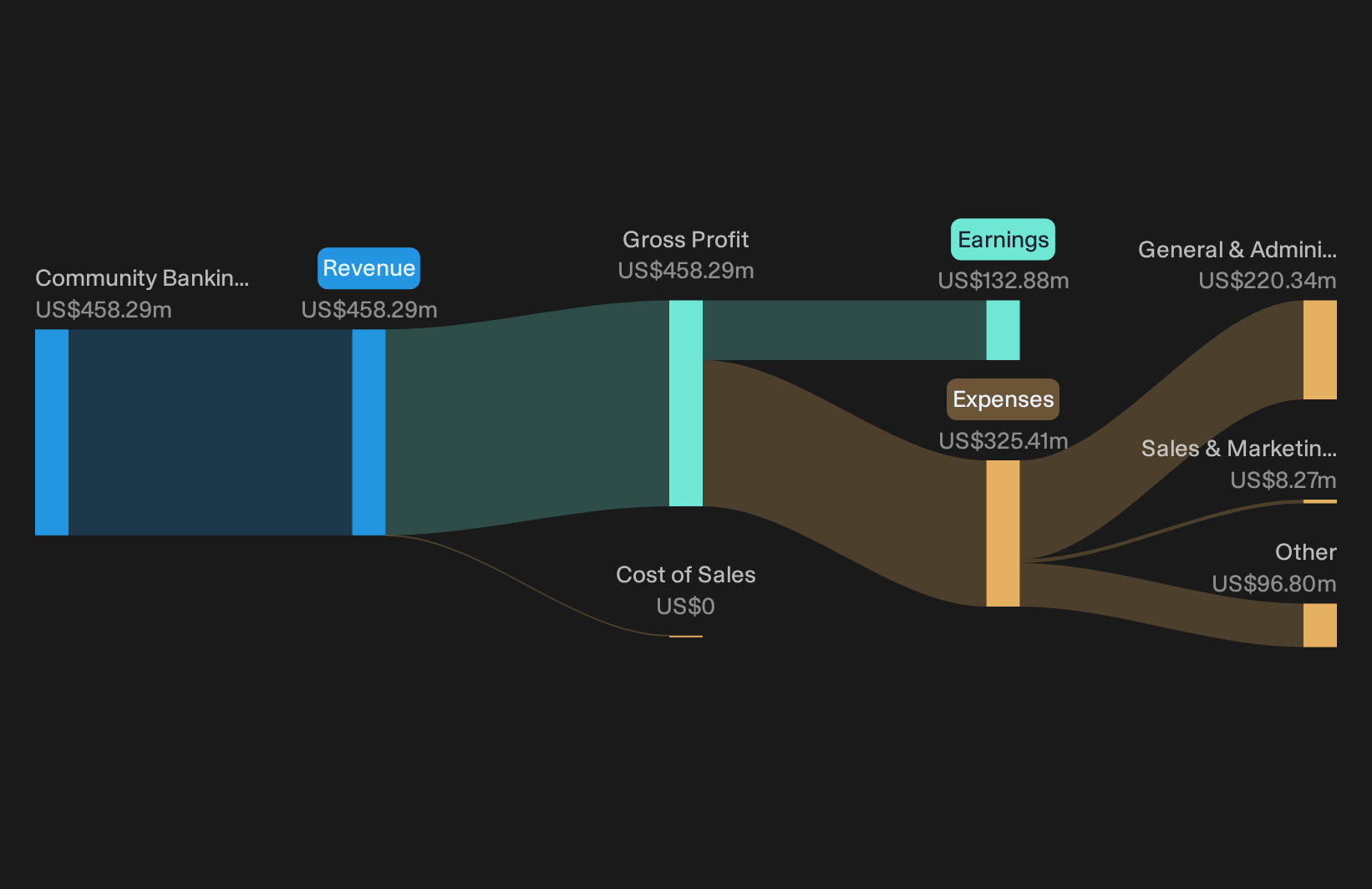
Operations: Dime Commercial Bancshares generates about US$458 million of community banking revenue entirely from the United States, reflecting a focused domestic model.
Market Cap: US$1.9b
Dime Commercial Bancshares matters for this higher rate focused screener because its loan and deposit engine is built to respond directly when the Fed moves, turning repricing moments into potential shifts in earnings power rather than just small line item tweaks.
"Further progress in shifting Dime Commercial Bancshares from a thrift-style multifamily lender toward a diversified commercial bank, with a higher mix of business and commercial real estate loans and broader geographic coverage, is positioned to support future revenue growth as the balance sheet continues to tilt toward commercial clients."
What happens if a single assumption about how quickly that richer mix converts into lasting margin gains begins to move the other way?
If that assumption starts to crack, read the full narrative for Dime Commercial Bancshares to see whether Dime Commercial Bancshares is quietly building a faster and more resilient earnings engine.
Hope Bancorp (HOPE)
Overview: Hope Bancorp is a US retail and commercial bank that earns most of its money by taking deposits and making loans.
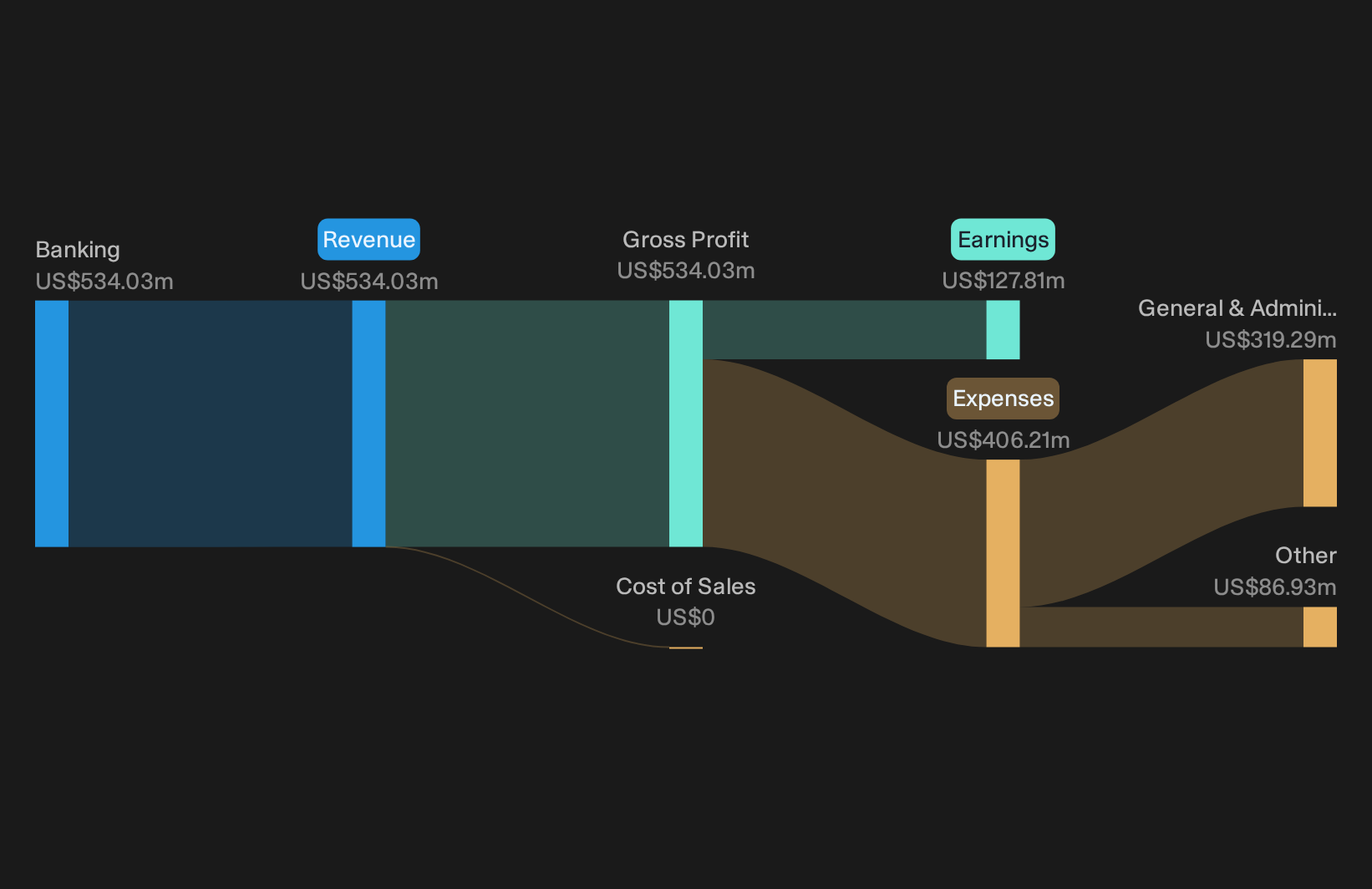
Operations: Hope Bancorp generates about US$534 million of banking revenue, entirely from customers in the United States.
Market Cap: US$1.8b
Hope Bancorp sits squarely in the US Bank and Financial Services Stocks theme because it is a mid sized, dividend paying lender whose earnings are tightly linked to the gap between what it earns on loans and what it pays on deposits. That gap can shift meaningfully when the Fed lifts rates.
"The SMBC MANUBANK commercial banking unit acquisition is expected to add roughly US$2.3b to US$2.7b of loans and US$2.6b to US$2.7b of largely non CD deposits, which could lift Hope Bancorp’s future net interest income and earnings once the book is integrated and repriced."
Everything now turns on how that new deposit mix and credit book reshape margins if a single key assumption on funding costs starts to move.
If that funding swing is what interests you, read the full narrative for Hope Bancorp to see how Hope Bancorp’s earnings power could accelerate or stall from here.
Seeking Alternatives Before The Crowd Moves
Fresh ideas move first. By the time a trend hits headlines, early entry points can be gone. Scan focused stock lists while they are still under the radar for now and establish your position early.
- Look for early cash flow improvements by running the 29 high quality undervalued stocks and sift for financially solid businesses before momentum traders start focusing on them.
- Track where industrial demand is quietly building and use the 16 top copper producer stocks to identify producers that may be aligned with rising interest in the space.
- Seek resilient compounding characteristics by filtering the 30 resilient stocks with low risk scores and shortlist companies with sturdier balance sheets before more defensive capital moves in.
Have feedback on this article? Concerned about the content? Get in touch with us directly. Alternatively, email editorial-team@simplywallst.com