


EN
How Investors May Respond To Rhythm Pharmaceuticals (RYTM) Japan Drug Launch
- Rhythm Pharmaceuticals has launched IMCIVREE in Japan for acquired hypothalamic obesity after inclusion on the National Health Insurance drug price list, supported by Phase 3 TRANSCEND data in 142 patients and regulatory approval in August 2026.
- This development opens access to an estimated 5,000 to 8,000 acquired hypothalamic obesity patients in Japan and expands Rhythm Pharmaceuticals' commercial reach into a new reimbursed rare disease market.
- The next step is to evaluate how Rhythm Pharmaceuticals' investment narrative could shift as IMCIVREE enters Japan with NHI reimbursement support.
Rhythm Pharmaceuticals Investment Narrative Recap
To own Rhythm Pharmaceuticals, you need to be comfortable with a rare disease business that is still loss making but trying to scale one lead therapy. IMCIVREE for acquired hypothalamic obesity in Japan adds another reimbursed market. This can help support that thesis, although it does not remove the heavy reliance on setmelanotide or the reality of continued operating losses and high spend.
The key near term catalyst remains execution on regulatory approvals and launches in additional indications and age groups, particularly in hypothalamic and genetic obesities. The biggest risk stays the same. Rhythm is concentrated in one mechanism with high R&D and SG&A, so slower international uptake or tighter pricing could keep the firm dependent on external capital.
The IMCIVREE launch in Japan plugs directly into one of the main previously flagged catalysts, which is expansion of Rhythm Pharmaceuticals into new geographies with supportive reimbursement for rare obesity disorders. Access to an estimated 5,000 to 8,000 acquired hypothalamic obesity patients under the NHI regime gives the commercial team a defined pool to work on rather than fragmented named patient access.
For you as an investor, attention now shifts to how efficiently Rhythm builds out local infrastructure in Japan and converts regulatory approval plus NHI listing into consistent treatment starts. Execution here matters because the company is still unprofitable, trades on a high P/S multiple versus peers, and remains exposed if other planned indications or markets progress more slowly than analyst forecasts assume.
Rhythm Pharmaceuticals' current consensus narrative points to revenues of US$1.1b and earnings of US$370.0 million by 2029, built on assumed yearly top line expansion of 66.3% and an earnings swing of about US$580.2 million from a loss of US$210.2 million today into positive territory.
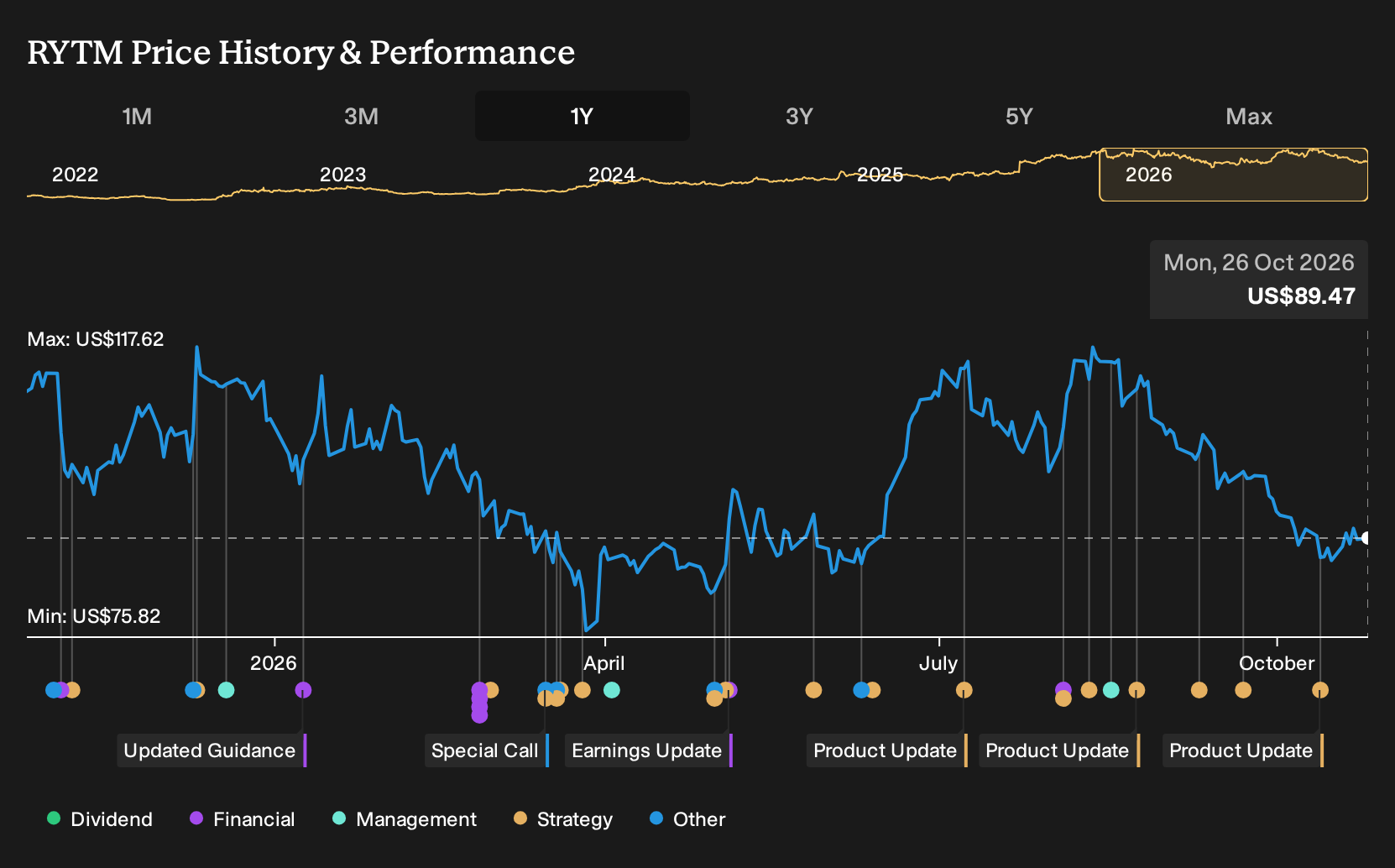
Uncover why Rhythm Pharmaceuticals' fair value indicates a 61% potential upside to its current price before that discount closes.
Exploring Other Perspectives
One alternate view focuses on competition risk rather than new launches. Bearish analysts worry that rivals like Superluminal Medicines could limit Rhythm Pharmaceuticals’ MC4R franchise, which helps explain why they were only modeling about US$868.0 million of revenue and US$33.0 million of earnings for 2029. Use that gap to test your own assumptions as this Japan news beds in.
Explore 2 other Rhythm Pharmaceuticals fair value estimates, including one that suggests it could be worth just $134.00!
Decide For Yourself
Disagree with existing narratives? Extraordinary investment returns rarely come from following the herd, so go with your instincts.
- A great starting point for your Rhythm Pharmaceuticals research is our analysis highlighting 3 key rewards that could impact your investment decision.
- See our latest analysis for Rhythm Pharmaceuticals. The report includes a comprehensive fundamental analysis summarized in a single visual, the Snowflake, making it easy to evaluate Rhythm Pharmaceuticals' overall financial health at a glance.
Looking For More Investment Ideas Beyond Rhythm Pharmaceuticals?
If the Rhythm Pharmaceuticals story has sharpened your sense of what you want in a rare disease opportunity, it can help to scan a wider field of potential candidates using the Simply Wall St Screener before you commit fresh capital.
- If you prefer to hunt for mispriced quality rather than pay up for hype, start with 29 high quality undervalued stocks that pair strong fundamentals with what our model flags as discounted share prices.
- If capital preservation ranks high on your checklist, filter for 30 resilient stocks with low risk scores that our scoring framework flags as having more resilient balance sheets and business profiles.
- If you are looking for smaller companies that the market may be overlooking, cast a wider net with a curated 21 high quality undiscovered gems that still show solid financial underpinnings.
Have feedback on this article? Concerned about the content? Get in touch with us directly. Alternatively, email editorial-team@simplywallst.com